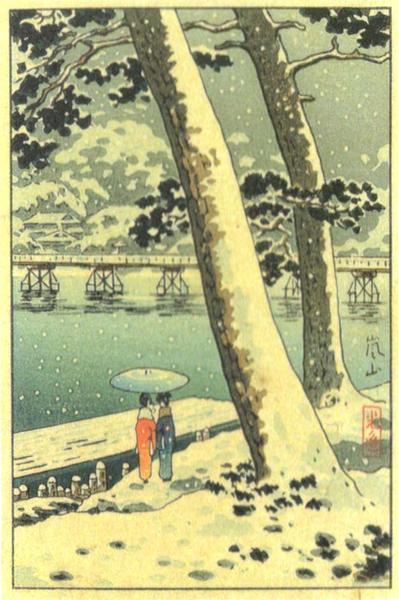
Arashiyama
- Medium:
- Woodblock print
- Source:
- Japanese Art Open Database
Description
Arashiyama is a postcard-format design by Tsuchiya Koitsu issued through the publisher Watanabe Shozaburo, drawing on one of the most celebrated scenic districts of Kyoto. The print is recorded through an impression aggregated by the Japanese Art Open Database under a postcard listing (https://ukiyo-e.org/image/jaodb/Tsuchiya_Koitsu-No_Series-Arashiyama_Postcard-00029634-020324-F06). Arashiyama, the hills on the western edge of Kyoto where the Hozu River becomes the Katsura and crosses under the wooden Togetsukyo Bridge, has been associated with cherry-blossom and autumn-foliage viewing since at least the Heian period and remained a steady subject for woodblock designers from the late Edo through the shin-hanga revival. Koitsu, who came to woodblock after training in oil painting and as an apprentice to Kobayashi Kiyochika, takes up Arashiyama in the calm atmospheric mode that defines his work for Watanabe. The composition typically frames the Togetsukyo Bridge against the wooded hillside, with the river carrying small boats or cormorant fishermen and a softly graded sky above. The seasonal choice, whether spring blossoms, summer green or autumn red, gives the shin-hanga workshop its tonal premise: bokashi gradients in the sky, complementary gradients in the water, and a carefully registered color block for the foliage that lifts the scene without breaking its envelope. The postcard format compresses these elements into a small souvenir-scale sheet, which served as a commercial bridge between the publisher's tourist trade and his deeper collector market. Within Koitsu's wider catalogue of Kyoto and Nara subjects, the Arashiyama postcard sits beside the Kiyomizu Temple sheet as evidence of how the shin-hanga revival refreshed the canonical sites of the old capital for an early twentieth-century audience seeking compact images of culturally legible Japan.
More Prints by Tsuchiya Koitsu
![Five-storied Pagoda at Nikkō [bright sky] by Tsuchiya Koitsu](https://1.api.artsmia.org/800/80121.jpg)

Featured in Collections
Curated cross-cuts that include this print.
Frequently Asked Questions
Arashiyama was created by Tsuchiya Koitsu (土屋光逸).