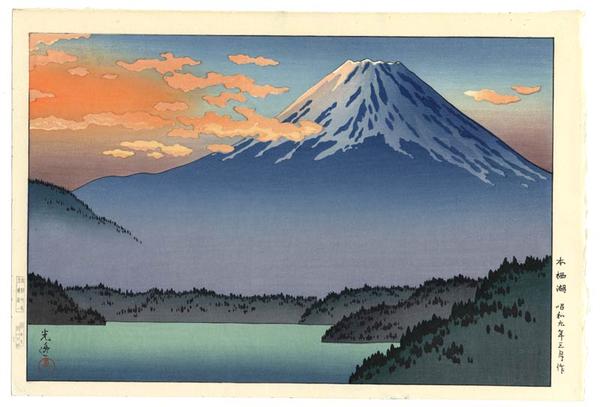
Lake Motosu
- Medium:
- Woodblock print
- Source:
- Japanese Art Open Database
Description
Lake Motosu, a Mount Fuji subject by Tsuchiya Koitsu issued through the publisher Watanabe Shozaburo, places the artist within the shin-hanga revival's long meditation on the volcano. Lake Motosu is the westernmost of the Fuji Five Lakes on the northern flank of the mountain, admired since the Edo period for the particularly clean reflection it offered of Fuji's south face on still mornings; the same composition would later be selected for the back of the modern thousand-yen note, but in Koitsu's lifetime the lake remained a relatively quiet alternative to the more travelled Kawaguchi and Yamanaka. The print is preserved through an impression aggregated by the Japanese Art Open Database (https://ukiyo-e.org/image/jaodb/Tsuchiya_Koitsu-No_Series-Lake_Motosu-00028543-030625-F06). Koitsu, who had trained first in oil painting and as an apprentice to Kobayashi Kiyochika before joining Watanabe's workshop in the late 1920s and early 1930s, brings a softly modulated tonal sensibility to a subject that earlier ukiyo-e designers had often handled as a graphic silhouette. Here Fuji is built up through layered bokashi pulls that move from a cool, almost silvery upper sky into pinker registers along the snowline, with the lake reflecting the same gradient in inverted form. A near-shore band of pines or low foliage provides a darker counterweight to the bright distance, in the manner Hasui used to anchor his own lake studies. The collaboration between Koitsu's design and Watanabe's carvers and printers gives the print the calm, painterly mood that defined the publisher's chuban and oban landscape program. Lake Motosu therefore sits within both an art-historical lineage that stretches back through Hokusai and Hiroshige and the more immediate shin-hanga effort to refresh the iconography of Fuji for early twentieth-century collectors in Japan and abroad.
More Prints by Tsuchiya Koitsu
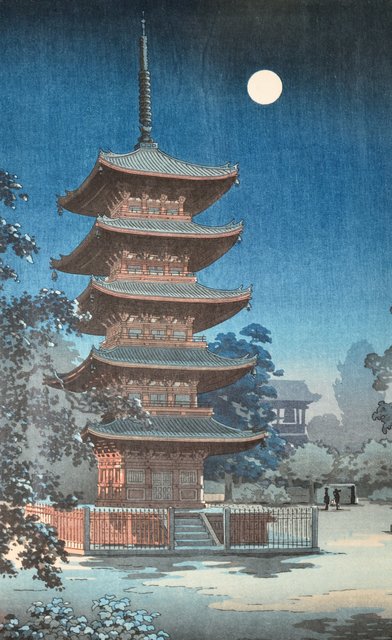
![Five-storied Pagoda at Nikkō [bright sky] by Tsuchiya Koitsu](https://1.api.artsmia.org/800/80121.jpg)

Featured in Collections
Curated cross-cuts that include this print.
Frequently Asked Questions
Lake Motosu was created by Tsuchiya Koitsu (土屋光逸).