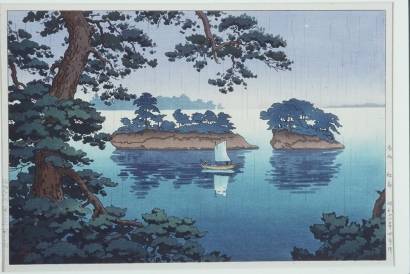
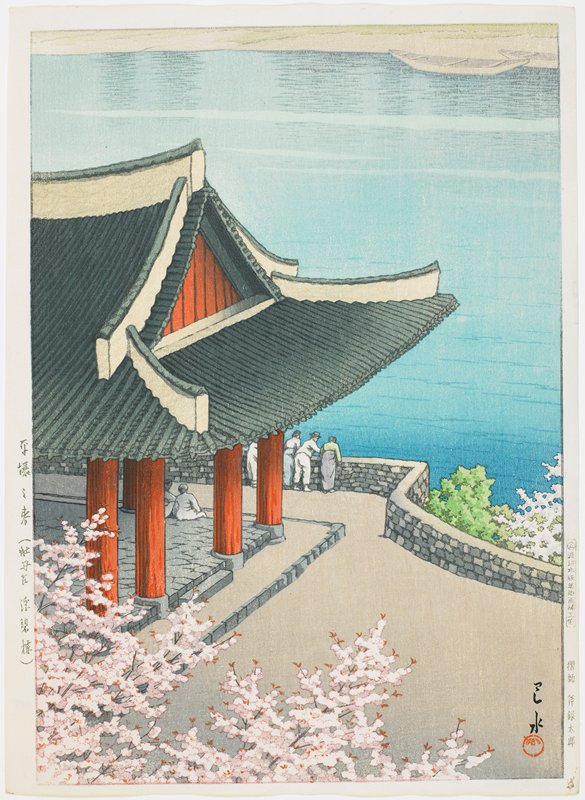
Spring Rain at Matsushima
- Medium:
- Woodblock print
- Format:
- Oban
- Publisher:
- Doi Sadaichi
- Edition:
- Published by Watanabe Shozaburo
- Source:
- Art Gallery of Greater Victoria
Description
Matsushima Bay in Miyagi Prefecture — its three hundred pine-covered islets scattered across the calm water — was already celebrated as one of Japan's three great scenic views when the haiku poet Matsuo Basho visited in 1689 and found himself nearly speechless. In spring rain, the islets appear and vanish in the mist, the distinction between water and sky dissolving into continuous grey-green atmosphere. Koitsu's treatment makes the famous scene intimate rather than grand, the rain reducing Matsushima to the quality of a half-remembered dream.
More Prints by Tsuchiya Koitsu


More Spring Prints

Featured in Collections
Curated cross-cuts that include this print.
Frequently Asked Questions
Spring Rain at Matsushima was created by Tsuchiya Koitsu (土屋光逸).
Spring Rain at Matsushima uses Bokashi, on woodblock print.
Spring Rain at Matsushima was published by Doi Sadaichi.
Spring Rain at Matsushima depicts spring and rain, set at Matsushima.