
Sakura Sôgorô taking leave of his family
- Medium:
- Mokuhanga (Japanese woodblock)
- Image courtesy of
- Saru Gallery
Description
The print shows the seventeenth-century peasant headman Sakura Sōgorō parting from his wife and children before travelling to Edo to lodge a direct appeal to the shogun against the punitive levies imposed on his Shimōsa village — an act of jikiso for which Sōgorō and his family were executed in 1653. Yoshitoshi frames the farewell as a domestic-scale tragedy, in compositions of this kind placing the figures inside a thatched cottage with the children clustered at the parents' knees. The cherry blossoms cited in the tag operate on two registers: as the literal toponym of Sakura village and as the customary emblem of mortality folded into so much Edo-period narrative. The story had circulated through bunraku and kabuki for more than two centuries by the time Yoshitoshi took it up, and the design belongs to his sustained 1870s–80s interest in subjects of moral martyrdom rather than the celebrity actors and bijin of earlier ukiyo-e generations.
More Prints by Tsukioka Yoshitoshi
More Cherry Blossoms Prints

Kumoi Cherry Trees (Kumoi sakura)
Kumoi sakura
1926
Color woodblock print

Hirosaki Castle, from the series "Eight Views of Cherry Blossoms"
1935
Color woodblock print

Chion-in Temple Gate (Romon), from the series Eight Scenes of Cherry Blossoms (Sakura hachidai)
Romon
1935
Color woodblock print
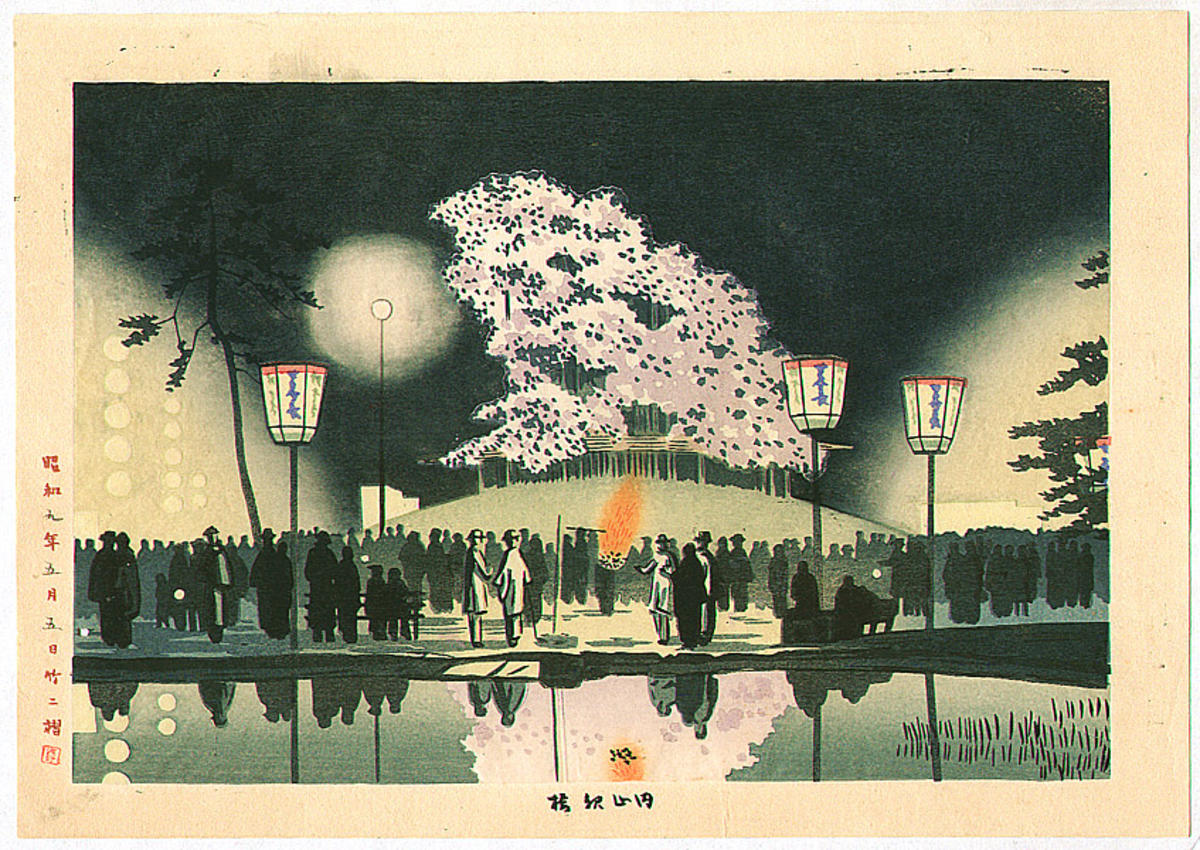
Cherry Blossoms at Maruyama Park
円山公園桜
Woodblock print
Featured in Collections
Curated cross-cuts that include this print.
Frequently Asked Questions
Sakura Sôgorô taking leave of his family was created by Tsukioka Yoshitoshi (月岡芳年).
Sakura Sôgorô taking leave of his family depicts cherry blossoms.