
Buddha in Usuki
- Medium:
- Mokuhanga (Japanese woodblock)
- Image courtesy of
- Saru Gallery
Description
This print depicts one of the Usuki Sekibutsu, the group of stone Buddha images carved into the soft tuff cliffs of Usuki in Oita Prefecture, Kyushu, dating from the late Heian to early Kamakura periods. Hiratsuka, a tireless student of Buddhist sculpture, returned repeatedly to weathered stone subjects in his sosaku-hanga practice, and the Usuki carvings — partially eroded, half-emerged from rock — suited his preference for bold black-and-white woodcuts. The composition would rely on broad areas of inked washi to render the bulk of the carved face and torso, with the gouge marks of the chisel left visible to translate the pitted, time-worn surface of the original stone. Such works exemplify the sosaku-hanga ethic he absorbed from Yamamoto Kanae: the artist alone designs, carves, and prints, with the cutter's hand legible throughout. Hiratsuka's Usuki print belongs to a wider devotional series in which he documented Japan's stone Buddhist heritage as both subject and homage to the unnamed sculptors who preceded him.
More Prints by Hiratsuka Un'ichi


More Religious Prints

The Great Buddha, Kamakura (Kamakura Daibutsu)
Kamakura Daibutsu
1930
Color woodblock print

Hall of the Great Buddha (Nara Daibutsuden)
1950
Color woodblock print
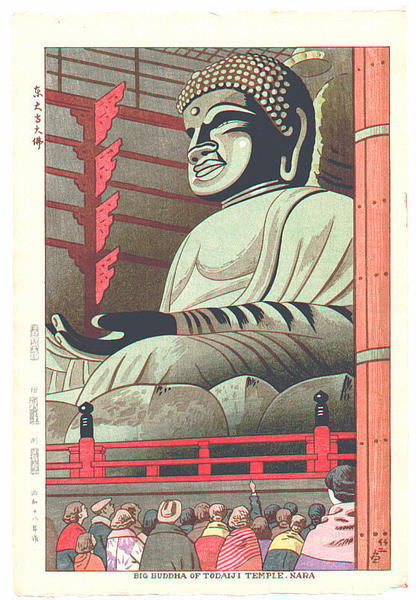
Great Buddha
大仏
Woodblock print

Clearing after a Snowfall at the Kannon Temple in Asakusa (Asakusa Kannon no yukibare), from the series "Twenty Views of Tokyo (Tokyo nijukkei)"
1926
Color woodblock print; oban
Featured in Collections
Curated cross-cuts that include this print.
Frequently Asked Questions
Buddha in Usuki was created by Hiratsuka Un'ichi (平塚運一).
Buddha in Usuki depicts religious.