
Mt. Fuji at sunrise
- Medium:
- Mokuhanga (Japanese woodblock)
- Image courtesy of
- Saru Gallery
Description
Hiratsuka's interpretation of the most heavily depicted motif in Japanese printmaking, treated through the reductive black-and-white vocabulary that distinguished his work from both ukiyo-e and shin-hanga predecessors. Where Hokusai and Hiroshige rendered Fuji through colored impressions and Yoshida Hiroshi through layered bokashi gradations, Hiratsuka typically reduced the mountain to a single carved silhouette and registered the sunrise through the contrast between unprinted washi and densely worked black surrounding fields. The summit snow may be carved as a discrete reserved area, while the slopes are textured by the controlled chatter of the chisel against the wood grain. As a founding figure of sosaku-hanga, Hiratsuka designed, carved, and printed each impression himself, and his Fuji subjects deliberately strip away the polychromatic conventions of the meisho-e tradition to test how much pictorial information the mountain motif can carry through line and tone alone. The print belongs to a thematic strand he revisited periodically across a career of more than eight decades.
More Prints by Hiratsuka Un'ichi


More Mount Fuji Prints
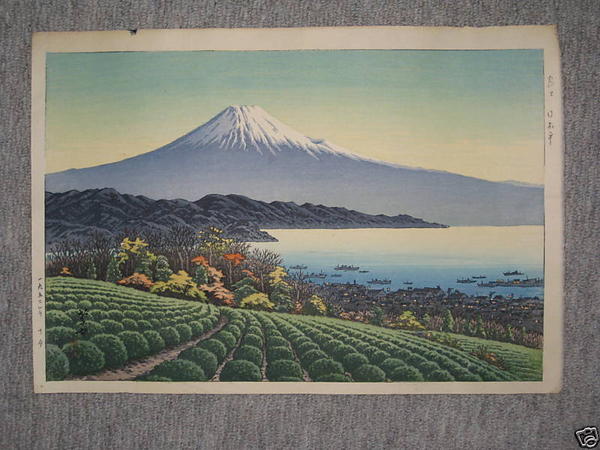
Fuji from tea farm
Woodblock print

Akasaka, Fujikawa, Okazaki, Chiryu, and Narumi, from the series "Famous Places on the Fifty-three Stations of the Tokaido, Five Stations (Tokaido gojusan eki goshuku meisho)"
c. 1830/35
Color woodblock print; oban
![Mount Fuji on a Moonlit Night, Kawai Bridge (Tsukiyo no Fuji [Kawaibashi]), from the series "Selection of Views of the Tokaido (Tokaido fukei senshu)" by Kawase Hasui](https://www.artic.edu/iiif/2/d0960668-1e73-339a-b182-fb995a54bff0/full/843,/0/default.jpg)
Mount Fuji on a Moonlit Night, Kawai Bridge (Tsukiyo no Fuji [Kawaibashi]), from the series "Selection of Views of the Tokaido (Tokaido fukei senshu)"
1947
Color woodblock print; oban

Mt. Fuji in Rain (Ame no Fuji)
n.d.
Color woodblock print
Featured in Collections
Curated cross-cuts that include this print.
Frequently Asked Questions
Mt. Fuji at sunrise was created by Hiratsuka Un'ichi (平塚運一).
Mt. Fuji at sunrise depicts mount fuji.