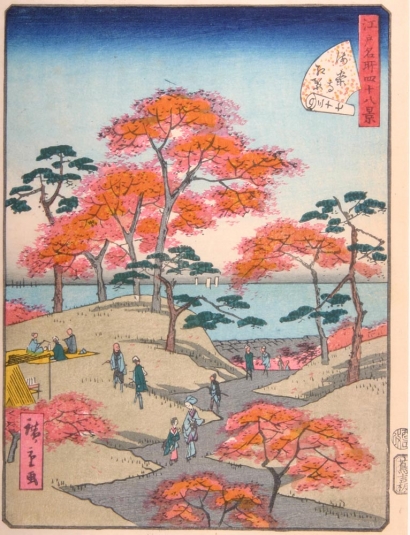
Akibasan
- Medium:
- Woodblock print
- Source:
- Art Gallery of Greater Victoria
- Image courtesy of
- Art Gallery of Greater Victoria
Description
Akibasan refers to Akiha Shrine or the sacred mountain associated with it, a site dedicated to fire prevention venerated widely throughout Edo-period Japan. Hiroshige's treatment of temple and shrine precincts characteristically emphasizes the architectural approach—torii gates, stone lanterns, a stairway ascending through cryptomeria forest—over the sanctuary itself, suggesting sacred space through threshold rather than direct depiction. The deep greens of the surrounding forest would be rendered through layered woodblock printing, with the cedar trunks providing strong vertical elements against which worshippers or pilgrims appear as small, incidental figures. Hiroshige often frames such subjects with a high viewpoint or oblique angle that gives the impression of ascending into a quieter, elevated realm. The shrine's association with fire made it especially important in a city where conflagrations were a constant threat, and Hiroshige's composition would likely convey the atmosphere of a place holding genuine communal meaning rather than merely scenic interest.
Current Listings
$1,180
More Prints by Utagawa Hiroshige


More Urban Scenes Prints
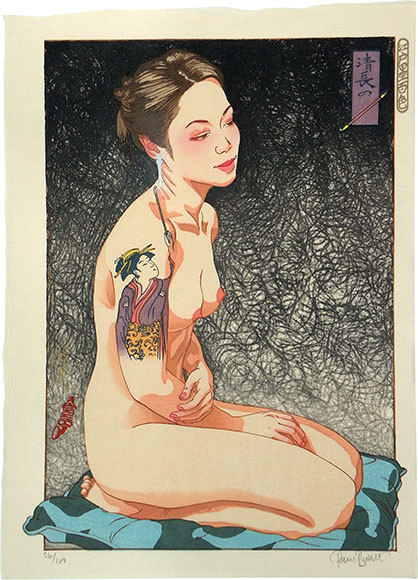
A Hundred Shades of Ink of Edo: Kiyonaga's Pipe (Edo zumi hyaku shoku: Kiyonaga no kiseru)
Woodblock print

View of Kabuki Theater from Matsuya (Ginza Matsuya yori Kabukiza), no. 3 from the series "Pictures of Ginza, First Series (Gashu Ginza dai isshu)"
1928
Color lithograph

Distant View of Mitsukoshi Movie Theater in Shinjuku from the Sixth Floor of Hoteiya (Hoteiya rokkai kara Shinjuku Mitsukoshi Musashi no kan enbo zu), no. 1 from the series "Scenery of Shinjuku (Gashu Shinjuku fukei)"
1930
Color lithograph
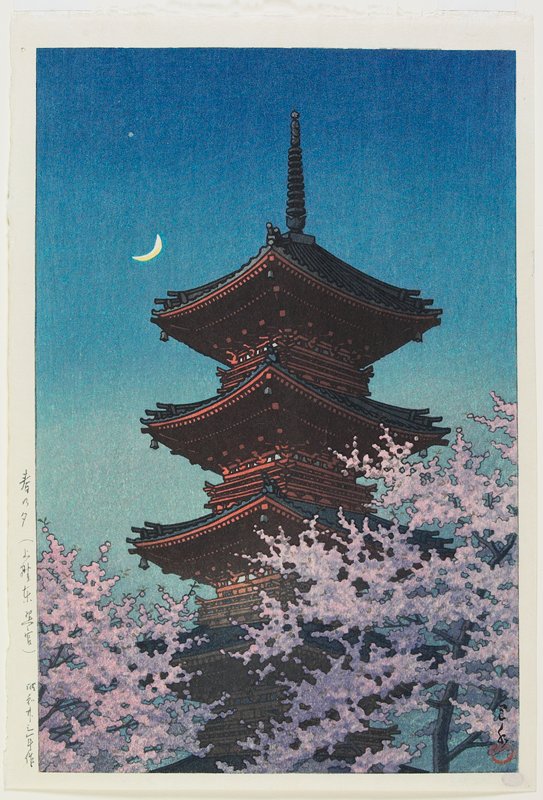
Spring Dusk at the Tōshō Shrine in Ueno
1948
Woodblock print, ink and color on paper
Featured in Collections
Curated cross-cuts that include this print.
Frequently Asked Questions
Akibasan was created by Utagawa Hiroshige (歌川広重).
Akibasan depicts urban scenes and temples & shrines.