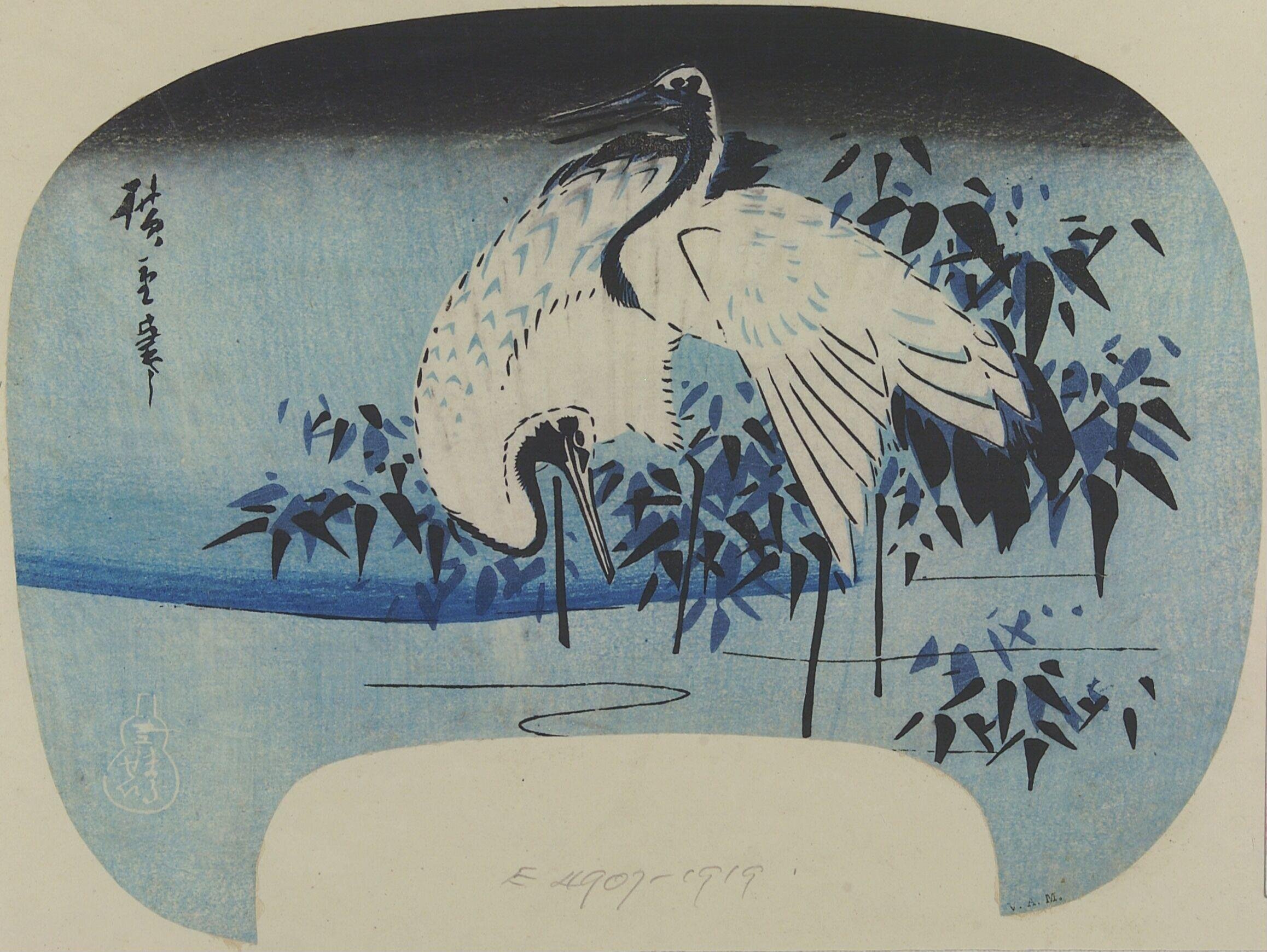
Cranes by the Water's Edge
- Date:
- ca. 1840-1842
- Medium:
- Source:
- Victoria and Albert Museum
Description
Cranes by the Water's Edge is an 1840 print by Utagawa Hiroshige (1797 to 1858), the great Edo ukiyo-e designer whose reputation rests primarily on landscape prints but who maintained a parallel and substantial practice as a designer of kacho-e, or bird and flower compositions. In Cranes by the Water's Edge Hiroshige turns to one of the most auspicious subjects in East Asian visual culture: the crane, which by long iconographic convention symbolizes longevity, fidelity, and good fortune. The birds are placed at the meeting of land and water, a setting that affords Hiroshige the opportunity to integrate his strengths as a landscape designer with the kacho-e tradition. The composition treats the cranes not as isolated specimens but as elements within a small landscape print, with reeds, water, and shore providing context. Hiroshige's bird and flower prints typically draw on Chinese painting models that had long been absorbed into Japanese decorative arts, but he renders them in the bold flat color and decisive outline that characterizes ukiyo-e production. The 1840 date situates this work in the period when Hiroshige's reputation was firmly established and he was producing prolifically across multiple genres. Cranes by the Water's Edge would have circulated to a buying audience that included both seasoned collectors of bird and flower prints and broader townspeople, who would have valued the auspicious imagery for display in homes during festive occasions. The impression is held in the Victoria and Albert Museum, London, where it sits alongside the museum's substantial Hiroshige holdings spanning landscape, kacho-e, and figure work.
More Prints by Utagawa Hiroshige


More Birds & Flowers Prints
Featured in Collections
Curated cross-cuts that include this print.
Frequently Asked Questions
Cranes by the Water's Edge was created by Utagawa Hiroshige (歌川広重) in ca. 1840-1842.
Cranes by the Water's Edge depicts birds & flowers and landscapes.