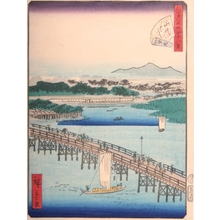
Eilaibashi
- Medium:
- Woodblock print
- Source:
- Art Gallery of Greater Victoria
- Image courtesy of
- Art Gallery of Greater Victoria
Description
Eitaibashi (rendered here in an alternate romanization) was one of the major bridges spanning the Sumida River in Edo, connecting the Nihonbashi district on the west bank to the Fukagawa district on the east. Hiroshige's prints of Sumida River bridges characteristically use the bridge's long horizontal span as the dominant compositional element, either viewed head-on as it recedes into the distance or seen from the riverbank with boats passing beneath its wooden piers. The broad river surface allowed for extended bokashi passages in blue-grey or greenish tones, reflecting the overcast skies typical of his weather-conscious approach. Figures crossing the bridge—merchants, travelers, porters—are rendered in miniature against the water and sky, emphasizing the bridge's scale and the river's breadth. Eitaibashi's position near the river mouth made it a hub of commercial water traffic, and the presence of cargo vessels or fishing boats beneath its spans would locate the scene within the economic geography of Edo's waterways.
More Prints by Utagawa Hiroshige


More Urban Scenes Prints
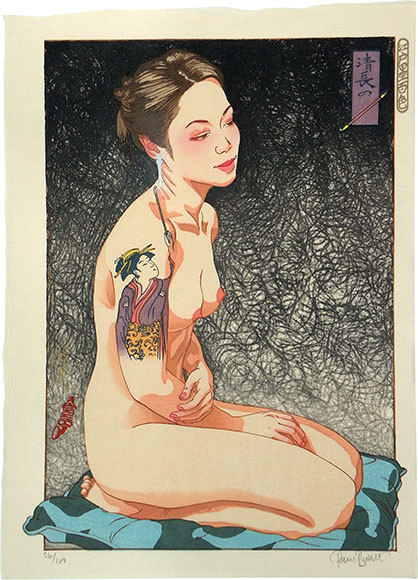
A Hundred Shades of Ink of Edo: Kiyonaga's Pipe (Edo zumi hyaku shoku: Kiyonaga no kiseru)
Woodblock print

View of Kabuki Theater from Matsuya (Ginza Matsuya yori Kabukiza), no. 3 from the series "Pictures of Ginza, First Series (Gashu Ginza dai isshu)"
1928
Color lithograph

Distant View of Mitsukoshi Movie Theater in Shinjuku from the Sixth Floor of Hoteiya (Hoteiya rokkai kara Shinjuku Mitsukoshi Musashi no kan enbo zu), no. 1 from the series "Scenery of Shinjuku (Gashu Shinjuku fukei)"
1930
Color lithograph
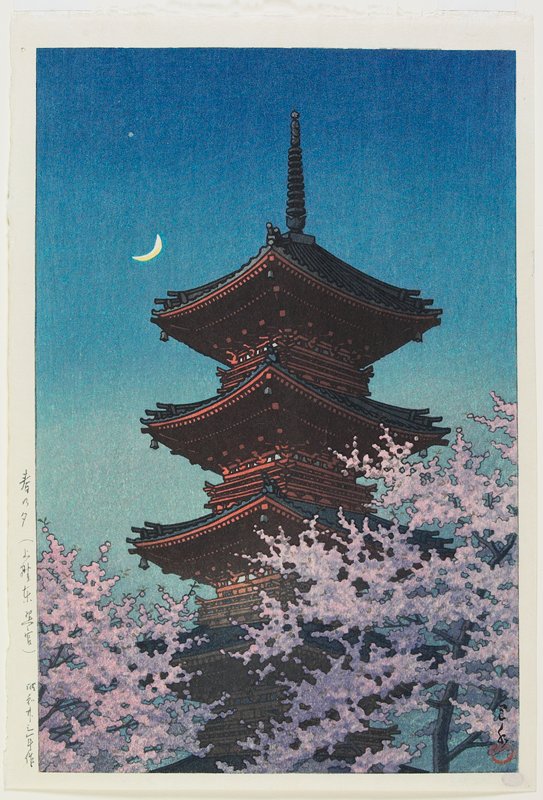
Spring Dusk at the Tōshō Shrine in Ueno
1948
Woodblock print, ink and color on paper
Frequently Asked Questions
Eilaibashi was created by Utagawa Hiroshige (歌川広重).
Eilaibashi depicts urban scenes and bridges.