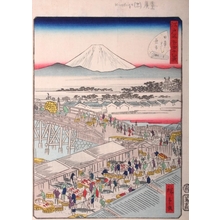
Nihonbashi
- Medium:
- Woodblock print
- Source:
- Art Gallery of Greater Victoria
- Image courtesy of
- Art Gallery of Greater Victoria
Description
Nihonbashi—literally Bridge of Japan—was the civic and commercial heart of Edo, the stone bridge from which the government measured all distances along the five great highways of the realm. Hiroshige treated this subject across multiple series, always grappling with the challenge of rendering a site dense with competing visual claims: fishing boats and cargo vessels on the Nihonbashi River, the procession traffic crossing the bridge, the fish market crowding the western bank, and the distant outline of Edo Castle in the background. In the most celebrated versions, Mount Fuji appears on the horizon as a small but structurally significant form, anchoring the composition within a broader national geography. The layered activity of the scene—boat crews, porters, merchants, samurai retinues—makes the Nihonbashi compositions among the most socially complex images in the meisho-e tradition.
More Prints by Utagawa Hiroshige


More Urban Scenes Prints
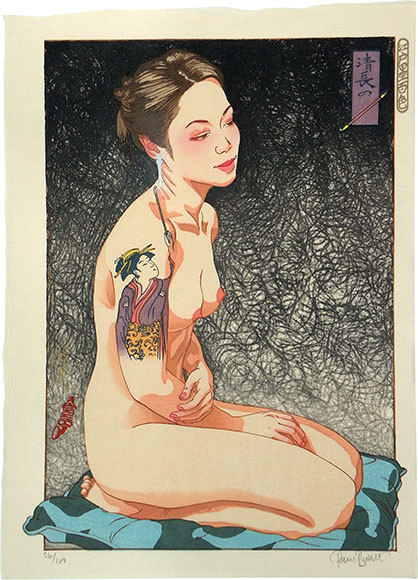
A Hundred Shades of Ink of Edo: Kiyonaga's Pipe (Edo zumi hyaku shoku: Kiyonaga no kiseru)
Woodblock print

View of Kabuki Theater from Matsuya (Ginza Matsuya yori Kabukiza), no. 3 from the series "Pictures of Ginza, First Series (Gashu Ginza dai isshu)"
1928
Color lithograph

Distant View of Mitsukoshi Movie Theater in Shinjuku from the Sixth Floor of Hoteiya (Hoteiya rokkai kara Shinjuku Mitsukoshi Musashi no kan enbo zu), no. 1 from the series "Scenery of Shinjuku (Gashu Shinjuku fukei)"
1930
Color lithograph
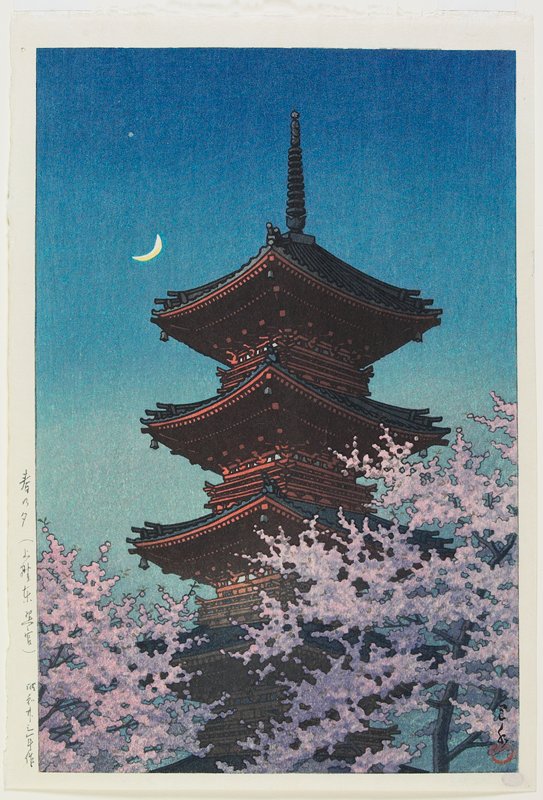
Spring Dusk at the Tōshō Shrine in Ueno
1948
Woodblock print, ink and color on paper
Frequently Asked Questions
Nihonbashi was created by Utagawa Hiroshige (歌川広重).
Nihonbashi depicts urban scenes.