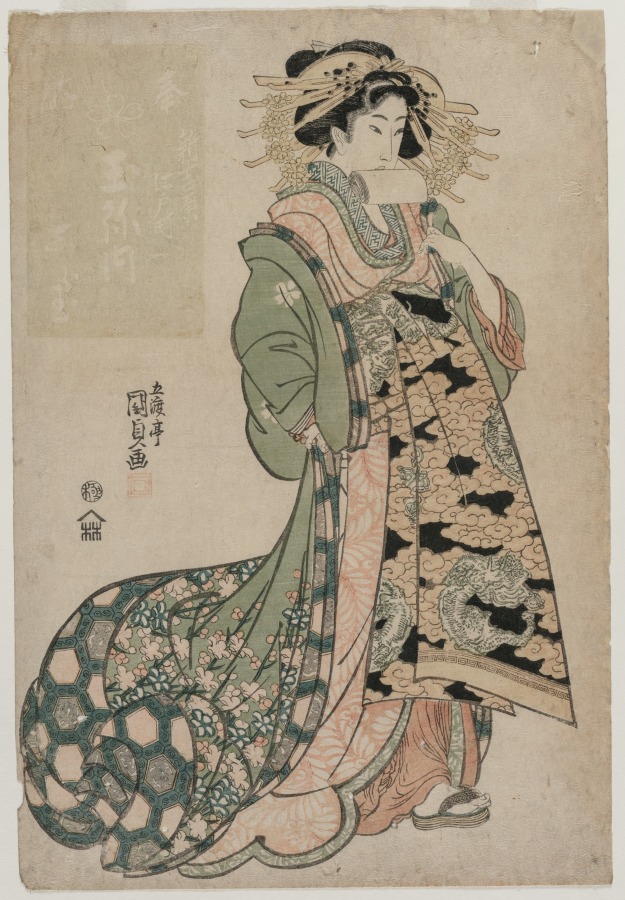
The Courtesan Shiratama of the Tamaya
- Date:
- c. early 1810s
- Medium:
- color woodblock print
- Source:
- Cleveland Museum of Art
Description
The Courtesan Shiratama of the Tamaya, dated 1810 in the Cleveland Museum of Art catalogue, is an early bijinga by Utagawa Kunisada from his first decade as a designer in the Edo ukiyo-e market. Shiratama was a courtesan of the Tamaya, one of the elite teahouses of the Yoshiwara licensed quarter, and the print belongs to the well-established tradition of single-figure portraits of named Yoshiwara women that publishers used to advertise both the courtesans themselves and the artists who depicted them. Kunisada, working under his teacher Toyokuni I's lineage, had begun producing such prints by the late 1800s, building rapidly on the bijinga formula refined by Kitagawa Utamaro. Compared with his mature Bunsei and Tempo-era beauties, this early work shows a softer, rounder facial template, with a fuller cheek and a more relaxed jaw line, and the courtesan's robe is patterned to display the seasonal motifs and textile values that were as important as the figure herself. The composition places Shiratama close to the picture plane, drawing attention to her hair ornaments, her layered kimono, and the cartouche identifying the establishment. As a Cleveland holding, the impression survives with strong color and clean key-block lines, providing useful evidence of how Kunisada's bijinga style developed before the consolidation of the Toyokuni III manner that would dominate the second half of his career. Early-period prints of this kind are comparatively scarce and document the Yoshiwara as it existed in the Bunka era.
More Prints by Utagawa Kunisada

The actors Ichikawa Danjuro VII as Takamoto no kitsune and Segawa Kikunojo V as Izumi no Chieda-gitsune
1818
Color woodblock print; shikishiban, surimono

Basketry Work: By the Craftsman Ichida Shōshichirō of Naniwa (Kagozaiku Naniwa saikunin Ichida Shōshichirō)
1819
Woodblock print; ink and color on paper
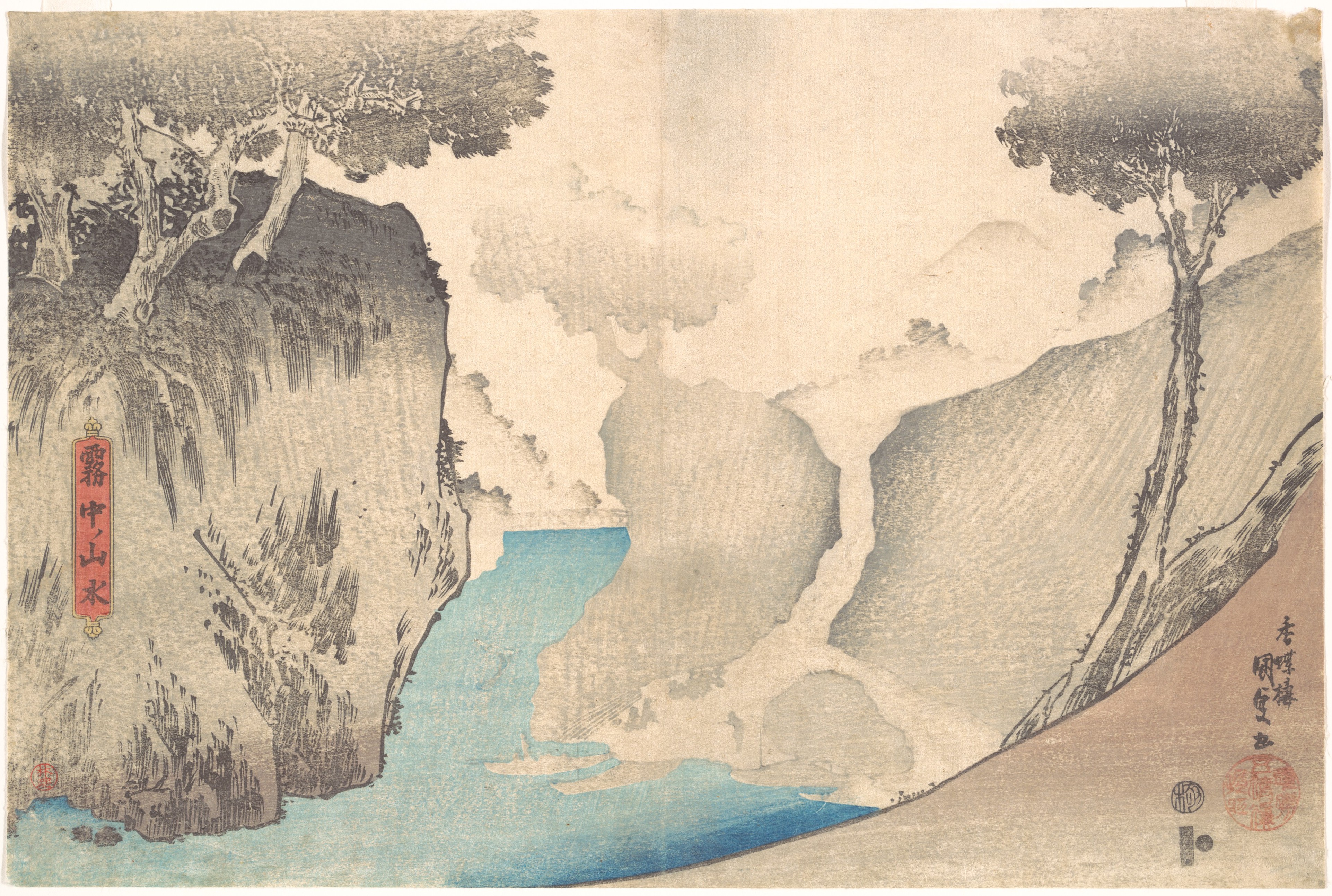
Ochanomizu in the Mist
mid-19th century
Woodblock print; ink and color on paper
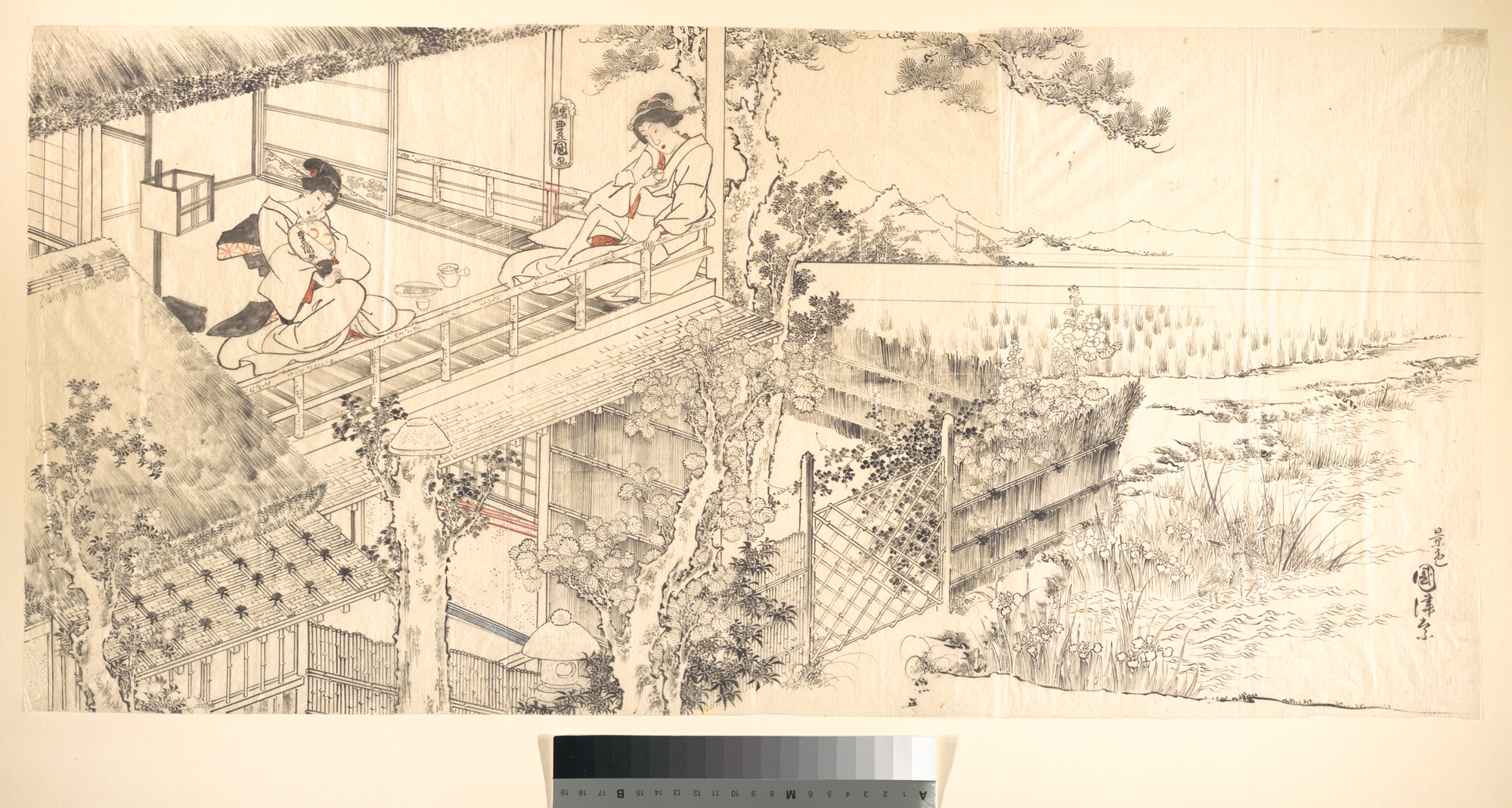
Two Courtesans Enjoying the View from a Teahouse
after 1844
Drawings intended as design for woodblock prints (triptych); ink and color on paper
Frequently Asked Questions
The Courtesan Shiratama of the Tamaya was created by Utagawa Kunisada (歌川国貞) in c. early 1810s.