
Great Victory of Our Forces at the Battle of Pyongyang (Heijo gekisen waga gun taisho no zu)
- Date:
- 1894
- Medium:
- Color woodblock print; oban triptych
- Source:
- Art Institute of Chicago
Description
This 1894 oban triptych, held by the Art Institute of Chicago, depicts the Imperial Japanese Army's decisive victory at the Battle of Pyongyang, fought on 15 September 1894 and widely celebrated in the Japanese press as the first large-scale land engagement of the First Sino-Japanese War. Japanese forces, under the command of Marshal Yamagata Aritomo and field commander Nozu Michitsura, surrounded the city before dawn and launched a coordinated assault from four directions; by evening the Chinese commander Zuo Baogui was dead and the city had fallen. Watanabe Nobukazu's triptych stages the engagement at the moment of Japanese breakthrough: officers in white uniform direct ranks of advancing infantry, artillery fires in clouds of smoke, and the walls and gates of the Korean city rise in the background. The composition's documentary specificity, with Western-style military uniforms, modern rifles, and recognizable Korean architecture, gives the print the character of visual reportage; its compositional logic of disciplined heroism marks it as patriotic propaganda. The print was signed in the artist name Yōsai Nobukazu and rushed to market in the autumn of 1894, when sensō-e of the Pyongyang victory dominated print shop windows in Tokyo and Osaka. It is part of the Art Institute of Chicago's collection of Meiji woodblock prints.
More Prints by Watanabe Nobukazu

Sino-Japanese War: Two Generals at the Battle of Fenghuangcheng (Nisshin gekisen ryosho Hoojo sen no zu)
1894
Color woodblock print; oban triptych
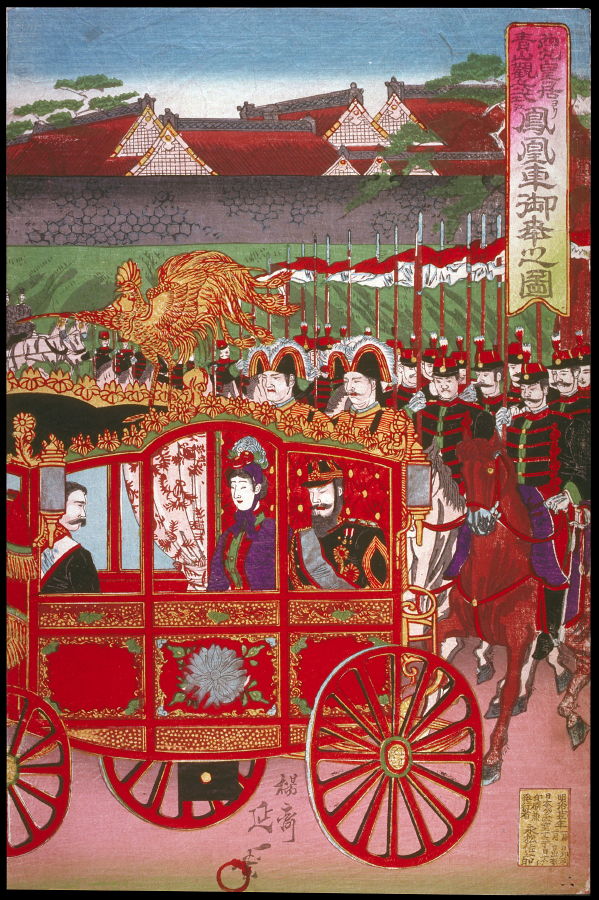
The Imperial Phoenix Carriage Leaves the Palace for the Military Review at Aoyama (right panel)
1892
Color woodcut; right panel of a triptych
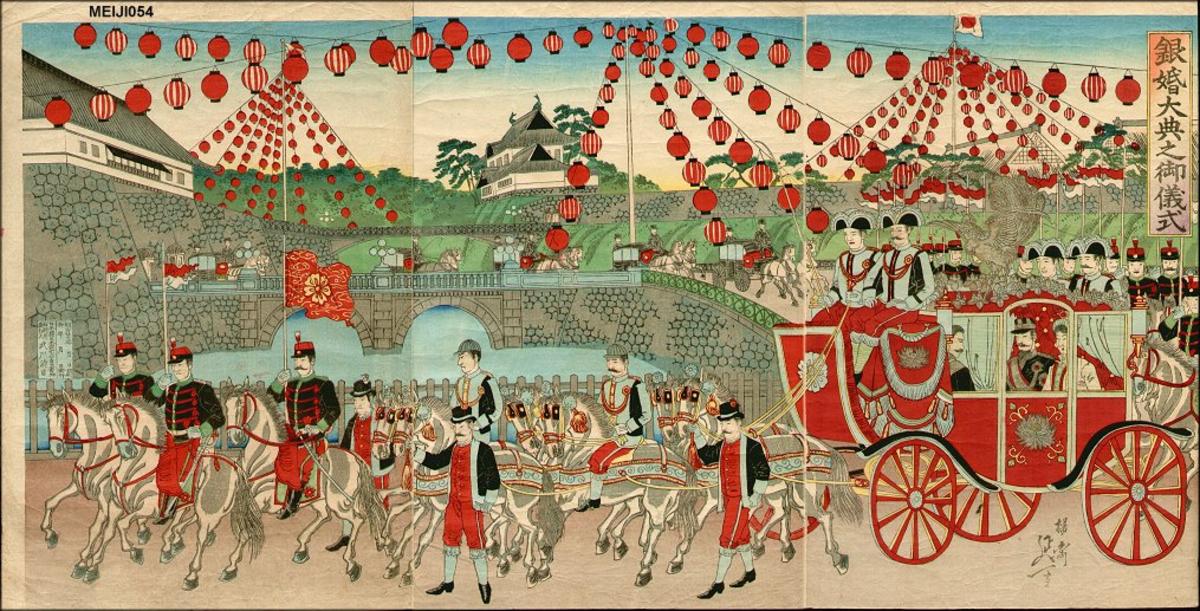
Silver Wedding Anniversary State Ceremony (Ginkon taiten no gi shiki)
銀婚大典之御儀式
1894
Color woodblock print; oban triptych

The Imperial Phoenix Carriage Leaves the Palace for the Military Review at Aoyama (left panel)
1892
Color woodcut; left panel of a triptych
Frequently Asked Questions
Great Victory of Our Forces at the Battle of Pyongyang (Heijo gekisen waga gun taisho no zu) was created by Watanabe Nobukazu (渡辺延一) in 1894.