Biography
Watanabe Nobukazu (渡辺延一, 1874–1944), who signed many of his prints under the artist name Yōsai Nobukazu (楊斉延一), was a Meiji-era ukiyo-e print designer whose career was built largely on the surge of patriotic visual culture that accompanied Japan's late nineteenth-century wars of empire. Trained as a pupil of Yōshū (Toyohara) Chikanobu, one of the leading sensō-e (war print) and bijin-ga designers of the period, and widely regarded as Chikanobu's best student, Watanabe Nobukazu followed his teacher into the market for triptych war prints, imperial ceremonial scenes, and bijin-ga produced in large numbers for an urban public hungry for visual reports of state events and military campaigns. He became one of the most prolific and prominent Meiji sensō-e specialists, and his triptychs of land and naval engagements in the Sino-Japanese and Russo-Japanese Wars circulated widely in Tokyo and beyond between 1894 and 1905.
Born in 1874, Watanabe Nobukazu entered Chikanobu's Tokyo studio while still young. Chikanobu — a former Tokugawa retainer who had taken up the Utagawa-school print idiom — had by the 1880s become a leading designer of imperial procession prints, court-life bijin-ga, and battle triptychs. Working alongside his teacher gave the young Nobukazu access to a publishing infrastructure that demanded steady, fast output and rewarded designers who could compose the standard sensō-e triptych: foreground heroes in Western-style military uniforms, a dramatic middle ground of advancing infantry or naval fire, and a distant horizon of smoke, mountains, or sea. By the early 1890s Nobukazu had begun signing prints independently, generally as 'Yōsai Nobukazu' — a studio name that echoed his teacher's own gō, Yōshū, with which it shares its leading character.
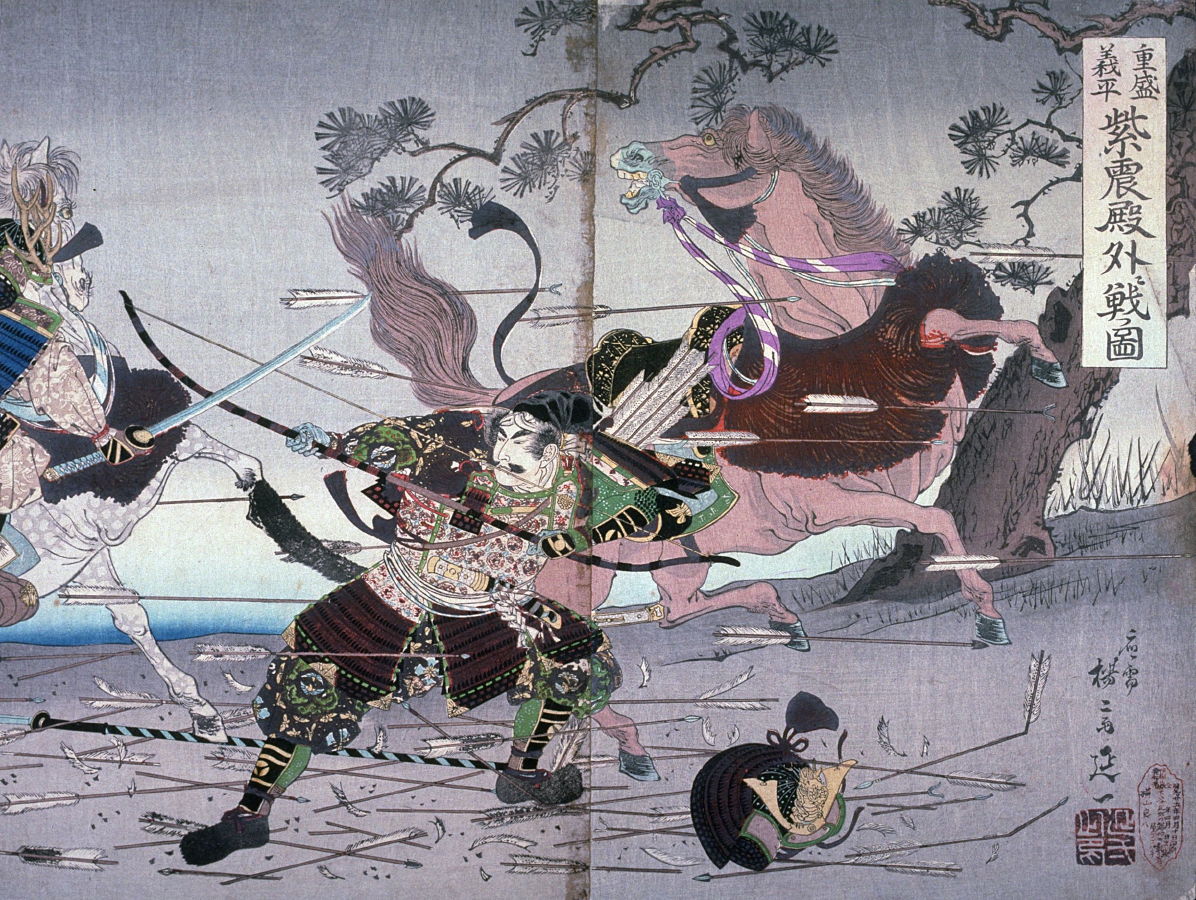
A substantial part of his early output belonged to the imperial ceremonial genre that boomed in Tokyo print shops during the late 1880s and early 1890s. His imperial-procession prints depict the imperial cortege in documentary detail, with court officials in European-cut uniforms, ranks of mounted cavalry, and the Emperor's carriage rendered as the visual climax of the composition. Such prints functioned as state-aligned visual reporting on the rituals of the new constitutional monarchy, aimed at a public for whom the Emperor's reviewable presence was still a recent and novel phenomenon. He also worked in the parallel genre of musha-e (warrior prints), restaging historical combats with the same dynamic triptych vocabulary that he would soon apply to modern war.
The First Sino-Japanese War of 1894–1895 made Watanabe Nobukazu's commercial reputation. He produced a great many sensō-e triptychs during these months, working at the pace that publishers demanded and that the public — gathering around print-shop windows to follow each new dispatch from the front — eagerly bought. His triptych 'Great Victory of Our Forces at the Battle of Pyongyang (Heijō gekisen waga gun taishō no zu),' held in the Art Institute of Chicago, is characteristic of his style during the conflict: identifiable Japanese officers stand at the center of the composition, Imperial Japanese Army infantry advance through the middle ground, and the distant background carries the smoke and rugged terrain of the Korean peninsula. The Battle of Pyongyang, fought on 15 September 1894, was the first large-scale land engagement of the war and a decisive Japanese victory; sensō-e triptychs depicting it were rushed to market in the weeks that followed and constitute one of the densest visual records of the conflict.
Alongside the war prints, Nobukazu continued to design imperial ceremonial scenes throughout the 1890s. His 1894 triptych of the Silver Wedding Celebration (Ginkon taiten gishiki no zu) commemorated the twenty-fifth anniversary of the Meiji Emperor and Empress's marriage — a state celebration that consciously borrowed the European convention of the silver wedding to project the imperial family as a modern dynastic household. The print is held in the Jean S. and Frederic A. Sharf Collection at the Museum of Fine Arts, Boston. He also designed a triptych of Yasukuni Shrine depicting the recently erected statue of the modernizing army strategist Ōmura Masujirō, whose 1869 assassination had become a foundational martyr narrative for the Imperial Japanese Army; the print sits at the intersection of news reportage, religious imagery, and political iconography that characterized Meiji visual culture at its most state-aligned.
Watanabe Nobukazu also produced bijin-ga and series of seasonal genre scenes depicting modish Meiji women, as well as prints of famous Tokyo views, including scenes of Asakusa and its landmark Ryōunkaku, the twelve-story brick tower that became an icon of the late-Meiji skyline. The Russo-Japanese War of 1904–1905 brought a second wave of sensō-e commissions, and Nobukazu produced battle triptychs for this conflict as well, though by then the rise of photographic illustration in newspapers and magazines was beginning to displace woodblock war prints from the mass market. He continued to work into the Taishō and early Shōwa periods, his output gradually thinning, and died in 1944.
His prints are held by the Art Institute of Chicago, the Museum of Fine Arts, Boston, and the Fine Arts Museums of San Francisco, among other major collections of Meiji woodblock prints. For students of Meiji visual culture, Watanabe Nobukazu is a useful figure: his work documents the imperial ceremonies that legitimized the new constitutional state, the battlefield victories that secured Japan's regional ambitions, and the modish Tokyo life that those upheavals reshaped. He stands beside Mizuno Toshikata, Migita Toshihide, Kobayashi Kiyochika, and his own teacher Chikanobu among the leading designers of the Sino-Japanese War print boom.
Key Facts
- Active Period
- 1874–1944
- Nationality
- 🇯🇵Japan
- Movements
- Meiji/Taishō PrintsUkiyo-e
- Works Indexed
- 7
Frequently Asked Questions
Watanabe Nobukazu (渡辺延一, 1874–1944), who signed many of his prints under the artist name Yōsai Nobukazu (楊斉延一), was a Meiji-era ukiyo-e print designer whose career was built largely on the surge of patriotic visual culture that accompanied Japan's late nineteenth-century wars of empire. Trained as a pupil of Yōshū (Toyohara) Chikanobu, one of the leading sensō-e (war print) and bijin-ga designers of the period, and widely regarded as Chikanobu's best student, Watanabe Nobukazu followed his teacher into the market for triptych war prints, imperial ceremonial scenes, and bijin-ga produced in large numbers for an urban public hungry for visual reports of state events and military campaigns. He became one of the most prolific and prominent Meiji sensō-e specialists, and his triptychs of land and naval engagements in the Sino-Japanese and Russo-Japanese Wars circulated widely in Tokyo and beyond between 1894 and 1905.
Watanabe Nobukazu was active from 1874 to 1944. They were associated with the Meiji/Taishō Prints and Ukiyo-e movements.
Watanabe Nobukazu's work was shaped by the Meiji/Taishō Prints and Ukiyo-e traditions in Japanese woodblock printmaking. Meiji/Taishō Prints: Meiji and Taishō era prints (1868–1926) bridge the transition from traditional ukiyo-e to the modern shin-hanga and sosaku-hanga movements. Ukiyo-e: ## What is ukiyo-e? Ukiyo-e ([浮世絵](/glossary/ukiyo-e)) — literally "pictures of the floating world" — is the Edo-period Japanese print and painting tradition that flourished from roughly 1660 to 1868, depicting the pleasures of urban life in Edo (modern Tokyo): courtesans, kabuki actors, sumo wrestlers, famous landscapes, and seasonal beauties.
Original prints by Watanabe Nobukazu can be found in collections including Art Institute of Chicago, Legion of Honor (Achenbach Foundation for Graphic Arts), ukiyo-e.org.
Woodblock Prints by Watanabe Nobukazu (7)

The Imperial Phoenix Carriage Leaves the Palace for the Military Review at Aoyama (left panel)
1892
Color woodcut; left panel of a triptych
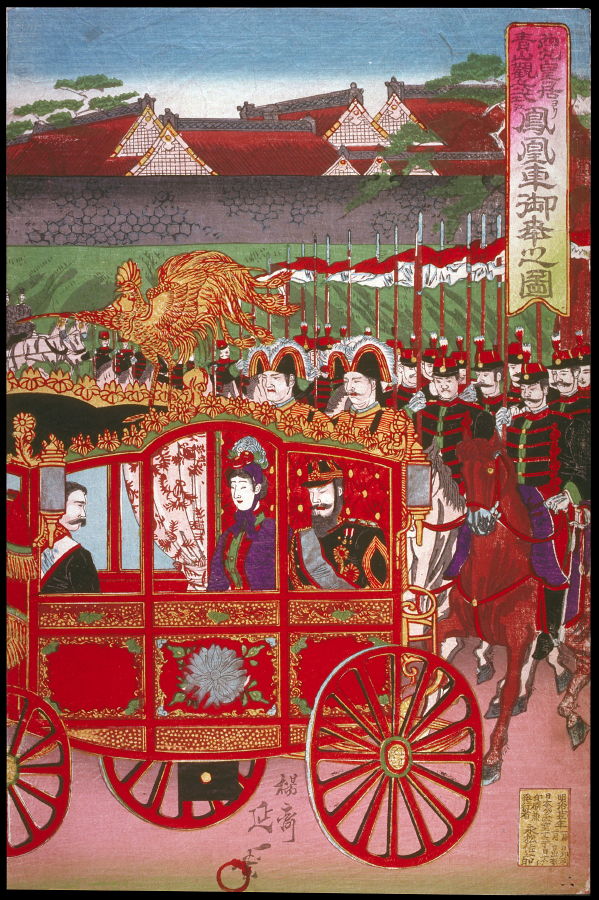
The Imperial Phoenix Carriage Leaves the Palace for the Military Review at Aoyama (right panel)
1892
Color woodcut; right panel of a triptych
Shigemori and Yoshihira Battling outside the Shishinden Palace
1892
Color woodcut; two panels of a triptych
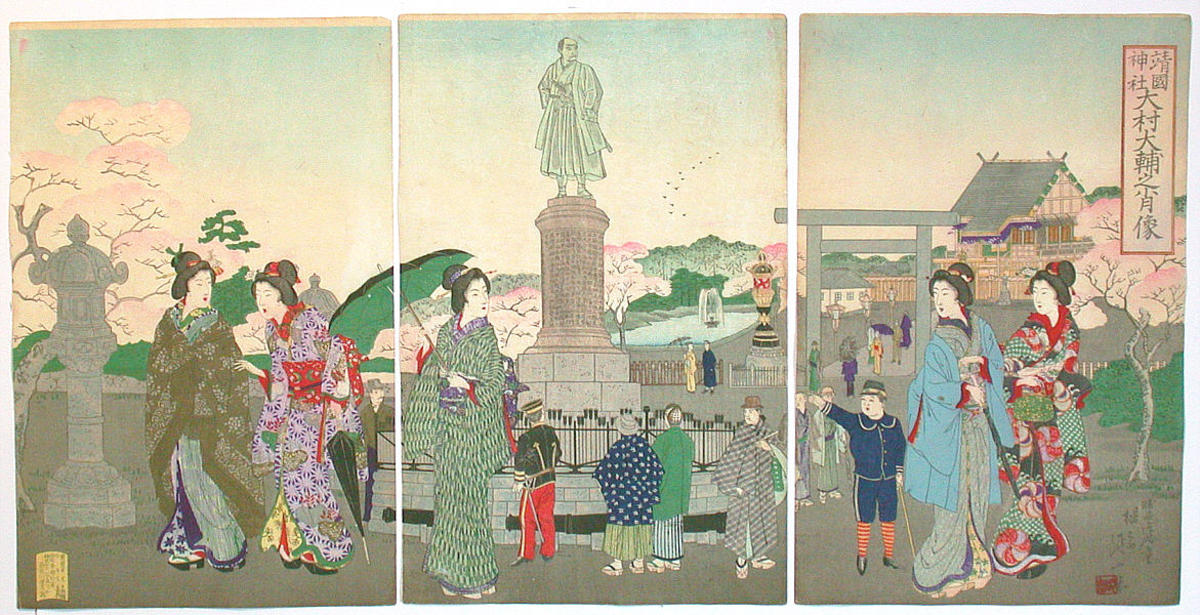
Yasukuni Shrine — Statue of Ōmura Masujirō (Yasukuni Jinja, Ōmura Masujirō no Shōzō)
靖国神社 大村益次郎の彫像
1893
Color woodblock print; oban triptych

Sino-Japanese War: Two Generals at the Battle of Fenghuangcheng (Nisshin gekisen ryosho Hoojo sen no zu)
1894
Color woodblock print; oban triptych

Great Victory of Our Forces at the Battle of Pyongyang (Heijo gekisen waga gun taisho no zu)
1894
Color woodblock print; oban triptych
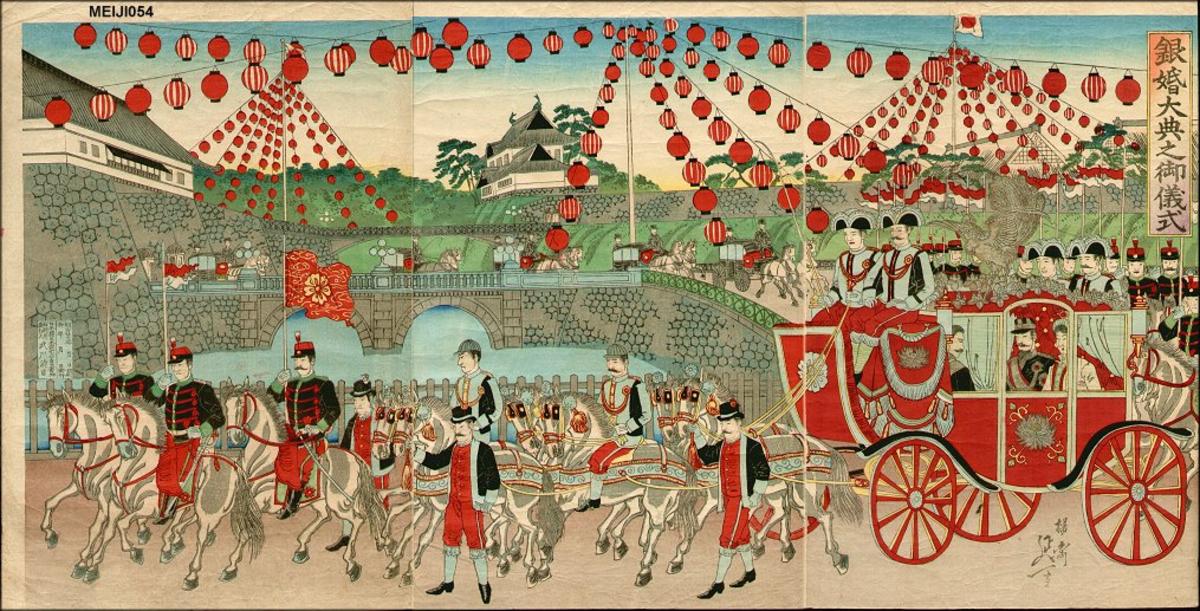
Silver Wedding Anniversary State Ceremony (Ginkon taiten no gi shiki)
銀婚大典之御儀式
1894
Color woodblock print; oban triptych