
Aragato
荒事
- Medium:
- Limited-edition lithograph on handmade Japanese rice paper
- Image courtesy of
- Hanga Ten (London)
Description
Aragoto (荒事, "rough business" — Aragato in the artist's transliteration) is the bombastic style of kabuki acting developed by Ichikawa Danjuro I in late seventeenth-century Edo, exemplified by superhuman heroes such as Shibaraku's Kamakura Gongoro and the demon-queller Kagekiyo. Aragoto roles are identified by exaggerated suji-guma kumadori in red lines, heavily padded costumes, mie freeze-poses held at climactic moments, and declamatory delivery. Yamada's print likely isolates a single aragoto figure as portrait or facial study against the paper rather than embedding the actor in a staged scene — consistent with her broader practice of drawing the painted face as primary subject. Lithography on handmade washi suits the visual vocabulary of aragoto: flat fields of saturated colour and graphic linearity translate directly into stone or plate, then onto absorbent paper that holds pigment with a slightly granular surface. The work belongs to the Tokyo-derived kabuki sequence that runs through Yamada's editioned output, drawn from the six years she spent observing performers before returning to the United States.
More Prints by Juliane Yamada


More Kabuki Prints
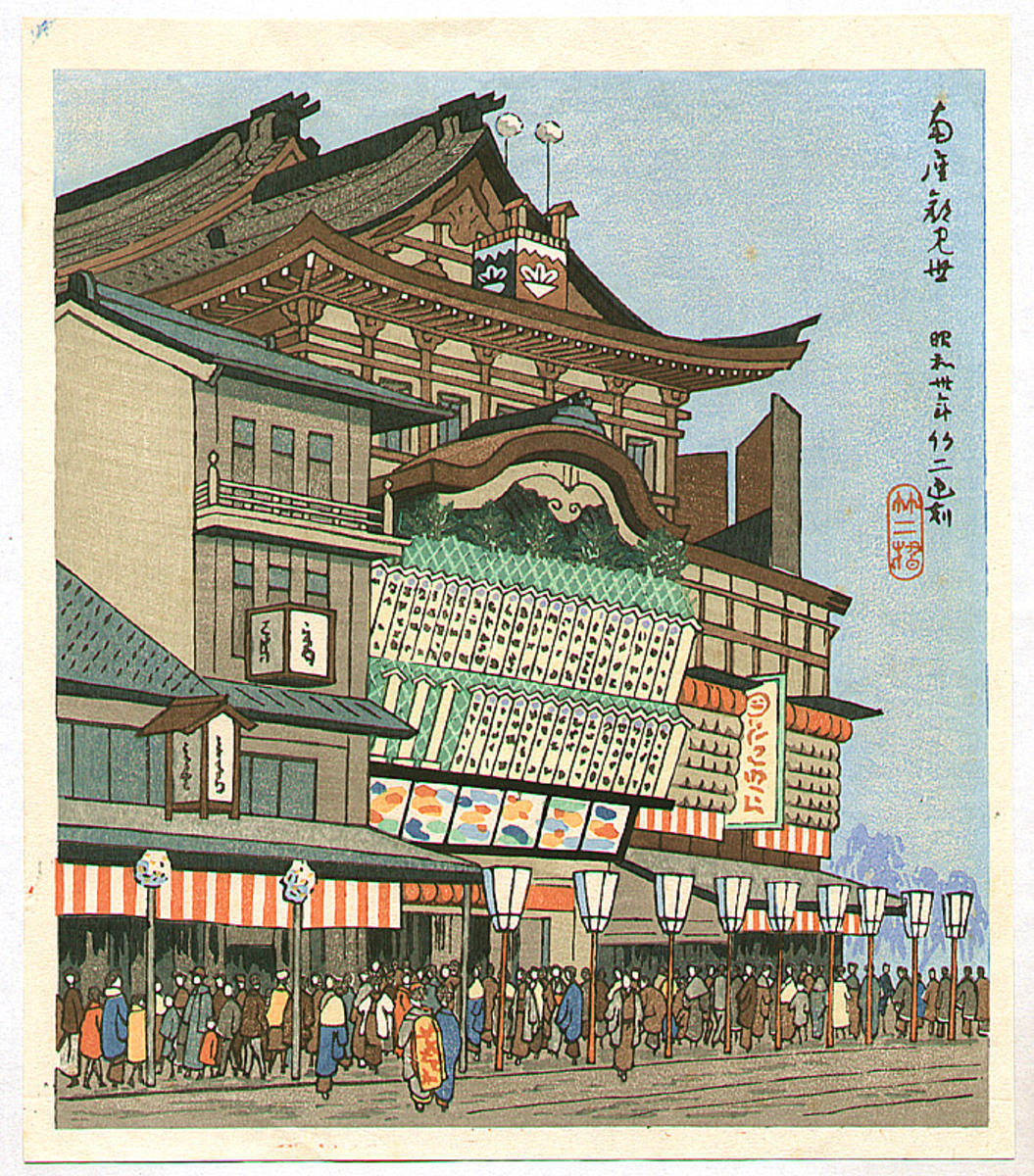
Kabuki Theater
歌舞伎
Woodblock print
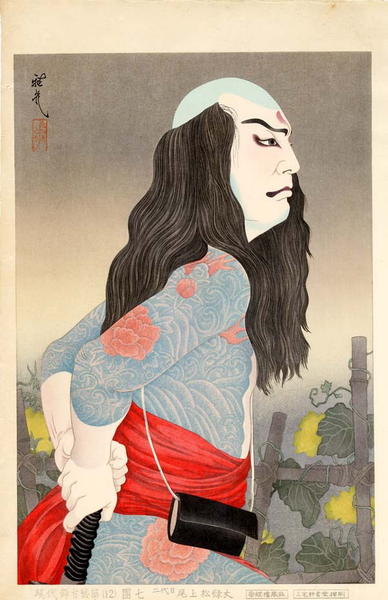
Onoe Shoroku II as the tattooed villain Danshichi
1955
Woodblock print

View of Kabuki Theater from Matsuya (Ginza Matsuya yori Kabukiza), no. 3 from the series "Pictures of Ginza, First Series (Gashu Ginza dai isshu)"
1928
Color lithograph

Distant View of Mitsukoshi Movie Theater in Shinjuku from the Sixth Floor of Hoteiya (Hoteiya rokkai kara Shinjuku Mitsukoshi Musashi no kan enbo zu), no. 1 from the series "Scenery of Shinjuku (Gashu Shinjuku fukei)"
1930
Color lithograph
Frequently Asked Questions
Aragato (荒事) was created by Juliane Yamada.
Aragato depicts kabuki.