
Kumadori
隈取
- Medium:
- Limited-edition lithograph on handmade Japanese rice paper
- Image courtesy of
- Hanga Ten (London)
Description
The print depicts the stylised facial makeup of a kabuki actor, applied as bold lines over a white oshiroi base. Kumadori (隈取, literally "taking shadow") codes character through colour: beni (red) lines indicate righteous heroism, ai-guma (indigo or black) signals villains, ghosts, or supernatural beings, and chairo-guma (brown) marks demons. The lines trace and exaggerate facial musculature so that emotion reads from the back of a large theatre. As a lithograph drawn from Yamada's underlying watercolour and pencil portrait, the work translates the granular graphite passages and pigment washes of her drawings into the flat, planographic registers of stone or plate, printed in successive colours on absorbent handmade washi rather than smooth Western paper. The fibres of the rice paper soften the printed edge in a way closer to her original drawings than commercial offset permits. Within Yamada's body of work — primarily watercolour and pencil portraiture, with editioned lithographs forming a much smaller output — kabuki faces recur as a sustained subject drawn from her six years observing Tokyo theatre.
More Prints by Juliane Yamada


More Kabuki Prints
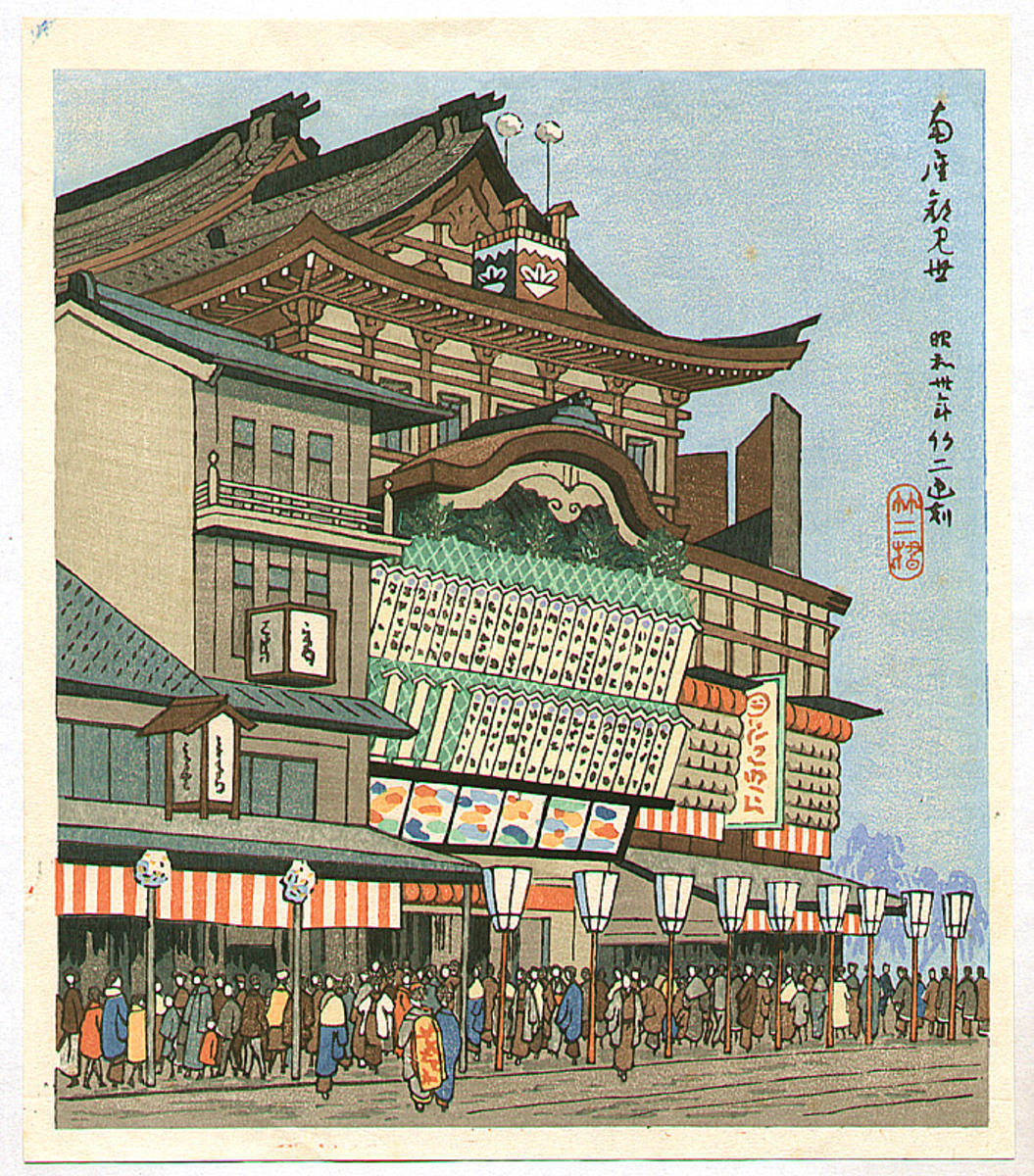
Kabuki Theater
歌舞伎
Woodblock print
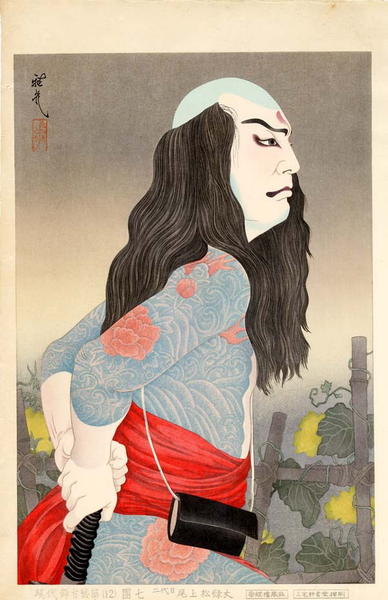
Onoe Shoroku II as the tattooed villain Danshichi
1955
Woodblock print

View of Kabuki Theater from Matsuya (Ginza Matsuya yori Kabukiza), no. 3 from the series "Pictures of Ginza, First Series (Gashu Ginza dai isshu)"
1928
Color lithograph

Distant View of Mitsukoshi Movie Theater in Shinjuku from the Sixth Floor of Hoteiya (Hoteiya rokkai kara Shinjuku Mitsukoshi Musashi no kan enbo zu), no. 1 from the series "Scenery of Shinjuku (Gashu Shinjuku fukei)"
1930
Color lithograph
Frequently Asked Questions
Kumadori (隈取) was created by Juliane Yamada.
Kumadori depicts kabuki.