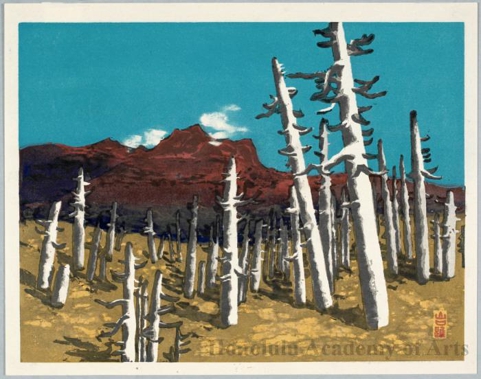
Burned Mountain with Dead Forest
- Date:
- c. 1955
- Medium:
- Color woodblock print
- Source:
- Honolulu Museum of Art
Description
Burned Mountain with Dead Forest, a color woodblock print produced around 1955 and held at the Honolulu Museum of Art, belongs to the central postwar phase of Yamaguchi Susumu's Japan Alps landscape practice and treats the volcanic and burned forest terrain that gave Mount Yakedake — literally Burned Peak — its name. The dead forest motif, in which standing trunks rise leafless from a scorched or flooded ground, recurs across Yamaguchi's mature Kamikochi compositions and connects this sheet to the iconic Taisho Pond images for which he is best known. By the mid 1950s Yamaguchi was working at the height of his sosaku-hanga career and had been brought to the attention of an American audience through Oliver Statler's 1956 book Modern Japanese Prints: An Art Reborn, with his major Japan Alps compositions entering American and European public collections during this period. The print uses the thick saturated water-based pigment, dampened torinoko paper, and grain-exposed blocks that defined his signature style, with deep blues and greens against warm earth tones and the bold cloisonné contours that contemporary critics compared to the French painter Georges Rouault. The Honolulu Museum of Art impression preserves the layered chromatic registration and the exposed woodgrain that distinguish strong sheets of his postwar Showa woodblock work and that mark his particular contribution to the sosaku-hanga landscape tradition.
More Prints by Yamaguchi Susumu

Featured in Collections
Curated cross-cuts that include this print.
Frequently Asked Questions
Burned Mountain with Dead Forest was created by Yamaguchi Susumu (山口進) in c. 1955.