
Taisho Pond
大正池
- Date:
- 1952
- Medium:
- Color woodblock print
- Source:
- British Museum
Description
Taisho Pond, a 1952 color woodblock print held at the British Museum, is one of the major Kamikochi compositions of Yamaguchi Susumu's postwar career, returning him to the high mountain pond in the Northern Japan Alps that he had first treated in his 1939 Art Institute of Chicago print. By 1952 Yamaguchi had been working in the sosaku-hanga medium for three decades and had become, alongside Onchi Koshiro, Sekino Junichiro, and his Ichimokukai colleagues, one of the most distinctive landscape printmakers of the postwar Showa generation. Taisho Pond is built around the mirror-like reflective surface of the pond and the silhouette of the dead trees that rise from its shallows, a subject Yamaguchi treated repeatedly across his career and that became one of the iconic images of the Japan Alps landscape tradition. The print uses the thick saturated water-based pigment, dampened torinoko paper, and grain-exposed blocks that defined his signature style, with deep blues and greens against warm earth tones and the bold cloisonné contours that contemporary critics compared to the French painter Georges Rouault. The American audience for Japanese sosaku-hanga, channelled through Oliver Statler's 1956 book Modern Japanese Prints: An Art Reborn, brought this generation of Yamaguchi's Kamikochi work into Western public collections, and the British Museum impression preserves the saturated chromatic registration and exposed grain that distinguish his strongest postwar Japan Alps landscape prints.
More Prints by Yamaguchi Susumu
Japan Alps (Chuo Arupusu), Yamaguchi yakedake
中央アルプス
1958
Color woodblock print
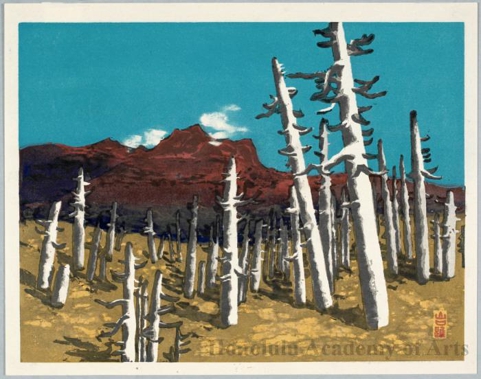
Burned Mountain with Dead Forest
c. 1955
Color woodblock print
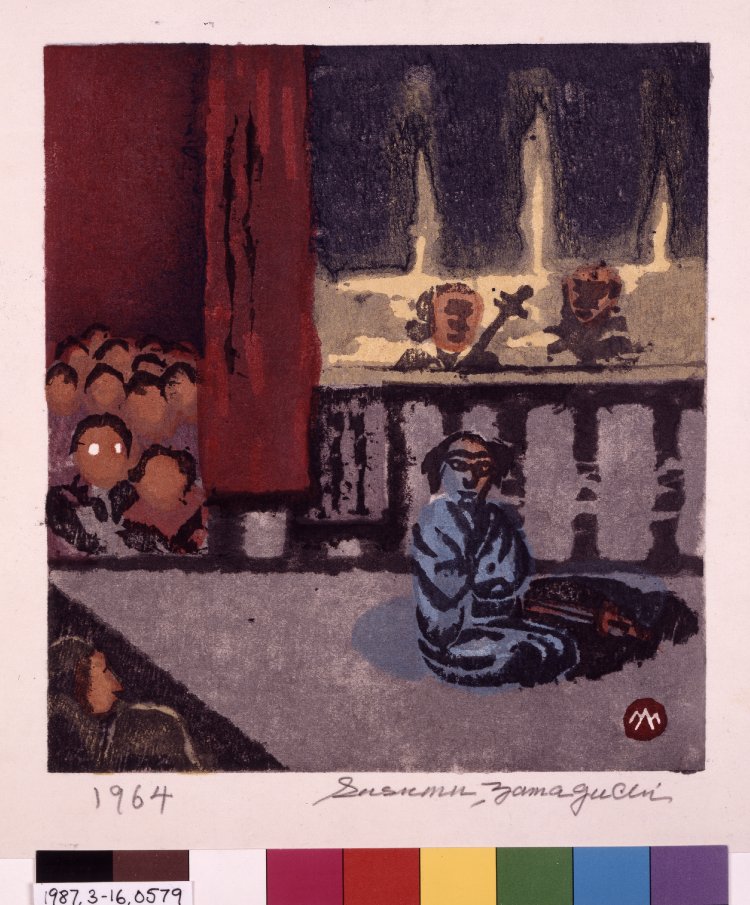
Inaka shibai (Country Theatre), from Ichimoku-shu (First Thursday Collection), Vol. 6
田舎芝居
1950
Color woodblock print
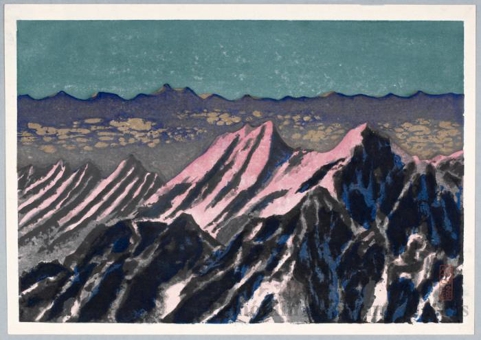
Mt. Hodaka at Daybreak
穂高暁
1955
Color woodblock print
Featured in Collections
Curated cross-cuts that include this print.
Frequently Asked Questions
Taisho Pond (大正池) was created by Yamaguchi Susumu (山口進) in 1952.