
Komatsu Shigemori from the Tales of Heike
- Date:
- c. 1820
- Medium:
- Woodblock print (surimono), ink and color on paper
- Source:
- Art Institute of Chicago
Description
Komatsu Shigemori from the Tales of Heike, a surimono by Yashima Gakutei dated to around 1820 and now in the Art Institute of Chicago, draws on one of the canonical works of Japanese literature, the medieval war chronicle Heike monogatari, for its subject. Taira no Shigemori, known as the Komatsu Lord, was traditionally remembered as the moral conscience of the Taira clan, the dutiful son whose early death his contemporaries saw as a portent of his family's downfall. For a kyoka-e audience, learned references like this one were currency: the printed poems beside the image would have played the chronicle's gravitas against the lighter Edo voice of comic linked verse. Gakutei, working in the Hokusai school under Katsushika Hokusai, shapes the figure in the careful, slightly archaizing manner that surimono commissioners favored when the subject was historical or classical. The print's surface uses the technical vocabulary that defines the genre at its peak: multiple impressions of mineral color, karazuri embossing for the textures of armor or court robes, and metallic powders that emphasize prestige attributes. Where commercial musha-e treated warriors as theatrical heroes, the surimono context turns Shigemori into a figure for contemplation, a hook on which a poetry circle could hang verses about loyalty, transience, and the passage of generations. The sheet exemplifies how Yashima Gakutei used historical iconography to give kyoka-e an additional layer of literary depth.
More Prints by Yashima Gakutei
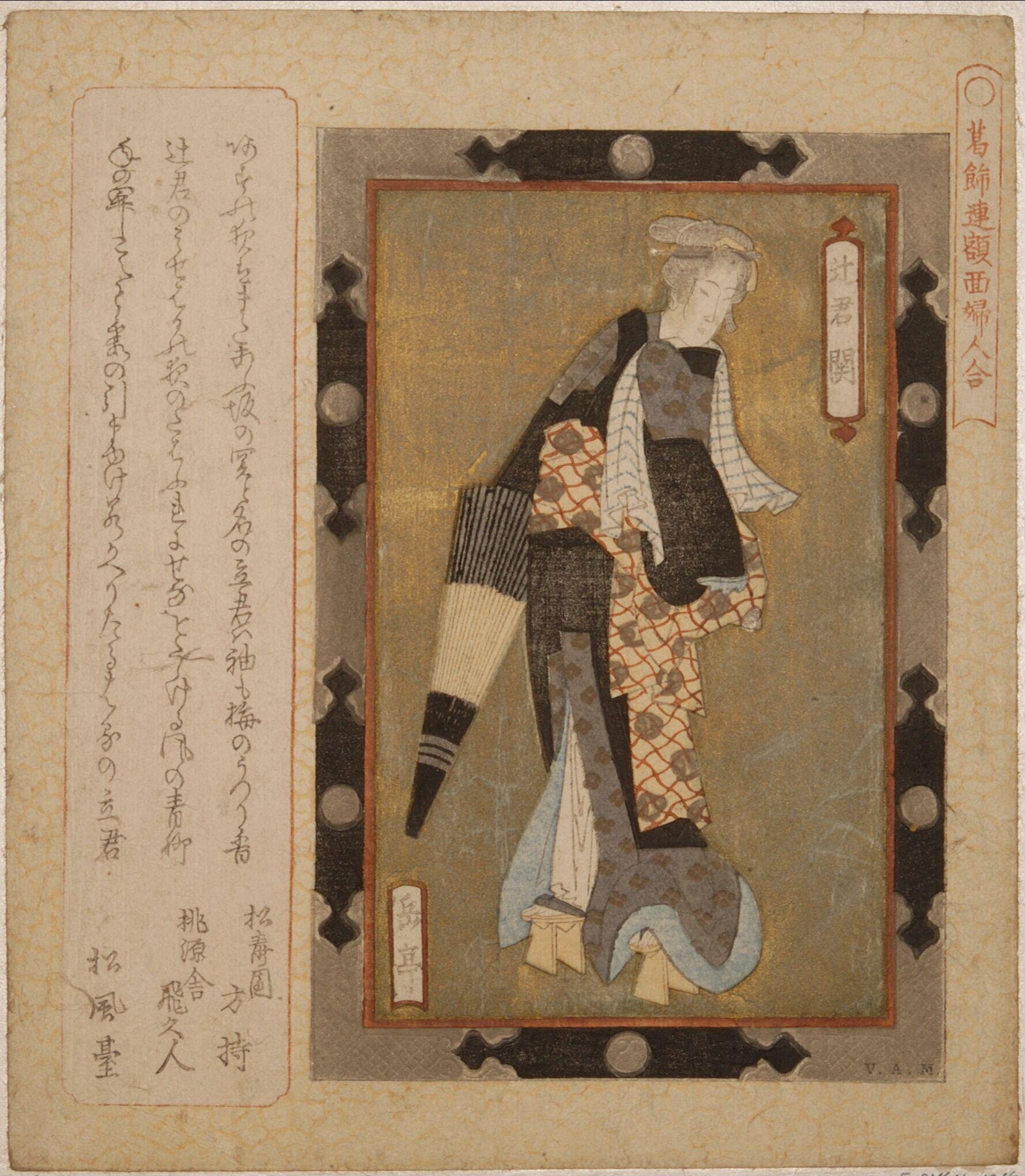
Tsujigimi Seki
ca. 1822

Lin Hejing (Rin Nasei) with Crane
19th century
Color woodblock print; shikishiban, surimono

Two Women Reading
19th century
Color woodblock print; shikishiban, surimono

Two Court Ladies Admiring Cherry Blossoms
19th century
Color woodblock print; surimono, vertical shikishiban diptych
Frequently Asked Questions
Komatsu Shigemori from the Tales of Heike was created by Yashima Gakutei (八島岳亭) in c. 1820.