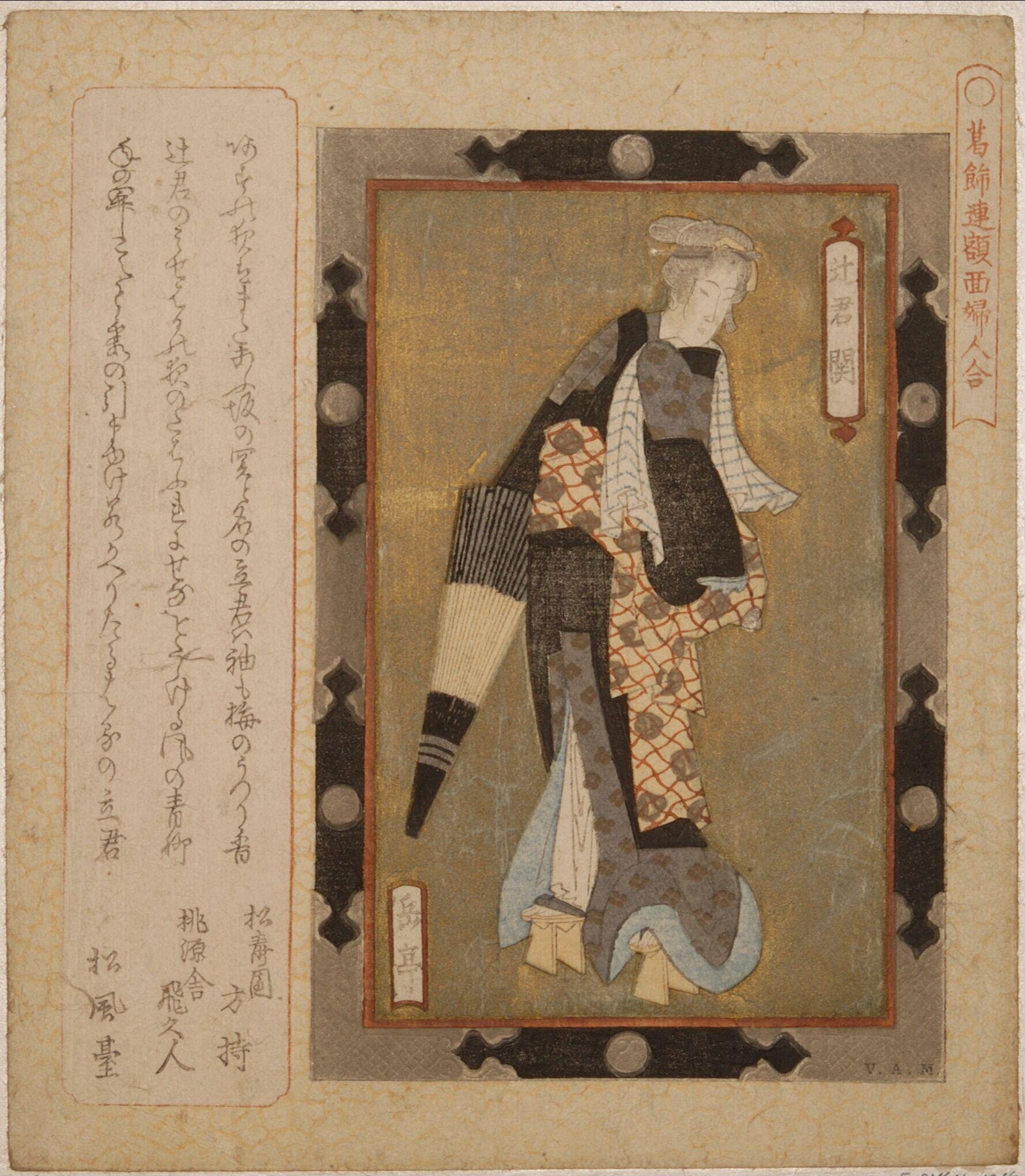
Tsujigimi Seki
- Date:
- ca. 1822
- Medium:
- Source:
- Victoria and Albert Museum
Description
Tsujigimi Seki, a 1822 print by Yashima Gakutei in the Victoria and Albert Museum, brings the surimono and kyoka-e idiom of his Edo career into contact with the more ephemeral world of late-Edo street culture. A tsujigimi was a low-ranking streetwalker who plied her trade in the alleys at the edges of the licensed quarters, and the seki of the title may refer to a personal or stage name. By the early 1820s ukiyo-e artists working in both Edo and Osaka had developed a substantial repertoire for these marginal figures, treating them with a mixture of compassion, curiosity, and class-coded humor. As a designer trained in the Hokusai school under Katsushika Hokusai, Yashima Gakutei brings to the subject the school's interest in figural type and characterful pose, but the surimono background of his bijin-ga gives even an unofficial street figure a measured refinement: the line is supple, the palette restrained, and the composition tuned to balance the figure against generous white space. Where the great courtesans of the Yoshiwara appeared in luxury surimono for kyoka clubs, a tsujigimi inhabits a quieter zone of the city's print culture, and Gakutei treats her with corresponding restraint. The print's preservation in the Victoria and Albert Museum testifies to the early western interest in ukiyo-e's full social range, not just its grandest spectacles. As a Yashima Gakutei figure in the Hokusai school manner, Tsujigimi Seki shows how the artist's surimono sensibility shaped his treatment of even the most marginal contemporary subject.
More Prints by Yashima Gakutei

Komatsu Shigemori from the Tales of Heike
c. 1820
Woodblock print (surimono), ink and color on paper

Lin Hejing (Rin Nasei) with Crane
19th century
Color woodblock print; shikishiban, surimono

Two Women Reading
19th century
Color woodblock print; shikishiban, surimono

Two Court Ladies Admiring Cherry Blossoms
19th century
Color woodblock print; surimono, vertical shikishiban diptych
Frequently Asked Questions
Tsujigimi Seki was created by Yashima Gakutei (八島岳亭) in ca. 1822.