
Two Women Reading
- Date:
- 19th century
- Medium:
- Color woodblock print; shikishiban, surimono
- Source:
- Art Institute of Chicago
Description
Two Women Reading, a surimono of around 1820 by Yashima Gakutei in the Art Institute of Chicago, takes one of the most quietly modern subjects in late-Edo print culture and refits it for kyoka-e. By the early nineteenth century, women in the merchant and samurai households of Edo and Osaka had access to a wide range of books, from popular fiction to poetry anthologies, and images of women absorbed in reading had begun to appear in commercial ukiyo-e. In the surimono format, where prints were privately commissioned by poetry circles, the subject became reflexive: a print depicting reading, paired with printed kyoka verses, asked its viewers to think about their own engagement with text. Working within the Hokusai school as a student of Katsushika Hokusai, Yashima Gakutei composes the two figures with the supple, slightly angular line that characterizes his bijin-ga. He uses areas of blank paper and a restrained palette to let the patterned kimono and the open book stand out, and the print's surface combines mineral pigments with the karazuri embossing and burnished metallic accents typical of deluxe surimono. The result is an unusually intimate image: domestic in subject, literary in implication, and made for an audience that read everything in the picture, from the brushed line to the embossed details, as part of a single composed gesture. As a Yashima Gakutei surimono in the Hokusai school manner, the print stands at the meeting point of bijin-ga and kyoka-e.
More Prints by Yashima Gakutei
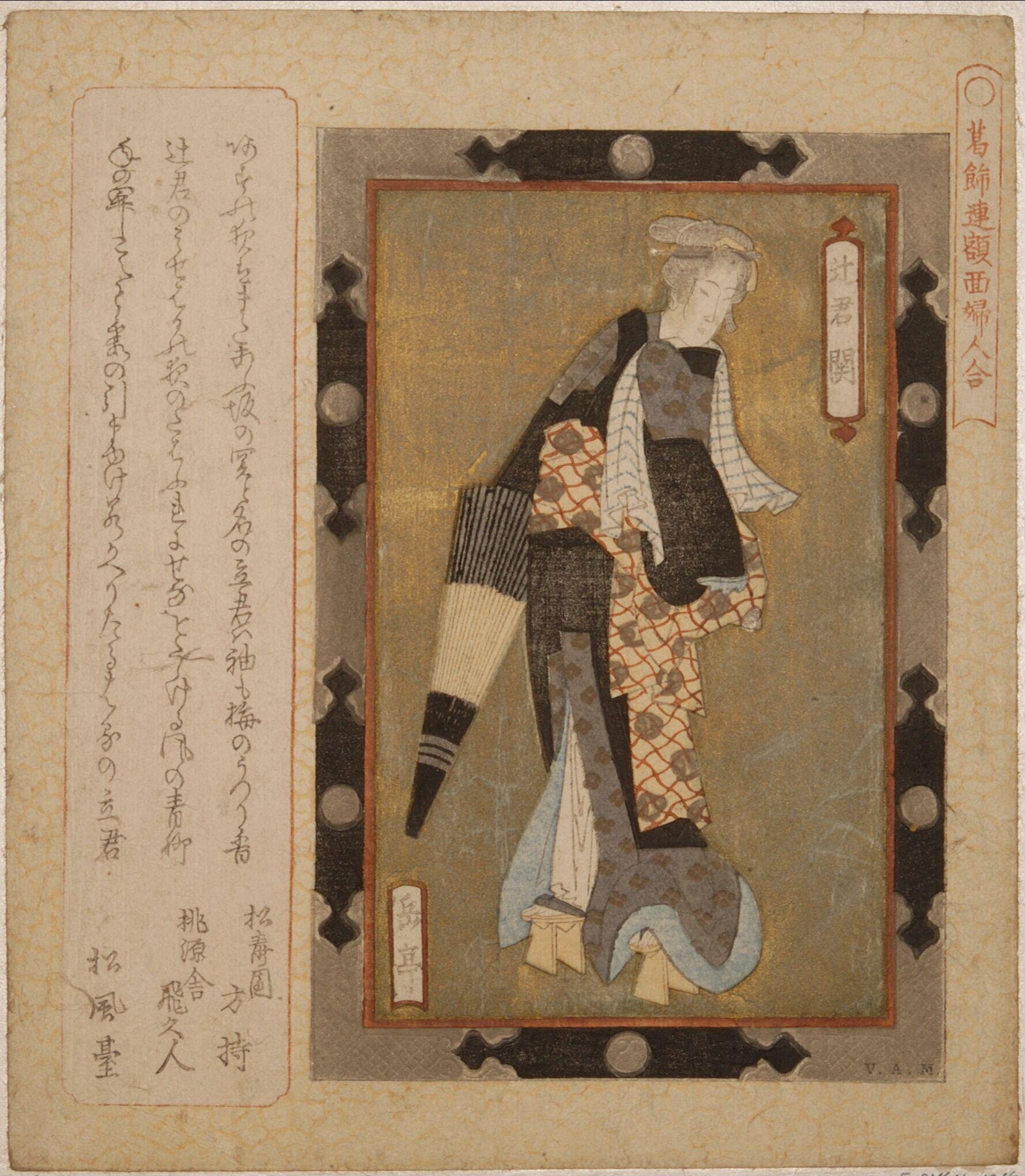
Tsujigimi Seki
ca. 1822

Komatsu Shigemori from the Tales of Heike
c. 1820
Woodblock print (surimono), ink and color on paper

Lin Hejing (Rin Nasei) with Crane
19th century
Color woodblock print; shikishiban, surimono

Two Court Ladies Admiring Cherry Blossoms
19th century
Color woodblock print; surimono, vertical shikishiban diptych
Frequently Asked Questions
Two Women Reading was created by Yashima Gakutei (八島岳亭) in 19th century.