Hokusai's Great Wave: History, Meaning, and Enduring Legacy
When people think of Japanese art, one image surfaces before all others: a towering, claw-like wave rearing up against a pale sky, three fishing boats caught in its trough, and Mount Fuji sitting small and still on the horizon. This is Under the Wave off Kanagawa — better known as the Great Wave — the opening print in Katsushika Hokusai's iconic series Thirty-six Views of Mount Fuji. Created around 1831, the Great Wave is not just a masterpiece of Japanese printmaking. It is one of the most reproduced images in the history of art.
Understanding the Great Wave means looking beyond the wave itself. The print tells a story about an artist who spent a lifetime preparing for this work, a pigment that had just arrived from the other side of the world, and a maritime culture whose daily dangers were woven into the fabric of Edo-period life. It is also a story about how a single woodblock print changed the way the West saw Japan.
Hokusai at Seventy: A Lifetime of Preparation
Katsushika Hokusai was already seventy years old when he began work on Thirty-six Views of Mount Fuji, the series that would cement his legacy. He had been making art for more than fifty years. He had studied under Katsukawa Shunsho, absorbed Chinese painting traditions, experimented with Western perspective, illustrated novels, designed surimono greeting cards, and produced thousands of sketches for his famous Manga drawing manuals. He had changed his artistic name more than thirty times, each new name signaling a fresh artistic identity.
In the postscript to his One Hundred Views of Mount Fuji, Hokusai wrote one of art history's most famous self-assessments: "All I produced before the age of seventy is not worth counting. At seventy-three I began to grasp the structures of birds and animals, insects and fish, and the way plants and trees grow. If I go on trying, I will surely understand them still better by the time I am eighty-six, so that by ninety I will have penetrated to their essential nature."
Hokusai genuinely believed that his best work lay ahead of him, and the Great Wave — created in his early seventies — represented a dramatic step forward in daring, sophistication, and emotional intensity.
The Composition: Chaos and Stillness
The genius of the Great Wave lies in its arrangement of opposites. The entire left two-thirds of the image is consumed by motion — the massive wave curling forward, its crest dissolving into white foam fingers that seem to claw at the sky. The boats in the trough are being tossed about, their rowers hunched low, gripping their oars. Everything in this zone of the print speaks of force, danger, and impermanence.
Then there is the right third of the image, where Mount Fuji sits in the distance, perfectly centered beneath the arc of the wave. Fuji is tiny compared to the wave — a visual surprise that reverses every expectation about which subject should dominate the frame. The mountain is utterly still, its snowy peak echoing the white foam of the wave. In Buddhist and Shinto thought, the mountain represents permanence, the sacred, and the enduring power of nature. The wave, for all its terrifying energy, is a momentary phenomenon. It will crash and dissipate. Fuji will remain.
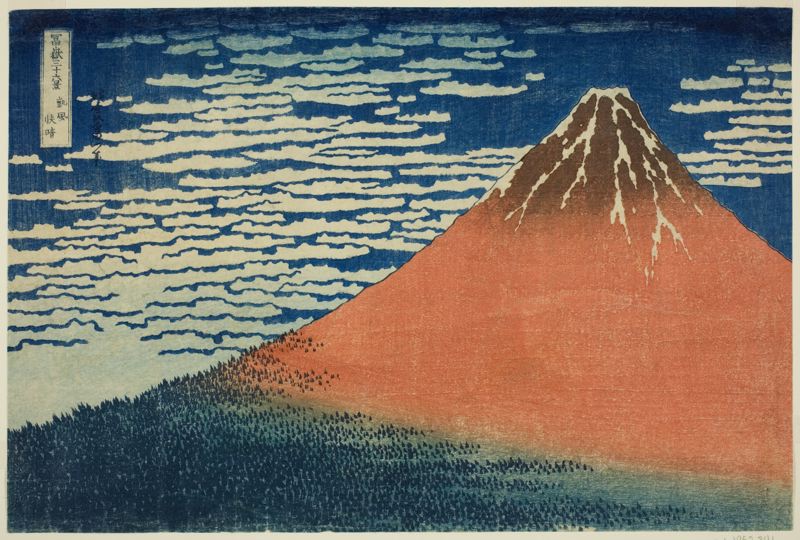
This tension between the fleeting and the eternal is the heart of the print. It is also the organizing principle of the entire Thirty-six Views series: every print shows Fuji from a different vantage point, in different weather, framed by different human activities — but the mountain is always there, constant and unmoved.
The composition also demonstrates Hokusai's absorption of Western perspective. The dramatic recession from the giant foreground wave to the tiny background mountain creates a depth of field unknown in traditional Japanese flat composition. Hokusai had studied Dutch prints and copper engravings, and the Great Wave synthesizes Western spatial ideas with Japanese graphic boldness into something entirely original.

Prussian Blue: The Color That Changed Everything
The most striking visual element of the Great Wave is its color — a deep, saturated blue that dominates the image. This blue has a specific name and a specific history: it is Prussian blue (bero-ai in Japanese, from the Dutch word for Berlin), a synthetic pigment invented accidentally in Berlin around 1706 and first imported to Japan in the late 1820s.
Before Prussian blue arrived, Japanese printmakers relied on plant-based indigo (ai) for their blues. Plant indigo is beautiful but relatively pale, prone to fading, and difficult to saturate. Prussian blue was intense, lightfast, and workable across a wide range of values, from the palest sky wash to an almost black midnight tone.
Hokusai was among the first ukiyo-e artists to grasp the potential of this new pigment. The early prints in Thirty-six Views, including the Great Wave, were printed almost entirely in shades of blue — a deliberate choice that showcased its extraordinary range. These monochromatic blue prints (aizuri-e) were a sensation, and the series sold enormously well.
The technique of bokashi, or gradient printing, was essential to the Great Wave's atmospheric effects. The sky behind Fuji transitions from a pale blue at the top to near-white at the horizon, achieved by the printer carefully grading the amount of pigment applied to the block. This is one of the most demanding skills in the printer's repertoire, requiring steady hands and an intuitive understanding of how moisture, pressure, and pigment interact on the surface of the woodblock.
Boats in the Trough: Maritime Culture in Edo Japan
The three boats being tossed by the wave are oshiokuri-bune, fast cargo vessels used to transport fresh fish from the outer Izu and Boso peninsulas to the markets of Edo (modern Tokyo). These were long, narrow boats crewed by about thirty rowers, making the open-water crossing routinely to deliver their catch to the city's fish markets by morning.
For the people of Edo, these boats battling the waves of Sagami Bay were an everyday reality. The Great Wave derives much of its emotional power from this familiarity. Viewers knew what those boats were, understood the risks the crews faced, and recognized the patch of ocean — within sight of Mount Fuji.
This connection to working life is characteristic of Hokusai's approach throughout Thirty-six Views. Every print includes human figures going about their daily activities — lumberjacks, fishermen, travelers, potters, rice farmers. Fuji presides over all of them, but the human presence gives each image its narrative dimension. In the Great Wave, that narrative is survival: the rowers flatten themselves against their hulls as the water rises above them.
The Printmaking Process Behind the Great Wave
The Great Wave was produced using the traditional collaborative process that defined the ukiyo-e era. Hokusai created the design, but skilled artisans executed the physical print. A horishi carved the blocks — likely from fine-grained cherry wood — and a surishi applied the pigments and pulled each impression by hand using a baren.
The print required multiple blocks. The key block printed the dark outlines — the contours of the wave, the boats, the mountain, the distant clouds. Separate color blocks handled the Prussian blue areas, the gradated sky, and the pale yellow of the sky behind the wave's crest. Each sheet of washi paper had to be aligned precisely against carved registration marks on every block, ensuring that the colors fell exactly where Hokusai intended.
The foam of the wave's crest deserves special attention. Those white, finger-like tendrils dissolving into spray are not printed in white pigment — they are the bare paper showing through. The carver cut away the blue areas around each tendril, leaving the paper untouched. This negative-space technique requires extraordinary precision from the carver, who must translate Hokusai's brush drawing into razor-clean relief lines in the wood. It is one of the print's most celebrated technical achievements.
Estimates suggest that somewhere between five thousand and eight thousand impressions were pulled from the original blocks. As the blocks wore down over the course of a large print run, later impressions lost some of the sharpness and color intensity of the earliest ones. Collectors today prize early impressions for their crisp lines, deep blues, and subtle gradations.
Japonisme: The Wave Reaches the West
When Japan opened its ports to foreign trade in the 1850s, after more than two centuries of near-total isolation during the Edo period, Japanese woodblock prints began flowing into Europe. They arrived as packing material, as curiosities, and eventually as coveted objects of art. The French term Japonisme describes the craze for Japanese aesthetics that swept through European culture in the second half of the nineteenth century.
The Great Wave, along with other prints by Hokusai and Utagawa Hiroshige, played an outsized role in this cultural moment. Claude Monet hung Japanese prints on the walls of his house at Giverny. James McNeill Whistler absorbed Japanese compositional principles into his paintings. Debussy composed La Mer partly under its influence — an impression of the print hung in his study, and it appeared on the cover of the orchestral score's first edition.
The irony is that Hokusai's work, which had incorporated Western perspective techniques, now traveled back to the West and inspired European artists to break free of their own conventions. The Great Wave was a meeting point of cultures — a Japanese artist borrowing from the West, whose result in turn transformed Western art.
The Wave's Afterlife
Nearly two centuries after its creation, the Great Wave has become one of the most widely reproduced images on earth — on phone cases, T-shirts, emoji keyboards, and album covers, reimagined by contemporary artists, referenced in films and video games.
This ubiquity can make it easy to forget what the print actually is: a hand-carved, hand-printed woodblock impression pulled from cherry wood blocks in an Edo-period workshop. Every surviving original was touched by the hands of the artisans who made it. No two impressions are perfectly identical.
The Great Wave is held in major collections around the world, including the Metropolitan Museum of Art, the British Museum, and the Art Institute of Chicago. Each impression has its own character — slight variations in color density, line sharpness, and the exact tone of the blue. These differences are not flaws. They are the fingerprints of a handmade process, and part of what makes original Japanese woodblock prints so compelling to browse and collect.
If you are new to Japanese woodblock prints, there is no better starting point than the Great Wave. And there is no better way to understand the print than to look past the wave itself and see everything it contains: an old man's lifelong ambition, a revolutionary pigment, the daily courage of fishermen, and a mountain that endures while everything around it changes.
Related Articles
Shin-hanga — "new prints" — was the early-twentieth-century revival movement that produced Kawase Hasui's atmospheric landscapes, Hiroshi Yoshida's mountain prints, and Ito Shinsui's elegant beauties. This guide explains what shin-hanga is, the role of publisher Watanabe Shōzaburō, and how it differs from both classical ukiyo-e and its modernist rival, sōsaku-hanga.
Ukiyo-e — "pictures of the floating world" — is the woodblock-print tradition that produced Hokusai's Great Wave, Hiroshige's snowy stations, and Utamaro's elegant courtesans. This guide explains what ukiyo-e is, how it emerged, and how to start exploring its major artists, genres, and themes.
The great Japanese print series — subscription-published sets of ten, thirty, or one hundred related images — transformed printmaking from single-sheet novelty into sustained artistic statement. From Hokusai's iconic Fuji views to Hasui's atmospheric travel landscapes, these series defined careers, shaped public taste, and remain the backbone of most collectors' wishlists today.
Start exploring Japanese woodblock prints