Famous Japanese Print Series: From Hokusai's Fuji to Hiroshige's Tokaido
When we think of Japanese woodblock prints, we almost always think in terms of series. Katsushika Hokusai's wave crashing before Mount Fuji, Utagawa Hiroshige's rain-soaked travelers at Shono, Kawase Hasui's snow falling on a temple gate — each of these famous images belongs to a larger set of prints conceived, published, and sold as a unified body of work. The series format was not just an artistic choice; it was a commercial model that drove the entire ukiyo-e industry and later sustained the shin-hanga revival. Understanding the great series is essential for anyone who wants to appreciate — or collect — Japanese prints.
The Business of Series: Subscriptions and Sequels
The series format emerged because it made economic sense for everyone involved. A publisher could gauge demand with the first few sheets and adjust the print run accordingly. Buyers could subscribe, purchasing each new design as it appeared rather than committing to an expensive set all at once. Artists gained a framework for sustained creative exploration — a set of thirty or fifty views of a single subject forced them to invent fresh compositions and push their technique in ways that a one-off design never demanded.
During the Edo period, series were typically sold through print shops and street vendors, one sheet at a time. The most popular sets generated sequels: when Hokusai's Thirty-six Views of Mount Fuji proved a sensation, the publisher added ten more designs, bringing the actual total to forty-six. Hiroshige's first Tokaido set sold so well that he produced at least five distinct versions of the same route over the course of his career. The market rewarded consistency and reputation, and a successful series could sustain an artist's livelihood for years.
This subscription model carried forward into the twentieth century. Shin-hanga publisher Watanabe Shozaburo issued Hasui's travel prints in numbered groups, and collectors eagerly awaited each new release.
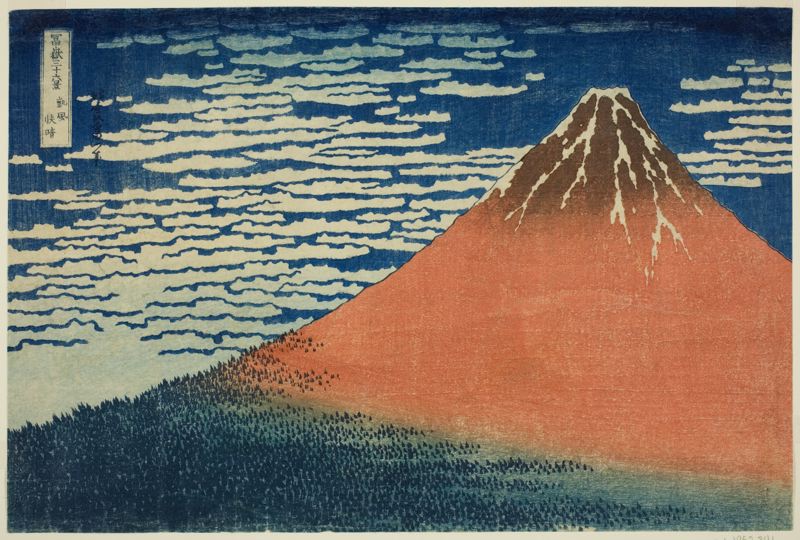
Hokusai's Thirty-six Views of Mount Fuji
No discussion of print series can begin anywhere other than Katsushika Hokusai's Thirty-six Views of Mount Fuji (Fugaku Sanjurokkei), published around 1830-1832 during the late Edo period. Hokusai was already in his seventies when he embarked on the project, and yet these prints represent the most inventive and technically ambitious work of his career.
The series includes the two most recognized images in all of Japanese art: "The Great Wave off Kanagawa" and "Fine Wind, Clear Morning" (commonly known as "Red Fuji"). But the set's genius lies in its relentless variety. Hokusai places Fuji behind barrel-makers at work, glimpsed through the rigging of fishing boats, reflected in the surface of a lake, framed by a hollow in a wave. The mountain is sometimes enormous and central, sometimes a tiny cone on the distant horizon. Every print asks the viewer to see the same subject from a radically different perspective.
Technically, the series introduced Prussian blue pigment to Japanese printmaking on a grand scale. This imported synthetic pigment offered an intensity and lightfastness that traditional plant-based indigos could not match. Hokusai exploited its depth for skies, water, and shadow, establishing a color palette that would influence Japanese prints for decades. The bokashi gradation in these skies — deep blue at the top dissolving into pale horizon — became a defining aesthetic of later landscape printmaking.
Collectors today prize the Thirty-six Views as the pinnacle of ukiyo-e landscape printing. Early impressions with vivid Prussian blue command extraordinary prices, while later printings are more accessible. Many collectors pursue individual sheets rather than attempting a complete set.
Hiroshige's Fifty-three Stations of the Tokaido
If Hokusai's Fuji series is about seeing one subject from every angle, Utagawa Hiroshige's Fifty-three Stations of the Tokaido (Tokaido Gojusan-tsugi, first published 1833-1834) is about experiencing many places through one artist's emotional lens. The Tokaido road connected Edo (modern Tokyo) with Kyoto, and its fifty-three post stations were a fixture of Japanese cultural life. Hiroshige traveled the route and translated his experiences into prints that capture not just geography but weather, mood, season, and the human comedy of the road.
What sets Hiroshige apart from his contemporaries is his sensitivity to atmosphere. The driving rain at Shono, the evening snow at Kanbara, the misty dawn at Mishima — these are prints that make you feel the weather on your skin. Hiroshige understood that a landscape is not just a physical arrangement of mountains, rivers, and trees; it is also the light falling across them, the precipitation softening their edges, the time of day coloring the sky. His bokashi work — the seamless gradation from dark sky to light horizon — remains among the most accomplished ever printed.
The Tokaido series was deeply connected to the culture of travel in Edo-period Japan. Pilgrimage, trade, and the mandatory processions of feudal lords meant that vast numbers of people had personal experience of these stations. Hiroshige's prints served simultaneously as fine art, souvenirs, and virtual travel guides. The Hoeido edition — named for the publisher — is the most celebrated version, prized by collectors for its strong color and sharp key-block lines.

Hiroshige's One Hundred Famous Views of Edo
Hiroshige's final masterpiece, One Hundred Famous Views of Edo (Meisho Edo Hyakkei, 1856-1858), is arguably the most visually daring series in all of Japanese printmaking. Published in the last years of Hiroshige's life during the closing days of the Edo period, these prints depict the city he loved through a cycle of seasons — spring, summer, autumn, winter — using compositions of astonishing boldness.
The series is famous for its use of extreme foreground framing. A wisteria trellis fills the top half of the image while the city stretches below. A cat perches on a windowsill in sharp close-up, gazing at the distant Asakusa rice paddies. Maple branches drape across the top of the composition like a curtain being pulled aside to reveal the scene beyond. This device — pushing a large element to the very edge of the picture plane — creates an almost photographic sense of depth and spontaneity. It profoundly influenced the French Impressionists, who discovered Japanese prints in the 1860s — a cultural phenomenon known as Japonisme. Vincent van Gogh famously painted copies of two designs from this series.
The seasonal organization gives the set a narrative rhythm absent from the Tokaido prints. Spring brings cherry blossoms along the Sumida River, summer offers fireworks and evening cool, autumn turns the maples red, and winter buries Edo under snow. For collectors, this seasonal structure makes it natural to pursue particular themes within the larger set. The nishiki-e color printing in the finest impressions is remarkably subtle, with delicate overprinting and sophisticated bokashi effects throughout.
Hasui's Souvenirs of Travel
Kawase Hasui is often called the greatest landscape printmaker of the twentieth century, and his "Souvenirs of Travel" (Tabi Miyage) series, published in three groups between 1919 and 1928, established his reputation. Working within the shin-hanga system under publisher Watanabe Shozaburo during the Taisho and early Showa eras, Hasui traveled extensively throughout Japan, sketching temples, lakes, mountain villages, and coastal scenes in every season and every kind of weather.
What distinguishes Hasui from the Edo-period masters is his treatment of light. Where Hiroshige conveyed atmosphere through weather effects and bokashi skies, Hasui built entire compositions around specific lighting conditions: the blue twilight after sunset, the warm glow of a lantern reflected in rain-wet streets, the flat gray light of a snowy overcast day. His snow scenes — Zojo Temple in snow, Shiobara in the snow — are masterpieces of restraint, using vast areas of white paper to convey the silence and weight of winter.
The Souvenirs of Travel prints were produced using the traditional collaborative woodblock printing method, with master carvers and printers translating Hasui's watercolor designs into prints of extraordinary refinement. Many of the original woodblocks were destroyed in the 1923 Great Kanto Earthquake and again in World War II bombings, making early impressions particularly scarce.
Yoshida's Mountain Landscapes
Hiroshi Yoshida occupies a unique position in the history of Japanese printmaking. Trained as a Western-style oil painter, Yoshida came to woodblock printing relatively late in his career and brought a painter's eye for light, color, and atmospheric perspective to the medium. His mountain landscapes — views of the Japanese Alps, the Himalayas, and peaks across Asia and America — are among the most technically accomplished prints ever produced.
Yoshida's approach differed from the traditional shin-hanga model. While he collaborated with skilled carvers and printers, he maintained far greater control over the printing process than most designers, experimenting with multiple color variations of the same composition. His "Sailing Boats" series exists in morning, afternoon, evening, and night versions, each printed from the same blocks but with completely different color schemes — demonstrating the extraordinary range of effects achievable through the baren printing technique during the Showa era.

Collecting Series Prints Today
For today's collectors, the great series offer both inspiration and practical challenges. A complete set of Hokusai's Thirty-six Views or Hiroshige's Hundred Famous Views would be extraordinary, but the rarity and cost of fine impressions make this an ambition for only the most dedicated collectors. Most focus on acquiring individual sheets that speak to them, building a personal selection across multiple series and artists.
When evaluating a series print, condition and impression quality matter enormously. An early impression, printed while the blocks were still sharp and the colors freshly mixed, will show crisp key-block lines, rich color saturation, and precise registration between color layers. Later impressions, pulled from worn blocks or re-carved replacements, may show thicker outlines, muddier colors, or slight misalignment. Learning to distinguish early from late impressions is one of the most important skills a collector can develop.
Whether you are drawn to Hokusai's compositional daring, Hiroshige's atmospheric poetry, Hasui's luminous stillness, or Yoshida's mountaineering grandeur, the great series remain the heart of Japanese printmaking. Each sheet is a self-contained artwork, but seen together they reveal the sustained creative vision that makes this tradition one of the richest in the history of art.
Related Articles
Reproductions of famous Japanese woodblock prints — Hokusai, Hiroshige, Hasui — circulate in every market, and even experienced collectors can be fooled. This step-by-step guide walks through how to tell a genuine original impression from a modern photolithographic reproduction, a late edition, or a posthumous reprint.
Shin-hanga — "new prints" — was the early-twentieth-century revival movement that produced Kawase Hasui's atmospheric landscapes, Hiroshi Yoshida's mountain prints, and Ito Shinsui's elegant beauties. This guide explains what shin-hanga is, the role of publisher Watanabe Shōzaburō, and how it differs from both classical ukiyo-e and its modernist rival, sōsaku-hanga.
Ukiyo-e — "pictures of the floating world" — is the woodblock-print tradition that produced Hokusai's Great Wave, Hiroshige's snowy stations, and Utamaro's elegant courtesans. This guide explains what ukiyo-e is, how it emerged, and how to start exploring its major artists, genres, and themes.
Start exploring Japanese woodblock prints