Beginner's Guide to Ukiyo-e: A Complete Introduction to Japan's Floating World Prints
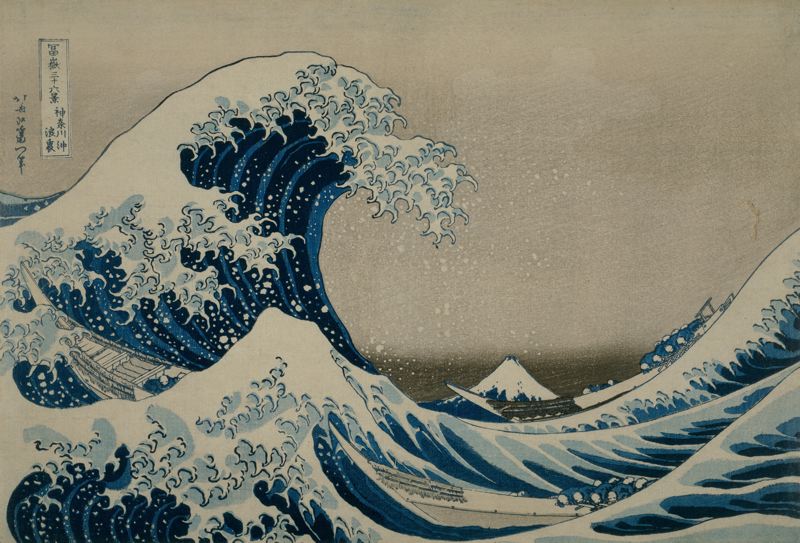
Ukiyo-e is the most recognizable visual tradition Japan ever produced, and almost every person reading this has already seen one of its prints. The Great Wave off Kanagawa — that towering blue curl about to engulf three boats while a small white-capped Mount Fuji watches from the horizon — is arguably the most reproduced image in art history, printed on T-shirts and tote bags and emoji keyboards. But "ukiyo-e" is far larger than one wave. It is a four-hundred-year tradition of urban culture, popular publishing, and astonishing technical refinement that gave the world some of its most beautiful prints — and seeded modern movements from French Impressionism to contemporary graphic design.
This guide is for anyone new to the field — a museum visitor wondering what they are looking at, a buyer trying to figure out where to start, or a student of Japanese art history beginning their reading list. By the end you will know what "ukiyo-e" actually means, how the prints were made and distributed, the major genres and the artists who defined them, and how to start exploring further on this site.
What Does "Ukiyo-e" Mean?
The word ukiyo-e is written with three characters: 浮 (uki, "floating") + 世 (yo, "world") + 絵 (e, "picture"). Literally, "pictures of the floating world." It is one of the most evocative phrases in art history, and it carries a quiet pun built into its origin.
In medieval Buddhist thought, the same syllables — *ukiyo* — were written with different characters meaning "this sorrowful world": the realm of impermanence, suffering, and worldly attachment that practitioners hoped to transcend. As Japan entered the long peace of the Edo period (1603–1868), a new merchant class in the city of Edo (modern Tokyo) flipped the term on its head. They kept the sound but swapped the first character, turning "the sorrowful world" into "the floating world." The new ukiyo was something to be embraced, not escaped: the transient pleasures of fashion, theater, courtesans, festivals, and travel.
Pictures *of* that world — ukiyo-e — were the visual record of urban Edo life. They were not aristocratic objects. They were affordable, mass-produced prints sold in shops to a literate, image-hungry middle class. A single print cost roughly the same as a bowl of noodles. People bought them as souvenirs, as decoration, as celebrity memorabilia of favorite kabuki actors, as travel posters before there were travel posters.
The Edo Period Setting
To understand ukiyo-e, you have to picture the city it came from. By 1700, Edo had more than a million residents, making it likely the largest city on earth. It was a peacetime capital under the Tokugawa shogunate, with samurai prohibited from fighting, a strict class hierarchy, and a wealthy commoner population (the *chōnin*) who could not legally rise socially but who could spend their money on entertainment.
Three urban institutions powered the demand for ukiyo-e:
- The Yoshiwara — Edo's licensed pleasure quarter, a walled district of teahouses, restaurants, and brothels that doubled as the city's fashion capital. The famous courtesans of the Yoshiwara set hairstyles and kimono trends; prints of them functioned as celebrity glamour shots, pin-ups, and style guides all at once.
- The kabuki theater — Spectacular, popular, and constantly evolving, with star actors whose names sold tickets. Prints of these actors in their signature roles — yakusha-e, "actor pictures" — were the playbills, posters, and souvenirs of an entire entertainment industry.
- Travel along the Tōkaidō — The great highway connecting Edo with the imperial capital Kyoto. Travel restrictions eased over the period, and prints of famous views, seasonal scenes, and the post stations of the road satisfied an enormous appetite for places people had been or wanted to see.
These three subjects — beautiful women, kabuki actors, and famous places — are the three pillars on which ukiyo-e rests.
How Ukiyo-e Prints Were Made
A ukiyo-e print is not a painting. It is a woodblock print (moku-hanga), produced by a team of specialists working in a publisher's workshop. The artist designed the image, a block carver translated the design onto cherry-wood blocks, and a printer pulled each impression by hand using water-based pigments, rice-paste binder, and a flat, circular hand tool called a baren.
The crucial breakthrough that made ukiyo-e a *color* art form happened in 1765. Before then, prints were monochrome sumi (black ink) images sometimes hand-tinted afterward. In 1765, a system of carved registration marks called kento made it possible to print multiple color blocks in precise alignment, layering pigment after pigment to create full-color images. The result was called nishiki-e — "brocade pictures" — and it revolutionized what the medium could do.
A complex nishiki-e by an artist like Kitagawa Utamaro might involve ten or fifteen carved blocks, each contributing a color layer. The colors soak into the surface of handmade washi paper, producing translucent, glowing effects impossible to achieve in oil-based Western printing. For a deeper look at materials and tools, see our complete guide to how Japanese woodblock prints are made.
The Three Pillars of Ukiyo-e
Bijin-ga: Pictures of Beautiful Women
Bijin-ga — literally "pictures of beautiful people," though in practice almost always women — was one of the founding genres. Bijin-ga images celebrate the fashion, posture, hair ornaments, and inner mood of idealized beauties: courtesans, geisha, teahouse waitresses, and ordinary women caught in private moments. The genre is at once portraiture, fashion plate, and study of feminine ideals.
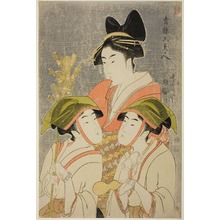
Suzuki Harunobu (1725–1770), the first great master of full-color nishiki-e, painted graceful young women in interior scenes — reading letters, dressing by a window, playing with cats. Kitagawa Utamaro (1753–1806) transformed bijin-ga by zooming in: close-up portraits revealing not just the figure but the psychology of a specific woman. Torii Kiyonaga (1752–1815) pushed in the opposite direction, depicting groups of tall, elegant women out walking in landscapes. Their styles defined how Japanese beauty would be pictured for the next two centuries.

Yakusha-e: Pictures of Actors
Yakusha-e — actor prints — were the entertainment-industrial complex of Edo on paper. When a popular actor took on a famous role, prints of the performance hit shops within days. A great actor portrait conveys not just likeness but the specific mie (frozen pose) at the climax of a scene, eyes crossed in fury, hands held in stylized rage.

Tōshūsai Sharaku is the great mystery of the genre. He appeared from nowhere in 1794, produced about 140 jagged, psychologically intense actor portraits over ten months, and vanished. No one knows who he really was. His portraits exaggerate every feature, scowls and squints rendered with cartoonish honesty — flattery had no place in his work, and contemporary viewers were divided between admiration and disgust. Today they are considered some of the most powerful portraits in any tradition.
The wider yakusha-e tradition was dominated by the Utagawa school, especially Utagawa Kunisada (1786–1865), the period's most commercially successful artist, who produced tens of thousands of designs over a fifty-year career.
Fūkei-ga: Pictures of Famous Places
Landscape prints came late to ukiyo-e — they are largely a nineteenth-century development — but when they arrived they transformed the field. Two artists carried the genre: Hokusai and Hiroshige.
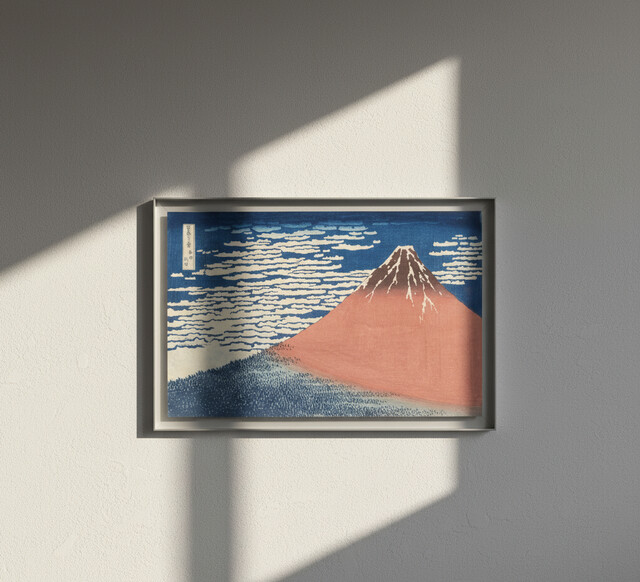
Katsushika Hokusai (1760–1849) was an obsessive who lived to eighty-nine and produced an estimated thirty thousand designs. His Thirty-six Views of Mount Fuji, published in the 1830s, treated the sacred mountain as a recurring character viewed from every angle, season, weather, and human activity. It is the series that contains the Great Wave — but also Red Fuji, a single mountain bathed in crimson dawn light, and dozens of other compositions that taught Western artists how landscape could be both decorative and emotionally serious at once.
Utagawa Hiroshige (1797–1858) was Hokusai's gentler counterpart. His landscapes are atmospheric, weather-haunted, and often empty of dramatic incident. He treated rain, snow, mist, and moonlight as protagonists. His two greatest series — the *Fifty-three Stations of the Tōkaidō* and *One Hundred Famous Views of Edo* — are among the most beloved sets of images in Japanese art.
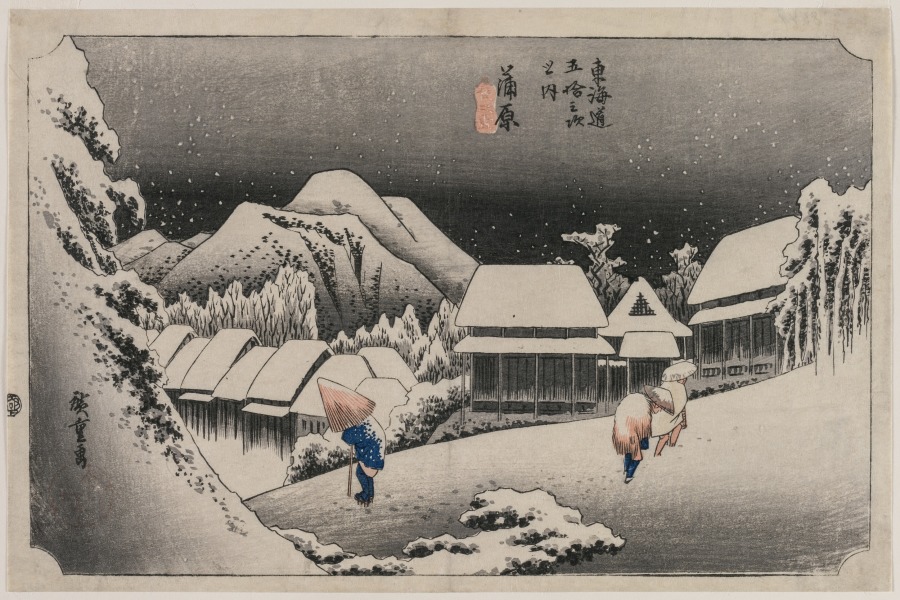
The print above — *Evening Snow at Kambara*, from the Tōkaidō series — shows three small figures struggling through deep snow at a remote post station. The technique called bokashi — wiping pigment off the block to create smooth gradations — produces the silent gray sky and the way snow seems to absorb sound from the scene. Bokashi is what gives Hiroshige's twilight skies and Hokusai's mountains their emotional weight.
Other Genres You Will Encounter
Beyond the three pillars, several other genres recur:
- [Musha-e](/glossary/musha-e) — warrior prints. Heroic samurai, legendary battles, swords drawn against demons. Utagawa Kuniyoshi (1798–1861) dominated the genre with violent, dynamic compositions drawn from history, the *Suikoden* romance, and Japanese folklore.
- [Kachō-e](/glossary/kacho-e) — bird-and-flower prints. Quiet, decorative compositions inherited from Chinese painting traditions, featuring birds, fish, insects, and seasonal flowers. Hokusai and Hiroshige both made memorable kachō-e.
- [Shunga](/glossary/shunga) — erotic prints. Surprisingly mainstream within ukiyo-e production: virtually every major artist made them, including Utamaro and Hokusai. They were tolerated by authorities and circulated openly.
- [Surimono](/glossary/surimono) — privately commissioned luxury prints, often containing poetry, made for poetry circles and New Year's greetings. Lavish use of metallic pigments, blind embossing (karazuri), and mica (kirazuri). Production values higher than anything in the commercial trade.
A useful late genre is rekishi-ga — history and legend prints — and within it the masterworks of Tsukioka Yoshitoshi (1839–1892), the last great ukiyo-e artist. Yoshitoshi worked through the violent end of the Edo period and the early Meiji era. His series *One Hundred Aspects of the Moon* — moonlit scenes from history, literature, and legend — is the swan song of the tradition.
Eight Artists to Start With
If you want a guided tour, start with these eight, listed in chronological order. Each links to their profile on this site with surviving artworks.
- [Suzuki Harunobu](/artists/suzuki-harunobu) (1725–1770) — The pioneer of full-color nishiki-e. Delicate, intimate scenes of women.
- [Torii Kiyonaga](/artists/torii-kiyonaga) (1752–1815) — Tall, elegant beauties in landscapes. Defined the late-eighteenth-century ideal.
- [Kitagawa Utamaro](/artists/kitagawa-utamaro) (1753–1806) — The greatest bijin-ga master. Psychological close-up portraits.
- [Tōshūsai Sharaku](/artists/toshusai-sharaku) (active 1794–95) — Mysterious actor-portraitist; only worked for ten months.
- [Katsushika Hokusai](/artists/katsushika-hokusai) (1760–1849) — Restless, lifelong experimenter. The Great Wave and Red Fuji.
- [Utagawa Hiroshige](/artists/utagawa-hiroshige) (1797–1858) — Atmospheric landscape master. Snow, rain, and twilight.
- [Utagawa Kuniyoshi](/artists/utagawa-kuniyoshi) (1798–1861) — Warriors, monsters, and dynamic figure compositions.
- [Tsukioka Yoshitoshi](/artists/tsukioka-yoshitoshi) (1839–1892) — The last great ukiyo-e artist; history and the moon.
Print Sizes You Will See in Catalogues
Ukiyo-e prints came in standard sheet sizes determined by the way handmade washi was cut. Knowing them helps when reading museum labels and auction listings.
| Format | Approximate size | Notes |
|---|---|---|
| Ōban | 39 × 26 cm (15 × 10 in) | The dominant standard format. Hokusai's Fuji series, most of Hiroshige's landscapes. |
| Chūban | 28 × 21 cm (11 × 8 in) | A common smaller format. Harunobu's bijin-ga were often chūban. |
| Koban | 23 × 18 cm (9 × 7 in) | Smaller still, often used for book illustration. |
| Hashira-e | 73 × 12 cm (29 × 5 in) | Tall, narrow "pillar prints" hung on wooden pillars in interiors. |
| Surimono | Various, often square ~20 cm | Luxury privately commissioned format. |
Browse the complete glossary of print formats for less common sizes (aiban, hosoban, kakemono-e, shikishiban).
Ukiyo-e vs. Shin-hanga vs. Sōsaku-hanga
You will frequently see two later movements compared with ukiyo-e:
- [Shin-hanga](/movements/shin-hanga) (literally "new prints") — A revival movement starting around 1915, led by publisher Watanabe Shōzaburō, that preserved the traditional collaboration of artist, carver, and printer but updated the imagery for the twentieth century. Kawase Hasui and Hiroshi Yoshida are its central figures.
- [Sōsaku-hanga](/movements/sosaku-hanga) (literally "creative prints") — A parallel modernist movement starting around 1905 in which a single artist conceived, carved, and printed their own work, with no division of labor. More individual, more experimental, often more abstract.
If shin-hanga is ukiyo-e's twentieth-century continuation, sōsaku-hanga is its revolution. We've written a more detailed comparison: Shin-hanga vs. Sōsaku-hanga.
How to Explore Ukiyo-e on This Site
A few practical starting points:
- The ukiyo-e movement page collects every artist and artwork on the site associated with the tradition.
- The Mount Fuji subject page shows prints of Japan's most-depicted mountain.
- The bijin-ga subject page collects beauty prints across artists.
- The snow scenes subject page gathers the genre Hiroshige defined.
- The kabuki subject page covers actor prints and theater scenes.
- The warriors subject page for Kuniyoshi and the musha-e tradition.
Once you find an artist whose work you love, the artist's profile page links every artwork on the site by them, plus related artists in the same movement. The browse all artists page is a good place to wander.
Frequently Asked Questions
What is the difference between ukiyo-e and Japanese woodblock prints in general?
Ukiyo-e is the *historical tradition* of woodblock prints produced in Japan during the Edo period (roughly 1660–1868), depicting the urban "floating world." Japanese woodblock printing as a *technique* extends from earlier Buddhist texts through ukiyo-e into the twentieth-century shin-hanga and sōsaku-hanga movements and continues today as contemporary mokuhanga. All ukiyo-e is woodblock printed, but not all Japanese woodblock prints are ukiyo-e.
Are ukiyo-e prints originals or reproductions?
Each impression from an original carved block is considered an "original print" in the field — there is no single "original" the way there is for a painting. A first-edition ōban print pulled in the artist's lifetime from the original blocks is the most valued state. Later impressions from the same blocks (early Meiji, late Meiji, twentieth-century reprints) progressively decline in value, and modern photo-mechanical reproductions are not considered originals. See our guide on identifying original vs. reproduction prints.
Why does the Great Wave look modern even though it's nearly 200 years old?
Hokusai borrowed Prussian blue — a synthetic European pigment — when it became newly available in Japan around 1830, and built the entire *Thirty-six Views of Mount Fuji* around it. The deep blue saturation and flat-graphic composition feel "modern" partly because they directly influenced the French Impressionists (Monet, Degas, Van Gogh) and through them most of what we recognize as twentieth-century graphic design. Hokusai's wave was inventing the visual language we now think of as modern.
How much does a real ukiyo-e print cost?
It ranges enormously. A common nineteenth-century Hiroshige in average condition can cost a few hundred dollars; a fine early impression of a famous design might be thousands. Sharaku, top Utamaro, and rare Hokusai compositions can reach five and six figures at auction. A practical entry point is mid-quality Hiroshige or Yoshitoshi impressions, where you can still buy something genuine and beautiful for under $500. Read our guide to starting a collection for a complete buyer's introduction.
What is the difference between ukiyo-e and "Japonisme"?
Ukiyo-e is the Japanese tradition itself. Japonisme is the nineteenth-century European craze for Japanese visual culture — the way ukiyo-e prints influenced Manet, Whistler, Degas, Van Gogh, Toulouse-Lautrec, and Art Nouveau. The flat colors, asymmetric compositions, and cropped framing of Impressionist and Post-Impressionist painting all owe a debt to ukiyo-e.
Which ukiyo-e prints are the most famous?
Three single images dominate the popular imagination: Hokusai's Great Wave, Hokusai's Red Fuji, and Hiroshige's *Sudden Shower over Shin-Ōhashi Bridge and Atake*. Beyond these, Utamaro's beauties, Sharaku's actor portraits, and Yoshitoshi's *One Hundred Aspects of the Moon* are the most-collected and most-exhibited.
What to Read Next
If this guide has hooked you, two natural next reads:
- How Japanese Woodblock Prints Are Made — the materials, tools, and step-by-step process behind every ukiyo-e print.
- Hokusai's Great Wave: History and Meaning — a deep dive into the single most famous print of the tradition.
- How to Start Collecting Japanese Woodblock Prints — practical guidance for buying real prints.
Or just start browsing artworks — the fastest way to develop your eye is to look at thousands of impressions and notice what holds your attention.
Related Articles
Shin-hanga — "new prints" — was the early-twentieth-century revival movement that produced Kawase Hasui's atmospheric landscapes, Hiroshi Yoshida's mountain prints, and Ito Shinsui's elegant beauties. This guide explains what shin-hanga is, the role of publisher Watanabe Shōzaburō, and how it differs from both classical ukiyo-e and its modernist rival, sōsaku-hanga.
Reproductions of famous Japanese woodblock prints — Hokusai, Hiroshige, Hasui — circulate in every market, and even experienced collectors can be fooled. This step-by-step guide walks through how to tell a genuine original impression from a modern photolithographic reproduction, a late edition, or a posthumous reprint.
Every Japanese woodblock print carries a constellation of marks — artist signatures, publisher seals, censor stamps, and sometimes carver and printer credits — that together form a detailed record of who made the print, when it was published, and under what authority. Learning to read these marks is one of the most rewarding skills a collector can develop.
Start exploring Japanese woodblock prints