What Is Shin-hanga? A Complete Guide to Japan's "New Prints" Movement
Walk into any specialist Japanese print dealer in 2026 and a particular type of image will dominate the walls: a quiet twilight street in soft snow, a moonlit shrine reflected in still water, a temple silhouetted against an evening sky. These are shin-hanga — "new prints" — the twentieth-century revival movement that produced what most collectors consider the most technically refined woodblock prints ever made.

If you have looked at one Japanese print in the last twenty years and felt your shoulders drop, there is a strong chance it was a shin-hanga. The movement's atmosphere — restrained, lyrical, melancholic — has aged remarkably well. This guide walks through what shin-hanga is, when and why it emerged, the artists who defined it, and how to start collecting or simply appreciating it.
What Does "Shin-hanga" Mean?
The word shin-hanga is built from two roots: 新 (shin, "new") + 版画 (hanga, "print"). Literally, "new prints." It was a deliberate, almost programmatic name, coined in the 1910s to distinguish the new work from the long shadow of classical ukiyo-e and from the cheap, declining commercial prints of the late Meiji period.
The "new" in shin-hanga refers to several things at once:
- New subjects that captured a Japan undergoing rapid modernization: electric lights, telegraph poles, train stations, Western-style buildings appearing in traditional landscape compositions.
- New techniques borrowed from Western painting: atmospheric perspective, modeling with light and shadow, naturalistic color, mood and weather as primary subjects.
- New collaborations between Japanese artists and the publisher-led workshop tradition, often produced specifically for the Western export market.
- A self-conscious sense of revival — the movement's leaders explicitly framed shin-hanga as the rescue of a dying craft tradition.
Shin-hanga was not a coherent academic style. It was a publisher-led commercial movement built around a few central workshops, and the unifying aesthetic emerged from the production system itself.
The Edo Tradition That Shin-hanga Saved
By 1900, Japanese woodblock printmaking was nearly extinct as a fine-art tradition. Two forces had pushed it to the edge.
The first was photolithography, which after 1880 displaced traditional moku-hanga for newspaper illustration, advertising, and book printing — the commercial uses that had sustained the trade. The second was the Meiji elite's pivot to Western art forms (oil painting, etching, lithography), which left the old ukiyo-e infrastructure of carvers, printers, and publishers without commissions.
By 1910 there were perhaps fewer than a dozen master block carvers and printers still working in Tokyo. The whole apparatus that had produced Hokusai and Hiroshige — the hanmoto publisher who financed and coordinated work, the horishi carvers who cut blocks, the surishi printers who pulled impressions — was within a generation of disappearing entirely.
Two interventions saved it. The first was the Yoshida workshop, which we will come to. The second, and more historically significant, was the work of one man: the publisher Watanabe Shōzaburō.
Watanabe Shōzaburō: The Publisher Who Defined Shin-hanga
Watanabe Shōzaburō (1885–1962) is the indispensable figure in shin-hanga. He was not an artist but a publisher with an unusually clear strategic vision. Working from a small shop in Tokyo's Kyobashi district, he singlehandedly reorganized the dying craft tradition around a new business model aimed at Western collectors and curators.
Watanabe's insight was three-fold:
- Western markets would pay premium prices for authentic Japanese fine-art prints, especially if they updated the imagery beyond traditional subjects.
- The traditional collaboration system — designer, carver, printer, publisher — produced higher quality than any single-artist process, because each step was done by a master specialist.
- The post-1910 Japanese commercial print trade had collapsed enough that he could hire any remaining master craftsman at sustainable wages.
Watanabe recruited artists, paired them with the best surviving carvers and printers, and personally controlled quality, edition sizes, and distribution. He coined the term "shin-hanga" around 1915 and applied it to a series of new artist-publisher collaborations beginning with prints by Goyō, Shinsui, Shōtei, and Hashiguchi.
His most consequential signing was Kawase Hasui, who joined Watanabe in 1918 and would produce roughly six hundred designs over the next forty years — every one of them in the Watanabe workshop system.
The Four Main Subjects of Shin-hanga
Shin-hanga settled into four main subject areas, all of which can be traced back to ukiyo-e precedents but with twentieth-century treatment.
Landscapes (Fūkei-ga)
Landscapes are the genre most people associate with shin-hanga, and they are dominated by Hasui and Yoshida. The two artists differ in temperament: Hasui composed introspective Japanese travel scenes — temples in snow, twilight streets, harbor sunsets — while Hiroshi Yoshida (1876–1950) traveled widely abroad (the Alps, India, the American Rockies) and combined Western painterly atmosphere with Japanese craft.

The print above is Yoshida's *Sailing Boats: Night*, one design from his *Seto Inland Sea* series in which he printed the same composition from the same blocks but in multiple different time-of-day color schemes (morning, noon, afternoon, evening, night). The series is a masterpiece of bokashi gradation printing — the entire emotional content shifts with only the color of light and water.
Major landscape shin-hanga artists beyond Hasui and Yoshida include Tsuchiya Kōitsu, Shirō Kasamatsu, and Takahashi Shōtei. Yoshida's son Toshi Yoshida carried the workshop into the postwar era and added bold modernist treatments to landscapes through the 1970s.
Bijin-ga: Beauty Prints
The shin-hanga version of bijin-ga updates the genre with naturalism and psychological depth, treating the figure with the same atmospheric care as a landscape.

Hashiguchi Goyō (1880–1921) was the great bijin-ga draftsman of the movement and worked outside the Watanabe workshop, publishing his own designs in tiny editions. He died at forty-one with only fourteen prints to his name; every one is now a major collecting target. Itō Shinsui (1898–1972) produced a longer, more prolific body of beauty prints under Watanabe and continued working into the postwar period. Torii Kotondo (1900–1976) made small numbers of intensely atmospheric beauties — his *Asanegami* ("Morning Hair") was deemed scandalous in 1933 for its frank intimacy.

Kachō-e: Birds and Flowers
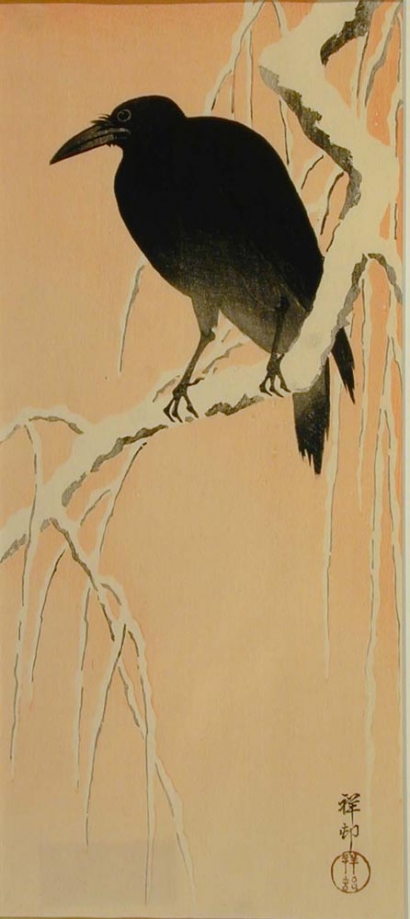
The bird-and-flower genre, kachō-e, was practically reinvented by one artist: Ohara Koson (1877–1945), who worked under two artist names (Koson, then Shōson) and produced hundreds of designs of birds, fish, and insects. His silent compositions — a single crow on a snow-laden branch, a heron stalking through reeds — are among the most-collected of all shin-hanga.
Yakusha-e: Actor Prints
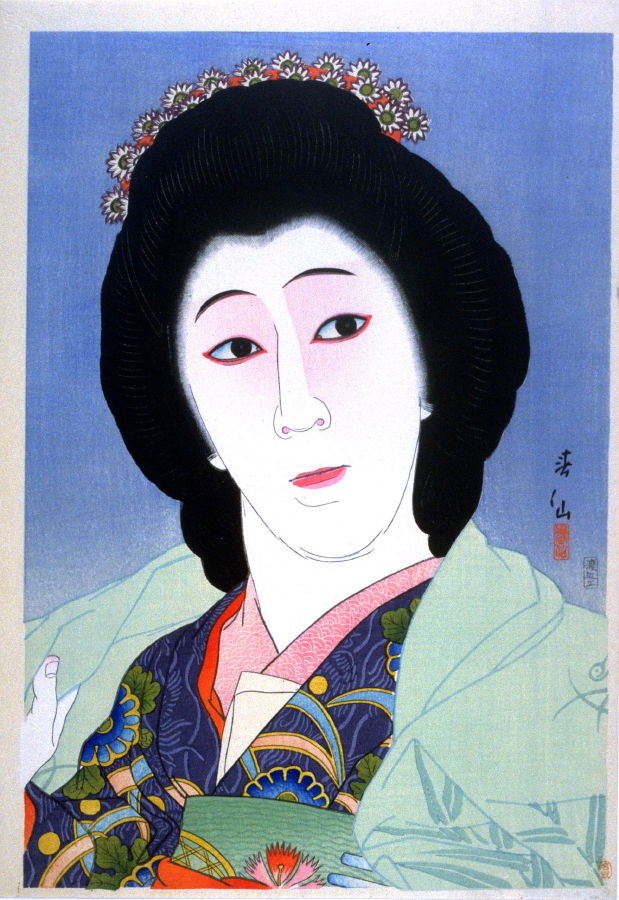
The actor portrait, classical ukiyo-e's most commercial genre, was extended into shin-hanga by Natori Shunsen (1886–1960), whose actor portraits of kabuki stars of the 1920s and 30s combine close-up psychological observation with traditional theater convention.
A few non-Japanese artists worked within or alongside the shin-hanga system. Elizabeth Keith (Scottish, 1887–1956) and Paul Jacoulet (French, 1896–1960) both spent decades in Asia and produced bodies of work made by Japanese carvers and printers using shin-hanga techniques — an interesting hybrid the movement was always large enough to absorb.
The Yoshida Workshop: Outside the Watanabe System
Hiroshi Yoshida deserves a separate note because he is the great exception to Watanabe's dominance. Yoshida had trained as a Western-style oil painter before turning to printmaking late in his career. After working briefly with Watanabe, he set up his own workshop in 1925, hiring his own carvers and printers and self-publishing every print he designed thereafter. He kept the traditional collaboration model — designer, carver, printer — but cut out the publisher.
The Yoshida workshop produced some of the most technically ambitious prints of the period: Hiroshi's *Twelve Scenes of the Inland Sea* (the multi-time-of-day series), his European travel prints, and his Indian and Egyptian prints. The workshop continued under his son Toshi after 1950 and the Yoshida family carved out an independent shin-hanga lineage that ran parallel to Watanabe's into the 1980s.

Shin-hanga vs. Sōsaku-hanga: The Other Movement
While shin-hanga was reviving the publisher-led collaboration, a rival movement called sōsaku-hanga — "creative prints" — was developing in parallel with the opposite philosophy.
Sōsaku-hanga insisted that the artist must do everything alone: design, carve, and print. The block carver and printer specialists were rejected on principle. The movement was self-consciously modernist, more politically radical, often more abstract, and aligned with the European avant-garde.
If shin-hanga prized technical perfection and atmospheric beauty, sōsaku-hanga prized artistic singularity and direct expression. The two movements existed in the same Tokyo galleries during the 1920s and 30s, mostly ignoring each other.
The collector's shorthand:
| Shin-hanga | Sōsaku-hanga | |
|---|---|---|
| Production | Artist designs; specialist carver and printer execute | Single artist designs, carves, and prints |
| Aesthetic | Atmospheric, lyrical, technically refined | Direct, expressive, often abstract |
| Market | Created largely for Western export | Created for Japanese avant-garde audience |
| Edition size | Often large (300–1000+ impressions) | Often small (10–50 impressions) |
| Central figures | Watanabe Shōzaburō (publisher), Hasui, Yoshida, Shinsui | Onchi Kōshirō, Munakata Shikō, Hiratsuka Un'ichi, Saitō Kiyoshi |
We've written a full side-by-side: Shin-hanga vs. Sōsaku-hanga.
When Did Shin-hanga End?
There is no clean end date. The movement's commercial peak ran from roughly 1915 to the late 1930s. The Pacific War interrupted production, and Watanabe's workshop was destroyed in the 1945 Tokyo firebombings, including the original blocks for many Hasui designs.
Watanabe rebuilt after the war, and Hasui, Shinsui, Kasamatsu, and Toshi Yoshida continued producing into the 1950s and 60s. Hasui died in 1957, after being named a Living National Treasure. By 1970 the last of the original shin-hanga generation was gone, and what continues today as Watanabe-published work uses recarved blocks and is more accurately called posthumous editions.
A useful periodization:
- 1915–1923 — Early shin-hanga: Watanabe's first collaborations with Goyō, Shōtei, Shinsui, and Hasui.
- 1923–1945 — Mature shin-hanga: the Great Kantō Earthquake destroys early stock; Watanabe rebuilds, Hasui and Yoshida hit their stride.
- 1945–1957 — Postwar continuation: rebuilding under Allied occupation, Western buyers (including the Imperial Hotel gift shop trade) sustain demand.
- 1957–1970 — Twilight: Hasui's death, gradual loss of master craftsmen, transition to estate editions.
How Many Shin-hanga Prints Are There?
The total number of shin-hanga designs is finite and well-documented. Estimates from auction catalogues and dealer reference books:
- Hasui: roughly 620 designs over a forty-year career
- Hiroshi Yoshida: roughly 260 designs
- Itō Shinsui: roughly 200 designs
- Ohara Koson/Shōson: roughly 500 designs across both names
- Tsuchiya Kōitsu: roughly 200 designs
- Hashiguchi Goyō: 14 designs (his entire output)
This is a *small* finite tradition compared with Edo-period ukiyo-e, which produced tens of thousands of designs. The combination of small total output, popular subject matter, and growing recognition is why shin-hanga has appreciated steadily over the last twenty years.
What to Buy First
If you are starting a shin-hanga collection, three practical paths:
- Begin with mid-edition Hasui or Shinsui — these artists made hundreds of designs in large editions, so authentic original impressions remain affordable ($300–$2,000) in good condition. They give you the canonical shin-hanga look at sustainable prices.
- Hunt for Ohara Koson — his bird-and-flower designs are still relatively under-collected outside specialist circles, and beautiful examples turn up under $500 regularly.
- Identify edition state carefully — Hasui's blocks were used through multiple editions; first editions printed during his lifetime carry full color saturation and the Watanabe seal of the period. Later "estate" or "recut" impressions are common and less valuable. See our guide on identifying Hiroshige print editions — the same edition-state reasoning applies to Hasui and other shin-hanga artists.
For a complete buyer's introduction read How to Start Collecting Japanese Woodblock Prints.
Frequently Asked Questions
What is the difference between shin-hanga and ukiyo-e?
Ukiyo-e is the historical tradition of Edo-period (c. 1660–1868) prints depicting the "floating world" of urban Edo life — kabuki actors, courtesans, famous places, history scenes. Shin-hanga is a twentieth-century revival movement (c. 1915–1960) that used the same woodblock technique and the same publisher-led production system, but updated the imagery for the modern era and aimed primarily at Western collectors. Both are produced by carved cherry-wood blocks pulled by hand on washi paper. The visual difference is largely one of atmosphere: shin-hanga uses Western-style atmospheric perspective, modeling with light and shadow, and emotional landscape composition where Edo ukiyo-e used flatter, more graphic compositions. For a longer introduction to the classical tradition, read the Beginner's Guide to Ukiyo-e.
Are shin-hanga prints originals?
Yes. Like ukiyo-e, every impression pulled from the original carved blocks during the lifetime of the artist (or by the original Watanabe workshop) is considered an original print. Modern reprints and posthumous editions are not. The challenge is that some Watanabe-published designs have been re-printed in multiple editions over many decades, including after the original blocks were destroyed and recarved. See Original vs. Reproduction Japanese Prints for how to read edition marks, seals, and paper to distinguish lifetime impressions from later editions.
How can I tell a Hasui from a reproduction?
Authentic Watanabe-published Hasui prints carry one of several version of the Watanabe seal (the publisher's mark) on the back or in the margin, plus Hasui's signature and seal in the image. The seal style changed across periods, which is the main tool for dating an impression. Color saturation, the depth of bokashi gradations, and the texture of the washi paper also vary across editions — first editions are crisper, deeper, and softer-papered than later ones. Reproductions are mechanically printed and lack the carved-block surface texture; under raking light a real print shows the slight relief of karazuri blind-printing where used.
How much do shin-hanga prints cost?
Wide range. The floor for an authentic minor Hasui in fair condition is roughly $200; a fine first-edition impression of a major design (a snow scene, a famous temple) runs $1,500–$5,000. Hashiguchi Goyō's fourteen designs trade at $10,000–$80,000 at top auction houses. Mid-tier shin-hanga (Tsuchiya Kōitsu, Shirō Kasamatsu, Takahashi Shōtei) is generally available in the $200–$800 range. Foreign artists like Paul Jacoulet are typically $500–$3,000. Visit the marketplace page for current listings.
Is shin-hanga still being made today?
The original Watanabe workshop still operates, run by Watanabe Shōzaburō's descendants, and produces new editions from recarved blocks of vintage Hasui and other shin-hanga designs. These are honest re-printings, but they are not the same thing as a lifetime impression and are priced accordingly. The closest living equivalent of shin-hanga is the contemporary mokuhanga movement — artists like David Bull explicitly producing new work in the shin-hanga tradition using identical techniques.
Why did shin-hanga aim at Western buyers?
Two reasons. First, the domestic Japanese fine-art market in the 1910s had pivoted to Western-style oil painting, etching, and lithography; traditional woodblock prints were seen by Japanese collectors as outdated. Second, Western collectors and curators — energized by the late-nineteenth-century Japonisme movement — were eager for authentic Japanese fine-art prints and had real disposable income, especially Americans in the 1910s–30s. Watanabe explicitly built his business around the Imperial Hotel gift shop, American department stores carrying Japanese goods, and direct sales to European dealers and museums.
What to Read Next
- Beginner's Guide to Ukiyo-e — the classical tradition that shin-hanga consciously revived.
- Shin-hanga vs. Sōsaku-hanga — full comparison with the parallel modernist movement.
- How Japanese Woodblock Prints Are Made — the carver, printer, and publisher system that shin-hanga inherited.
- Famous Japanese Print Series — including Hasui's *Twenty Views of Tokyo* and Yoshida's *Inland Sea*.
Or jump straight into browsing: the shin-hanga movement page collects every artist and artwork in the tradition on this site.
Related Articles
Ukiyo-e — "pictures of the floating world" — is the woodblock-print tradition that produced Hokusai's Great Wave, Hiroshige's snowy stations, and Utamaro's elegant courtesans. This guide explains what ukiyo-e is, how it emerged, and how to start exploring its major artists, genres, and themes.
Hiroshi Yoshida and Kawase Hasui are the two most-collected shin-hanga landscape artists, and new collectors often ask which they should focus on first. This side-by-side comparison covers their biographies, styles, production methods, subject matter, current market prices, and which artist suits which collector.
Reproductions of famous Japanese woodblock prints — Hokusai, Hiroshige, Hasui — circulate in every market, and even experienced collectors can be fooled. This step-by-step guide walks through how to tell a genuine original impression from a modern photolithographic reproduction, a late edition, or a posthumous reprint.
Start exploring Japanese woodblock prints