Biography
Katsukawa Shun'ei (1762-1819) was one of the most important Japanese woodblock print artists of the late eighteenth and early nineteenth centuries, a leading figure of the Katsukawa school whose Edo yakusha-e (kabuki actor prints) and sumo prints helped define the visual culture of the Kansei and Bunka eras. Born in 1762, he entered the studio of Katsukawa Shunshō, the founder of the Katsukawa school and the artist most responsible for transforming actor prints from generalized type portraits into recognizable individual likenesses. Under Shunshō's direction during the 1770s, Shun'ei absorbed the school's commitment to nigao-e, or true-likeness portraiture, which captured the distinctive facial features, postures, and stage presences of specific kabuki performers rather than relying on stock conventions. By the early 1780s, when he was barely twenty, Shun'ei had begun signing his own designs and was already producing hosoban-format actor prints of remarkable sophistication.
The Katsukawa school dominated kabuki actor prints in Edo from the late 1760s through the 1790s, and Shun'ei emerged as the artist who carried that dominance into a new generation. While Shunshō remained the school's elder authority until his death in 1792, Shun'ei increasingly shouldered the workload of designing prints for the leading Edo kabuki theaters — among them the Nakamura, Ichimura, Kiri, and Kawarazaki — that staged the seasonal kabuki productions on which the print market depended. The chronology preserved in major museum collections shows Shun'ei working at extraordinary pace during the late 1780s and 1790s, producing hosoban-format single sheets and multi-sheet compositions tied to specific theatrical productions, often dated to particular months and theaters. His prints from this period document a vivid roster of celebrated performers: Ichikawa Danjurō V, Iwai Hanshirō IV, Segawa Kikunojō III, Matsumoto Kōshirō IV, Ichikawa Komazō II and III, Otani Oniji III, Onoe Matsusuke I, Nakamura Kumetarō II, and Nakayama Tomisaburō I — the leading lights of late-eighteenth-century Edo kabuki.
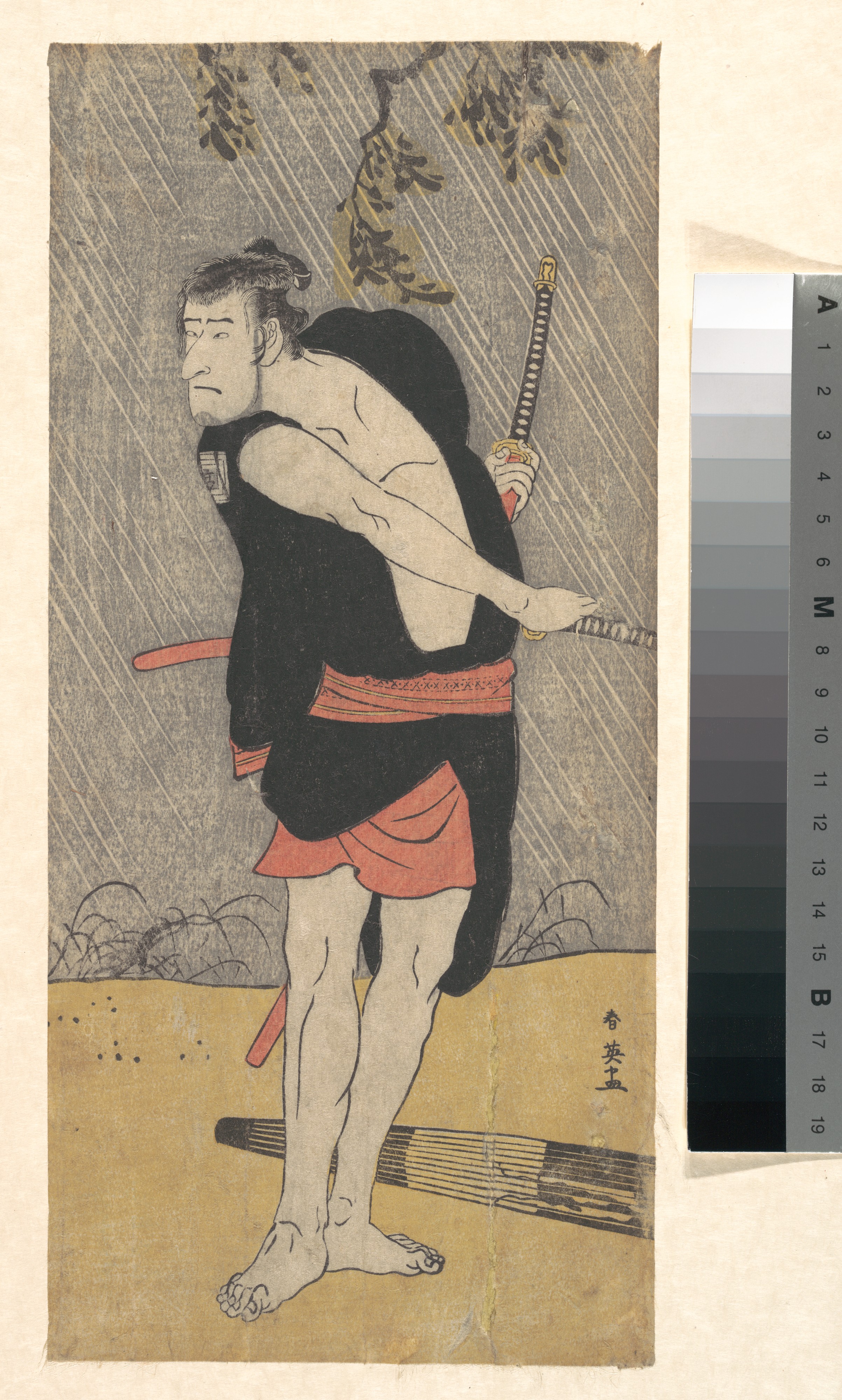
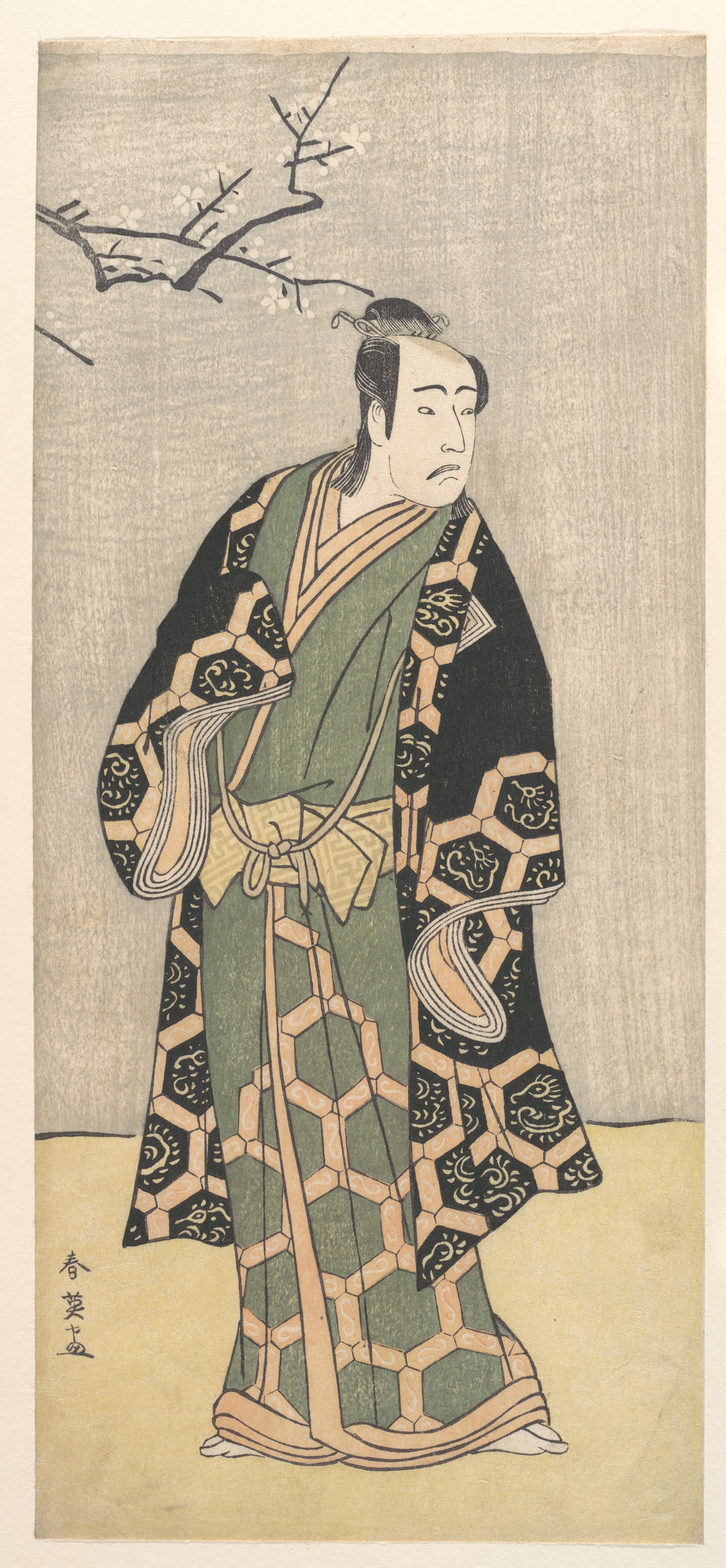
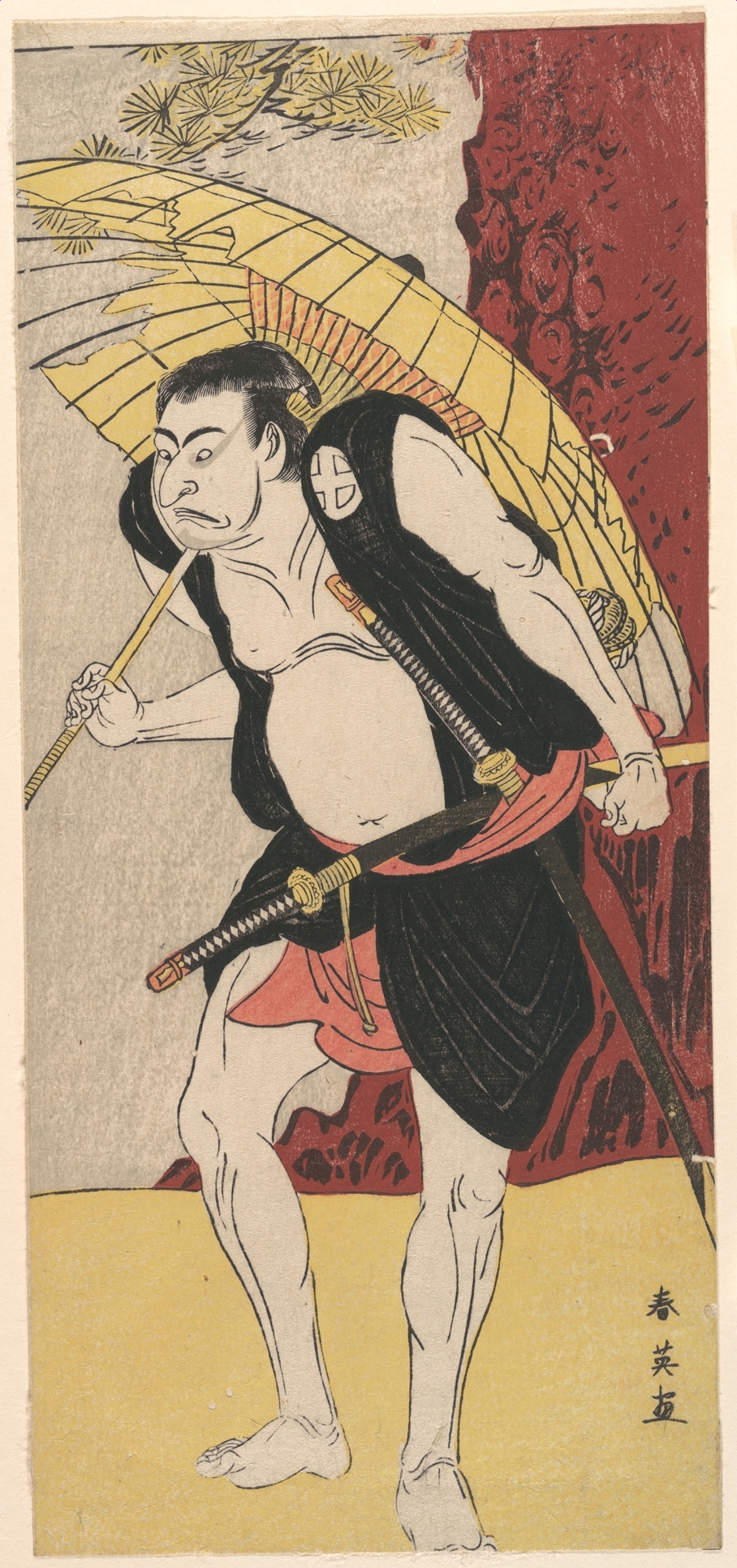
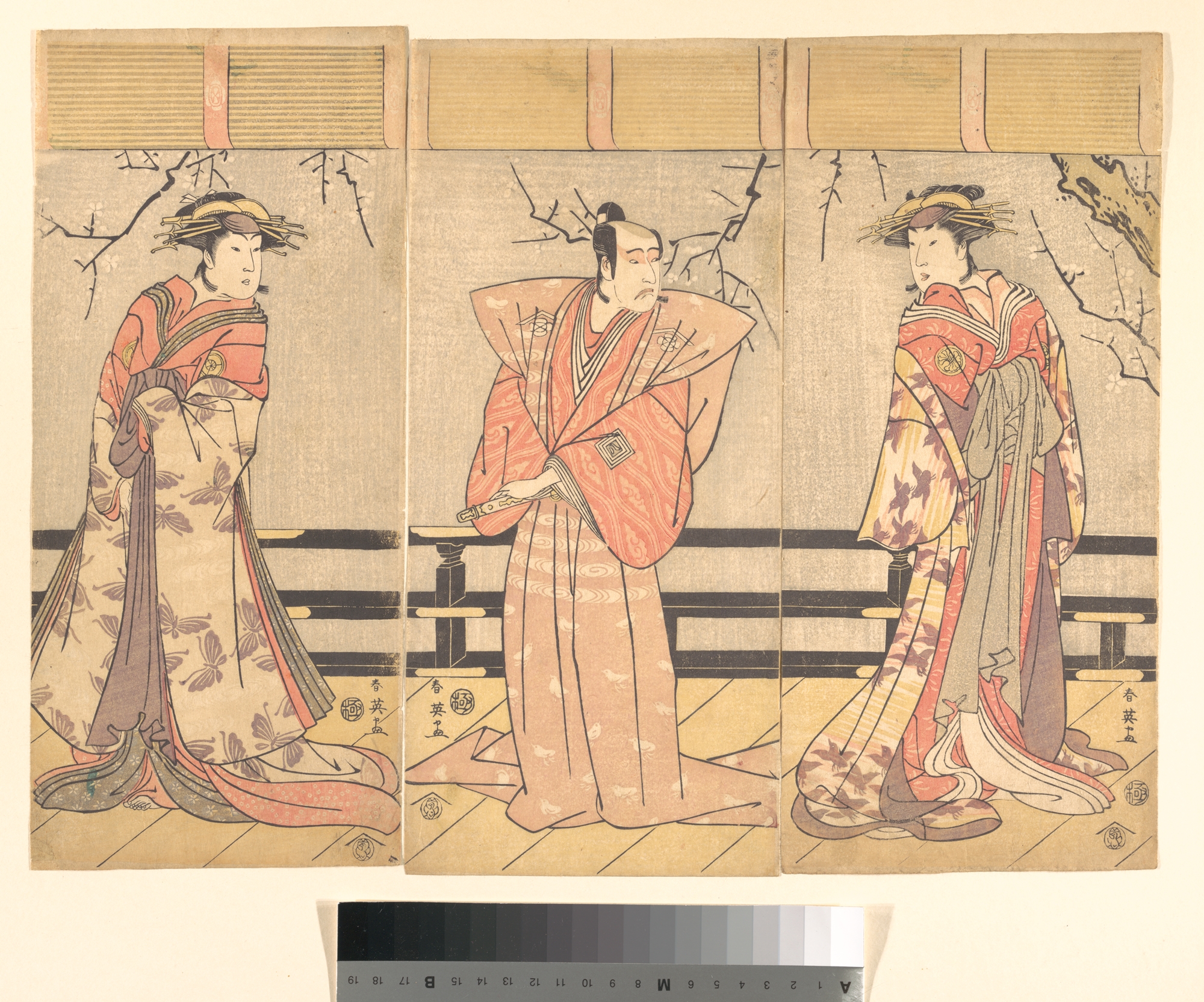
Shun'ei's stylistic contribution to the Katsukawa tradition lay in a tightening of psychological observation. Where Shunshō's actor portraits often retained a certain serene formality, Shun'ei pushed toward sharper individualization, exaggerating asymmetries, jaw lines, and characteristic eye shapes to make each face unmistakable. His figures occupy hosoban sheets with confident, often dynamic poses drawn from specific moments in performance: a Soga brother brandishing a weapon, a wagoto lover in tender introspection, a shibaraku hero in tomb-stone stillness, a fox-spirit caught mid-transformation. The Art Institute of Chicago, the Museum of Fine Arts Boston, the British Museum, and the Tokyo National Museum all hold significant holdings of these prints, many of them documenting productions performed at the Ichimura, Nakamura, Kiri, and Kawarazaki theaters between 1786 and 1791 — a period when Shun'ei's output stood at the front rank of Edo yakusha-e alongside the work of his Utagawa-school rivals.
When Tōshūsai Sharaku's famously bold and short-lived series of actor prints appeared in 1794-1795, scholars have noted the parallels between Sharaku's psychological intensity and the observational portraiture Shun'ei had already developed during the previous decade. Where Sharaku worked for only ten months under the publisher Tsutaya Jūzaburō, Shun'ei sustained his portraiture across decades, providing one of the essential bridges between the founding generation of the Katsukawa school and the new Utagawa-dominated nineteenth-century actor print. He also designed a small number of surimono — privately commissioned, deluxe woodblock prints — and a series of distinctive sumo prints depicting individual wrestlers, which the Art Institute of Chicago and other collections preserve and which document the surge in sumo's popularity during the Kansei era (1789-1801), contributing to the iconography of professional wrestlers that later artists would extend throughout the nineteenth century.
By around 1800 Shun'ei had succeeded Shunshō as head of the Katsukawa school, and in that role he trained the next generation of pupils — most prominently Katsukawa Shuntei and Katsukawa Shunsen — who carried Katsukawa subjects forward into the early nineteenth century. He worked productively into the Bunka era (1804-1818), continuing to design actor portraits and musha-e (warrior prints), his later work showing a more relaxed line and, at times, a more painterly composition.
Shun'ei died in 1819, just before the great late-Edo masters of the Utagawa school, Kunisada and Kuniyoshi, would transform the actor and warrior print yet again. By that point, however, the conventions of psychological portraiture, theater-specific documentation, and stylistic individualization that he and his Katsukawa colleagues had refined had become the inherited language of Japanese woodblock kabuki imagery. For collectors and scholars of Edo yakusha-e today, Shun'ei occupies a central position: the artist whose hosoban prints from the late 1780s and 1790s offer the most thorough surviving visual record of late-eighteenth-century kabuki, and whose contribution to the Katsukawa school carried its tradition through one of the most stylistically inventive periods in the history of ukiyo-e.
Key Facts
- Active Period
- 1762–1819
- Nationality
- 🇯🇵Japan
- Movement
- Ukiyo-e
- Works Indexed
- 85
Frequently Asked Questions
Katsukawa Shun'ei (1762-1819) was one of the most important Japanese woodblock print artists of the late eighteenth and early nineteenth centuries, a leading figure of the Katsukawa school whose Edo yakusha-e (kabuki actor prints) and sumo prints helped define the visual culture of the Kansei and Bunka eras. Born in 1762, he entered the studio of Katsukawa Shunshō, the founder of the Katsukawa school and the artist most responsible for transforming actor prints from generalized type portraits into recognizable individual likenesses. Under Shunshō's direction during the 1770s, Shun'ei absorbed the school's commitment to nigao-e, or true-likeness portraiture, which captured the distinctive facial features, postures, and stage presences of specific kabuki performers rather than relying on stock conventions. By the early 1780s, when he was barely twenty, Shun'ei had begun signing his own designs and was already producing hosoban-format actor prints of remarkable sophistication.
Katsukawa Shun'ei was active from 1762 to 1819. They were associated with the Ukiyo-e movement.
Katsukawa Shun'ei's work was shaped by the Ukiyo-e tradition in Japanese woodblock printmaking. Ukiyo-e: ## What is ukiyo-e? Ukiyo-e ([浮世絵](/glossary/ukiyo-e)) — literally "pictures of the floating world" — is the Edo-period Japanese print and painting tradition that flourished from roughly 1660 to 1868, depicting the pleasures of urban life in Edo (modern Tokyo): courtesans, kabuki actors, sumo wrestlers, famous landscapes, and seasonal beauties.
Katsukawa Shun'ei's prints frequently feature sumo, summer, children, mount fuji, mythology, birds & flowers.
Original prints by Katsukawa Shun'ei can be found in collections including Art Institute of Chicago, Victoria and Albert Museum, Metropolitan Museum of Art, Cleveland Museum of Art.
Woodblock Prints by Katsukawa Shun'ei (85)
The Actor Ichikawa Komazo II as a Samurai in Fighting Trim
ca. 1703
Woodblock print; ink and color on paper

Scene from Tale of Heike
Late 18th to 19th century
Color woodblock print; aiban

Watanabe no Tsuna receiving the sign post for Rashomon Gate from Minamoto no Yorimitsu
n.d.
Color woodblock print; surimono
An Unidentified Actor
1762–1819
Woodblock print; ink and color on paper

Segawa Kikunojo, in a Female Role
1762–1819
Woodblock print; ink and color on paper
The Actor Otani Oniji
1762–1819
Woodblock print; ink and color on paper
1762–1819
Triptych of woodblock prints; ink and color on paper

The Sumo Wrestler Kurogumo Otozô with the Teahouse Waitress Naniwa Okita
Early 1790s
Early 1790s

The Actor Third Sawamura Sojuro as a Man of High Position
ca. 1791
Woodblock print; ink and color on paper

Actors Mimasu Tokujirô I as Hayano Kampei (Left) and Nakayama Kojûrô VI as Ono Sadakurô (Right) in “Treasury of the 47 Loyal Retainers” (“Kanadehon chûshingura”)
About 1786
Color woodblock prints; hosoban diptych
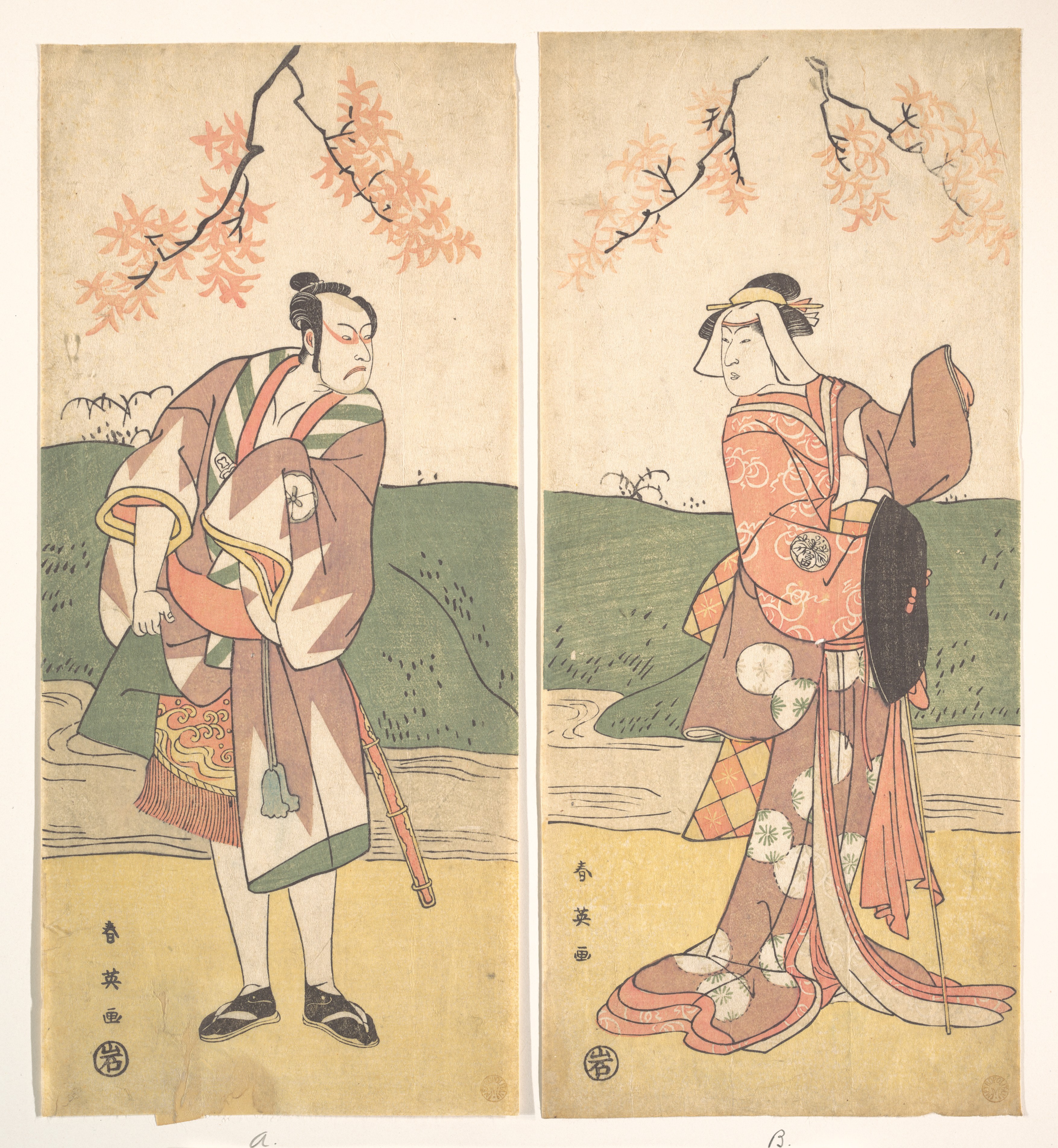
The Actor Morita Kanya Wearing One Sword
ca. 1792
Diptych of woodblock prints; ink and color on paper

The Actor Nakayama Tomisaburo as a Woman at a Picnic under Autumn Maple Trees
ca. 1792
Woodblock print; ink and color on paper

The Actor Otani Oniji III in an Unidentified Role in the Play Yukimi-zuki Eiga Hachi no Ki (?), Performed at the Nakamura Theater (?) in the Eleventh Month, 1787 (?)
c. 1787
Color woodblock print; hosoban

The Actor Iwai Hanshiro IV as Tonase (?) in the Play Kanadehon Chushingura (?), Performed at the Kiri Theater (?) in the Eighth Month, 1787 (?)
c. 1787
Color woodblock print; hosoban

The Actor Iwai Hanshiro IV as Yae (?), in the Play Sugawara Denju Tenarai Kagami (?), Performed at the Kiri Theater (?) in the Seventh Month, 1788 (?)
c. 1788
Color woodblock print; hosoban; right sheet of diptych (?)

The Actor Iwai Hanshiro IV in Street Attire (by Shun'ei) Conversing with Two Women (by Shuncho)
c. 1788
Color woodblock print; aiban

The Actor Iwai Kiyotaro II as Lady Itohagi (?) in the Play Genji Saiko Kogane Tachibana (?), Performed at the Ichimura Theater (?) in the Eleventh Month, 1788 (?)
c. 1788
Color woodblock print; hosoban; left sheet of diptych

The Actor Ichikawa Danjuro V as Hei Shinno Masakado in the Play Hana no O-Edo Masakado Matsuri, Performed at the Ichimura Theater in the Eleventh Month, 1789
c. 1789
Color woodblock print; hosoban

Actor Segawa Kikunojô III Possibly as Ono no Komachi in “Komachi Village: New Year at the Theater” (“Komachimura shibai no shôgatsu”)
About 1789
Color woodblock print; hosoban diptych

The Actor Iwai Hanshiro IV as Okumi of the Mieido Fan Shop (?) in the Play Sanjuk-koku Yobune no Hajimari (?), Performed at the Ichimura Theater (?) in the Fifth Month, 1789 (?)
c. 1789
Color woodblock print; hosoban

The Actor Iwai Hanshiro IV as Soga no Goro Tokimune in the Play Koi no Yosuga Kanegaki Soga, Performed at the Ichimura Theater in the First Month, 1789
c. 1789
Color woodblock print; hosoban; one sheet of triptych (another sheet: 1939.897)

The Actor Segawa Kikunojo III as Kojoro-gitsune (Female Fox) Disguised as Omiki in the Play Komachi-mura Shibai no Shogatsu, Performed at the Nakamura Theater in the Eleventh Month, 1789
c. 1789
Color woodblock print; hosoban

The Actor Matsumoto Koshiro IV as Hatakeyama Shigetada Disguised as Honjo Soheiji (?) in the Play Edo no Fuji Wakayagi Soga (?), Performed at the Nakamura Theater (?) in the First Month, 1789 (?)
c. 1789
Color woodblock print; hosoban; from a multisheet composition

The Actor Ichikawa Danjuro V as Benkei in the Play Dai Danna Kanjincho, Performed at the Kawarazaki Theater in the Eleventh Month, 1790
c. 1790
Color woodblock print; hosoban