
Parting Spring (Yuku haru) — left screen
行く春 左隻
- Date:
- 1916
- Medium:
- Six-panel folding screen; ink and color on paper
Description
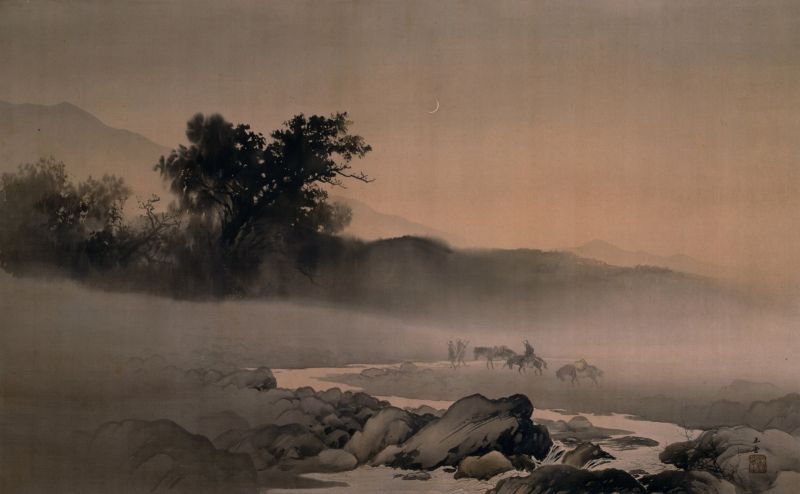
Parting Spring (Yuku haru) is a pair of six-panel folding screens (byōbu) executed by Kawai Gyokudō in 1916 in ink and color on paper, exhibited at the tenth Bunten exhibition in 1916 and now held by the National Museum of Modern Art, Tokyo. This is the left screen (sahyaku) of the pair, completing the river scene begun in the companion right screen and extending the composition downstream. The combined twelve panels depict the slow drift of cherry-blossom petals along a Japanese river in late spring, with willows in fresh leaf along the banks, a moored boat or two, and small figures of fishermen and travelers giving scale to the composition. Gyokudō's handling balances the close, observed brushwork of the Kyoto Shijō tradition he absorbed under Kōno Bairei and Mochizuki Gyokusen against the more atmospheric, monumental scale of the Kanō-school painting he learned from Hashimoto Gahō in Tokyo, with the result that the screen reads simultaneously as a precise, located image of a specific river in Japan and as a generalized poetic emblem of the passage of spring (yuku haru) familiar from centuries of waka and haikai literature. Parting Spring is one of the most-reproduced works of Taishō nihonga and a key reference for understanding Gyokudō's mature landscape style.
More Prints by Kawai Gyokudō



More Spring Prints

Frequently Asked Questions
Parting Spring (Yuku haru) — left screen (行く春 左隻) was created by Kawai Gyokudō (川合玉堂) in 1916.
Parting Spring (Yuku haru) — left screen depicts spring.