Biography
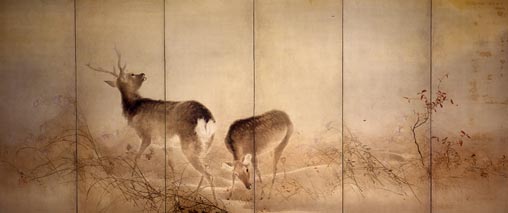
Konoshima Ōkoku (木島桜谷, 1877–1938) was one of the leading nihonga painters of late Meiji and Taishō Kyoto, a celebrated specialist of animal subjects within the Maruyama-Shijō tradition whose technical mastery and quiet introspection set him apart from the noisier currents of early twentieth-century Japanese painting. Trained under Imao Keinen — the great Meiji bird-and-flower painter — Ōkoku absorbed the centuries-old Kyoto practice of sketching directly from living animals and plants, and he extended it into a body of work distinguished by close observation of deer, foxes, monkeys, eagles, and the seasonal landscapes those creatures inhabit. Although the woodblock-print revival was largely a Tokyo phenomenon driven by the shin-hanga and sōsaku-hanga movements, Ōkoku's reputation rested on his hanging-scroll and folding-screen paintings, exhibited at the official Bunten salon, where his name became synonymous with a particular kind of austere, atmospheric nihonga rooted in Kyoto's painting heritage. He taught as a professor at the Kyoto Municipal School of Painting and came to be remembered as one of the last great heirs of the Shijō school.
Ōkoku was born in 1877 in the Sanjō Muromachi district of Kyoto, into a merchant family. His given name was Bunjirō (文治郎). Showing artistic talent as a child, at the age of sixteen he entered the studio of Imao Keinen (1845–1924), the senior Kyoto kachō-e painter and one of the most prestigious living exponents of the Maruyama-Shijō lineage that ran from Maruyama Ōkyo and Matsumura Goshun through Suzuki Hyakunen, under whom Keinen himself had trained. In Keinen's atelier Ōkoku acquired the foundations of the Shijō practice: the discipline of shasei (sketching from life), the use of long diagonals and asymmetric placements against generous negative space, the careful handling of ink wash and graduated color, and the literary and seasonal vocabulary inherited from centuries of Japanese painting. He took the art name Ōkoku (桜谷) and retained it throughout his career.
Alongside his painting, Ōkoku cultivated a lifelong engagement with classical Chinese literature and poetry — a grounding that shaped his work throughout his life, since many of his most ambitious paintings draw their subject matter from classical themes, and his late landscapes in particular are inflected by the literati-painting tradition that Kyoto Shijō painters had absorbed into their own idiom. He was also a tireless observer of animals, filling hundreds of sketchbooks in the Shijō manner with studies of the deer, monkeys, foxes and small mammals that recur throughout his mature work, whose anatomical precision is rare in twentieth-century Japanese painting.
Ōkoku's professional breakthrough came with the founding of the Bunten (Ministry of Education Art Exhibition), Japan's official national salon, which opened in 1907. He exhibited from the very first Bunten and won prizes at each of its first six exhibitions, quickly becoming one of the recognized leaders of the Kyoto contingent. His folding-screen composition of figures caught in a sudden downpour, shown at that first exhibition of 1907, established the kind of dramatic atmospheric subject that would become his signature: a single coherent narrative moment, sketched against an empty or lightly tinted ground, with figures and animals rendered with sharp specificity. Spring on a Main Road (駅路之春), a folding-screen composition of a roadside spring landscape, remains among the iconic images of his Bunten years.
The most discussed of all Ōkoku's paintings was Winter Moon (Kangetsu, 寒月, 1912), a pair of six-fold folding screens depicting a fox crossing a moonlit, snow-dusted bamboo grove in deep winter. Exhibited at the Bunten in 1912, the screens were awarded a top prize but provoked one of the most famous critical exchanges of Taishō art history: the novelist Natsume Sōseki published an essay sharply criticizing the work. The dispute became a touchstone in debates about the modernization of nihonga, and later critics have largely vindicated Ōkoku's restrained, technically innovative handling of the subject, which has drawn renewed attention in recent years. The screens are now held by the Kyoto Municipal Museum of Art (today the Kyoto City KyoCera Museum of Art), and Ōkoku returned to the same composition roughly a decade later.
Around the age of thirty-seven Ōkoku moved to Kinugasa, northwest of Kyoto, where he built a large studio. Over the following years his art turned in a more introspective direction, and — increasingly out of sympathy with the noisier currents of Shōwa-period nihonga — he withdrew from the Bunten and Teiten exhibition circuit to devote himself to private painting and to Chinese poetry and calligraphy. His late works — quiet studies of birds, animals, waterfalls, snow scenes and pine groves — display a more meditative manner in which atmospheric ink wash and economical brushwork carry the burden of feeling. The Honolulu Museum of Art holds one of his late waterfall paintings, while the golden folding screens of the flowers of the four seasons that he created for the Osaka residence of the Sumitomo family are today among the holdings of the Sen-oku Hakukokan Museum.
Ōkoku died in 1938. After his death his reputation entered a quiet period in which his work was overshadowed by both the shin-hanga revival on the print side and the rise of later nihonga painters. A strong reevaluation has taken hold in recent decades, driven by major exhibition series at the Sen-oku Hakukokan Museum and the Fukuda Art Museum that have reintroduced him as one of the central animal painters of his era. Today his paintings are held by the Kyoto Municipal Museum of Art, the Sen-oku Hakukokan Museum, the Fukuda Art Museum, the National Museum of Modern Art, Tokyo, the Honolulu Museum of Art, and other major collections. He is increasingly recognized as one of the great heirs of the Maruyama-Shijō tradition into the twentieth century — "the last of the Shijō school" — and as a painter whose combination of zoological precision and atmospheric reserve marks him out from his Tokyo contemporaries.
Key Facts
- Active Period
- 1877–1938
- Nationality
- 🇯🇵Japan
- Movement
- Meiji/Taishō Prints
- Works Indexed
- 16
Frequently Asked Questions
Konoshima Ōkoku (木島桜谷, 1877–1938) was one of the leading nihonga painters of late Meiji and Taishō Kyoto, a celebrated specialist of animal subjects within the Maruyama-Shijō tradition whose technical mastery and quiet introspection set him apart from the noisier currents of early twentieth-century Japanese painting. Trained under Imao Keinen — the great Meiji bird-and-flower painter — Ōkoku absorbed the centuries-old Kyoto practice of sketching directly from living animals and plants, and he extended it into a body of work distinguished by close observation of deer, foxes, monkeys, eagles, and the seasonal landscapes those creatures inhabit. Although the woodblock-print revival was largely a Tokyo phenomenon driven by the shin-hanga and sōsaku-hanga movements, Ōkoku's reputation rested on his hanging-scroll and folding-screen paintings, exhibited at the official Bunten salon, where his name became synonymous with a particular kind of austere, atmospheric nihonga rooted in Kyoto's painting heritage. He taught as a professor at the Kyoto Municipal School of Painting and came to be remembered as one of the last great heirs of the Shijō school.
Konoshima Ōkoku was active from 1877 to 1938. They were associated with the Meiji/Taishō Prints movement.
Konoshima Ōkoku's work was shaped by the Meiji/Taishō Prints tradition in Japanese woodblock printmaking. Meiji/Taishō Prints: Meiji and Taishō era prints (1868–1926) bridge the transition from traditional ukiyo-e to the modern shin-hanga and sosaku-hanga movements.
Konoshima Ōkoku's prints frequently feature spring, moonlight, autumn foliage, waterfalls.
Original prints by Konoshima Ōkoku can be found in collections including Wikimedia Commons (Japanese public domain), Fukuda Art Museum (via Wikimedia Commons), Tokyo National Museum (via Wikimedia Commons), Meiji Memorial Picture Gallery, Tokyo (via Wikimedia Commons).
Woodblock Prints by Konoshima Ōkoku (16)

Shower (Yūdachi), right screen
驟雨 右隻
1907
Ink and color on silk; folding screen
Shower (Yūdachi), left screen
驟雨 左隻
1907
Ink and color on silk; folding screen

Spring of a Main Road (Umayaji no Haru), left screen
駅路之春 左隻
1913
Ink and color on silk; folding screen

Spring of a Main Road (Umayaji no Haru), right screen
駅路之春 右隻
1913
Ink and color on silk; folding screen

Winter Moon (Kangetsu), right screen
寒月 右隻
1922
Ink and color on silk; folding screen

Hardness of Travelers' Ways, right screen
行路難 右隻
1922
Ink and color on silk; folding screen

Hardness of Travelers' Ways, left screen
行路難 左隻
1922
Ink and color on silk; folding screen

Winter Moon (Kangetsu), left screen
寒月 左隻
1922
Ink and color on silk; folding screen

Dusk in Wintertime
雪暮図
c. 1930
Ink and color on silk; folding screen

Emperor and Empress at a Noh Play
能楽天覧図
1934
Mural painting on canvas

Lion
獅子図
early 20th century
Ink and color on silk; folding screen

Chrysanthemums
菊花図
early 20th century
Ink and color on silk

Peacock
孔雀図
early 20th century
Ink and color on silk; folding screen

Cherry Blossom under Misty Moon
朧月夜の桜
Taishō era
Ink and light color on silk; hanging scroll

Studies of Cats
猫図
early 20th century
Ink on paper

Waterfall
瀑布図
late 1910s
Ink and color on silk; hanging scroll