
Mochizuki Gyokusen
望月玉泉
1834–1913
Japan
Biography
Mochizuki Gyokusen (1834–1913) was one of the leading Kyoto nihonga painters of the Meiji period, the fourth-generation head of the hereditary Mochizuki school of painters, an artist to the Imperial Household, and one of the founding teachers of the Kyoto Prefectural Painting School. His career spans the closing years of the Edo period, the upheavals of the Meiji Restoration, and the institutionalisation of Japanese painting in the late nineteenth century. Working largely in the inherited vocabulary of the Maruyama-Shijō and Kishi traditions but with an increasingly observational sensibility, Gyokusen produced landscapes, bird-and-flower paintings, animal studies, and figural compositions for both temple and court patrons, and circulated his designs through the woodblock-printed painting album he published for the instruction of younger painters.
Gyokusen was born in Kyoto on 20 July 1834 (Tenpō 5) into the Mochizuki school of painting. He began drawing under his grandfather from the age of six and took up painting in earnest under his father — a Mochizuki-school painter who died in 1852 — from around the age of sixteen, absorbing the Shijō-school discipline of shasei (sketching from life) and the Maruyama-Shijō and Kishi repertoire of birds, plants, animals, and landscapes. In time he became the fourth-generation head of the Mochizuki school, maintaining the position of one of Kyoto's hereditary painting houses through the upheavals of the late Bakumatsu and early Meiji years.
In 1855 (Ansei 2) Gyokusen contributed sliding-door paintings to the reconstructed Kyoto Imperial Palace, rebuilt after fire had destroyed parts of the complex the previous year. The commission gave him an early association with court patronage and a place among the painters trusted with prestigious public work in the city. He continued through the 1860s and 1870s to work in the manner of his Shijō inheritance while gradually responding to the new pressures of the Meiji period: the dismantling of feudal patronage, the rise of yōga (Western-style painting), the consolidation of Tokyo as the political and increasingly the cultural capital, and the simultaneous Kyoto effort to defend traditional painting through new schools and exhibition societies.
In 1878 Gyokusen joined Kōno Bairei and other leading Kyoto painters in petitioning for the establishment of the Kyoto Prefectural Painting School (Kyōto Furitsu Gagakkō), the first public painting school in Japan and the institutional vehicle through which Kyoto painters sought to systematise the training of the next generation of nihonga artists. When the school opened in 1880 he served as one of its instructors, and his role places him among the architects of the Kyoto painting establishment of the late nineteenth century. He exhibited at the domestic painting competitive exhibitions and the international expositions of the era — earning a commendation at the Naikoku Kaiga Kyōshinkai (Domestic Painting Competitive Exhibition) in 1882 and a bronze medal at the Paris Exposition Universelle of 1889 — building his reputation both nationally and internationally, and showing again at the Paris Exposition of 1900.
Gyokusen's institutional career reached its summit on 16 April 1904, when he was appointed a Teishitsu Gigeiin (Artist to the Imperial Household), among the highest formal honours then conferred on a Japanese painter, and he was thereafter regarded as one of the senior representatives of Kyoto painting alongside Takeuchi Seihō of the next generation. He continued to work into his late seventies, producing landscapes, snow scenes, birds of prey, waterfalls, and animal subjects that combined his lifelong Shijō observational practice with the more atmospheric and decorative modes that Kyoto nihonga had developed by the late Meiji period.
Alongside his painting practice, Gyokusen produced a woodblock-printed picture album that disseminated his designs to students, collectors, and rival painters. The Gyokusen shūgajō (玉泉習画帖, Gyokusen's Study-Painting Album), a three-volume colour-printed album, was published in Kyoto in 1891 (Meiji 24) as a study album for the use of younger painters and amateurs. It appeared in the same years as Imao Keinen's Keinen kachō gafu and belongs to the tradition of Meiji Kyoto colour-printed picture albums associated with masters such as Kōno Bairei and Keinen. Sets of the album entered Western museum collections in the decades after publication.
Gyokusen died in Kyoto on 16 September 1913, at the age of seventy-nine. His students included his own son, Mochizuki Gyokkei, who continued the Mochizuki school into the twentieth century, and — most notably — the young Kawai Gyokudō (1873–1957), who studied with Gyokusen in Kyoto before going on to become one of the major Nihonga painters of the modern era. Within the broader history of Meiji nihonga, Gyokusen represents a particular kind of conservative Kyoto modernity: rooted in the Shijō lineage rather than the Tokyo academic establishment, committed to traditional subject categories and formats — hanging scrolls, folding screens, painted fans, and woodblock-printed albums — but increasingly aware of European naturalism and willing to accommodate it in his treatment of light, atmosphere, and animal form. His works are held by the Yale University Art Gallery, the Musée Cernuschi in Paris, and other museums in Japan, Europe, and North America. For collectors of Japanese prints, his name is most reliably encountered through the Gyokusen shūgajō, which sits within the Meiji Kyoto colour-printed picture-album tradition alongside the albums of Bairei and Keinen.
Key Facts
- Active Period
- 1834–1913
- Nationality
- 🇯🇵Japan
- Works Indexed
- 8
Frequently Asked Questions
Mochizuki Gyokusen (1834–1913) was one of the leading Kyoto nihonga painters of the Meiji period, the fourth-generation head of the hereditary Mochizuki school of painters, an artist to the Imperial Household, and one of the founding teachers of the Kyoto Prefectural Painting School. His career spans the closing years of the Edo period, the upheavals of the Meiji Restoration, and the institutionalisation of Japanese painting in the late nineteenth century. Working largely in the inherited vocabulary of the Maruyama-Shijō and Kishi traditions but with an increasingly observational sensibility, Gyokusen produced landscapes, bird-and-flower paintings, animal studies, and figural compositions for both temple and court patrons, and circulated his designs through the woodblock-printed painting album he published for the instruction of younger painters.
Mochizuki Gyokusen was active from 1834 to 1913.
Mochizuki Gyokusen's prints frequently feature fish, autumn foliage, waterfalls, winter.
Original prints by Mochizuki Gyokusen can be found in collections including Minneapolis Institute of Art (via Wikimedia Commons), Smithsonian Libraries / Freer Gallery of Art Study Collection (via Wikimedia Commons), Yale University Art Gallery (via Wikimedia Commons), Honolulu Museum of Art (via Wikimedia Commons).
Woodblock Prints by Mochizuki Gyokusen (8)
Snow Landscape
雪景山水図
1879
Hanging scroll; ink on silk
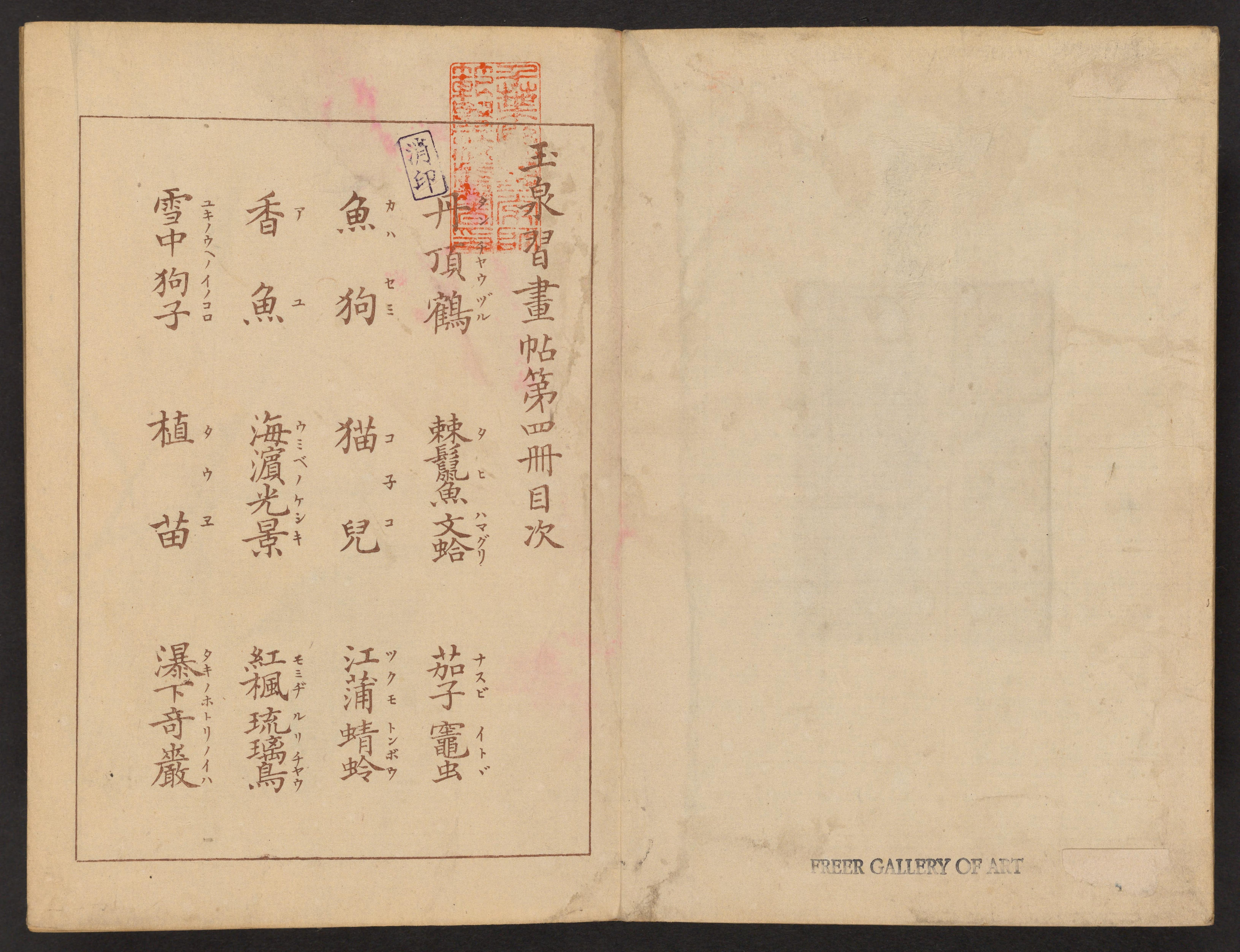
Gyokusen shūgajō (Gyokusen's Collected Picture Album)
玉泉習画帖
1891
Woodblock-printed book; ink and color on paper

Eagle on Rock by Waves
怒涛巖上鷲図
late 19th–early 20th century
Pair of hanging scrolls; ink and color on silk

Bamboo and Squirrels
竹に栗鼠図
late 19th–early 20th century
Hanging scroll; ink and color on silk

Black Bull
黒牛図
late 19th–early 20th century
Hanging scroll; ink and color on silk

Landscape with Fisherman Outside a Cave
洞窟漁夫山水図
late 19th–early 20th century
Hanging scroll; ink and light color on silk

Wild Geese and Waterweeds
蘆雁図
1900–1913
Pair of two-panel folding screens; ink and color on paper

Waterfall
滝図
1910
Hanging scroll; ink and color on silk