
Biography
Suzuki Harushige (1747–1818), better known to history by his later name Shiba Kōkan, occupies one of the most fascinating dual positions in late Edo period Japanese art. Born in Edo in 1747, he led essentially two artistic lives: first as a youthful ukiyo-e designer working in the immediate shadow of Suzuki Harunobu, and later as Japan's pioneering Western-style painter (yōga) and the first Japanese artist to master European copperplate etching. The arc of his career, traced from his early bijin-ga woodblock prints to his late copperplate engravings of Western perspective landscapes, is in many ways the arc of Japan's gradual opening to European visual culture during the long isolation of the Tokugawa shogunate.
Harushige's early years as a print designer began under Kanō school training and continued under the brushwork tradition of Sō Shiseki, a Nagasaki-school painter who had absorbed Chinese bird-and-flower conventions. His turn to ukiyo-e came around 1770, the year that Suzuki Harunobu — the originator of the full-color nishiki-e print and the dominant designer of refined bijin-ga in the late 1760s — died suddenly at the height of his fame. Whether by training, friendship, or commercial calculation, the young Harushige stepped directly into Harunobu's vacated stylistic territory. His Edo ukiyo-e prints of the early 1770s adopt Harunobu's compositional vocabulary, his slender willow-like figures, his small-headed beauties with delicate fingers and softly arched eyebrows, and his characteristic muted palette of mauves, sage greens, and pale yellows. So thoroughly did Harushige imitate Harunobu's manner that for many decades cataloguers and collectors attributed his prints to the master, and a number of works long admired as Harunobu originals were eventually reassigned to Harushige once stylistic distinctions could be drawn with more confidence. Harushige himself later boasted in his autobiographical writings that he had successfully forged Harunobu prints — a candor that, while damaging to his ukiyo-e reputation among purists, has made him a key figure for understanding the workshop economics and stylistic transmission of post-Harunobu bijin-ga.
The surviving Harushige prints — including chuban-format scenes of courtesans, young couples, the Six Jewel Rivers theme, and pleasure-quarter genre — are among the finest examples of a post-Harunobu Edo style that hovers between homage and authorship. Works such as Praying for Rain Komachi and the Hagi Jewel River — the latter drawn from the classical Six Jewel Rivers (Mu Tamagawa) theme — demonstrate his fluency with classical poetic conventions: dressing literary and waka-derived subject matter in contemporary urban guise, a strategy known as mitate-e that Harunobu had perfected. Pleasure-quarter scenes such as Scene of the Pleasure Quarter at Fukagawa show his willingness to depict the demimonde with documentary specificity, while his many courtesan interiors and street vignettes capture the textures of Edo daily life — powder shops, summer evenings, mosquito-burning rituals — with quiet observational warmth.
The great rupture in Harushige's career came through his association with Hiraga Gennai (1728–1780), the celebrated polymath, rangaku (Dutch Studies) scholar, inventor, and dramatist whose Edo salon was the principal node for transmission of Western scientific and visual knowledge in mid-Edo Japan. Through Gennai and his circle, Harushige encountered Dutch-imported European prints, anatomical illustrations, and treatises on optics and linear perspective. By the late 1770s he had abandoned ukiyo-e and reinvented himself as Shiba Kōkan, the name under which he would conduct the remainder of his career. In 1783 he produced what is widely regarded as the first Japanese-made copperplate etching, the View of Mimeguri shrine — a technical breakthrough achieved through painstaking experimentation with engraving tools, etching grounds, and printing presses, all reverse-engineered from Dutch books since no European engraver was available to teach him. He went on to produce dozens of copperplate landscapes, often rendered in striking one-point perspective, of famous sites in Edo, the Tōkaidō, and the Dutch trading enclave at Nagasaki.
As Shiba Kōkan he also painted oil and tempera landscapes on canvas and silk, wrote influential treatises promoting the heliocentric Copernican model of the solar system (then nearly unknown in Japan), produced one of Japan's earliest Western-style maps of the world in 1792, and traveled in 1788 to Nagasaki — a journey he documented in the woodblock-printed travel diary Seiyūryōdan (A Diary of Travel from Edo to Nagasaki), eventually published in 1803. He argued in essays and visual demonstrations that European pictorial naturalism, with its shadows, perspective, and modeling, was a superior tool for accurate representation than the Japanese and Chinese traditions in which he had been trained — an argument that made him both a controversial figure and one of the most consequential proto-modernizers of Japanese visual culture.
Shiba Kōkan died in 1818 in Edo at age seventy-one, leaving a legacy that bridges two largely separate art-historical conversations. To students of ukiyo-e, he is the late and somewhat shadowy heir to Harunobu, whose Edo bijin-ga of the early 1770s remain prized examples of the post-Harunobu chuban style. To historians of yōga, rangaku, and early modern science in Japan, he is a foundational figure whose copperplate prints, Western-style oil landscapes, and Copernican advocacy mark the beginning of Japan's deliberate engagement with European visual knowledge — an engagement that would not bear full fruit until the Meiji Restoration half a century after his death. His career is the rare instance in which a single Japanese artist participated meaningfully in two distinct revolutions: the full-color woodblock print that defined Edo popular art, and the European-derived perspectival image that would help redefine Japanese seeing in the centuries to come.
Key Facts
- Active Period
- 1747–1818
- Nationality
- 🇯🇵Japan
- Movement
- Ukiyo-e
- Works Indexed
- 9
Frequently Asked Questions
Suzuki Harushige (1747–1818), better known to history by his later name Shiba Kōkan, occupies one of the most fascinating dual positions in late Edo period Japanese art. Born in Edo in 1747, he led essentially two artistic lives: first as a youthful ukiyo-e designer working in the immediate shadow of Suzuki Harunobu, and later as Japan's pioneering Western-style painter (yōga) and the first Japanese artist to master European copperplate etching. The arc of his career, traced from his early bijin-ga woodblock prints to his late copperplate engravings of Western perspective landscapes, is in many ways the arc of Japan's gradual opening to European visual culture during the long isolation of the Tokugawa shogunate.
Suzuki Harushige (Shiba Kōkan) was active from 1747 to 1818. They were associated with the Ukiyo-e movement.
Suzuki Harushige (Shiba Kōkan)'s work was shaped by the Ukiyo-e tradition in Japanese woodblock printmaking. Ukiyo-e: ## What is ukiyo-e? Ukiyo-e ([浮世絵](/glossary/ukiyo-e)) — literally "pictures of the floating world" — is the Edo-period Japanese print and painting tradition that flourished from roughly 1660 to 1868, depicting the pleasures of urban life in Edo (modern Tokyo): courtesans, kabuki actors, sumo wrestlers, famous landscapes, and seasonal beauties.
Suzuki Harushige (Shiba Kōkan)'s prints frequently feature children, rain, fish.
Original prints by Suzuki Harushige (Shiba Kōkan) can be found in collections including Art Institute of Chicago, Metropolitan Museum of Art.
Woodblock Prints by Suzuki Harushige (Shiba Kōkan) (9)

The Hagi Jewel River, from an untitled series of Six Jewel Rivers
c. 1770/71
Color woodblock print; chuban
Praying for Rain Komachi (Amagoi Komachi)
Edo period (1615–1868), 1770
Color woodblock print; chuban

Two Women with Boy in Front of Powder Shop
c. 1770/71
Color woodblock print; chuban

Young Couple Enjoying the Cool of Evening
c. 1771/72
Color woodblock print; chuban

Courtesan Burning Mosquitoes as Her Guest Arrives
c. 1772/73
Color woodblock print; chuban

Scene of the Pleasure Quarter at Fukagawa
late 18th century
Woodblock print; ink and color on paper

Young Girl Throwing Fish into Pond
c. 1771/72
Color woodblock print; chuban

Young Man Walks in as Two Courtesans Read Love Letter
c. 1772/74
Color woodblock print; chuban
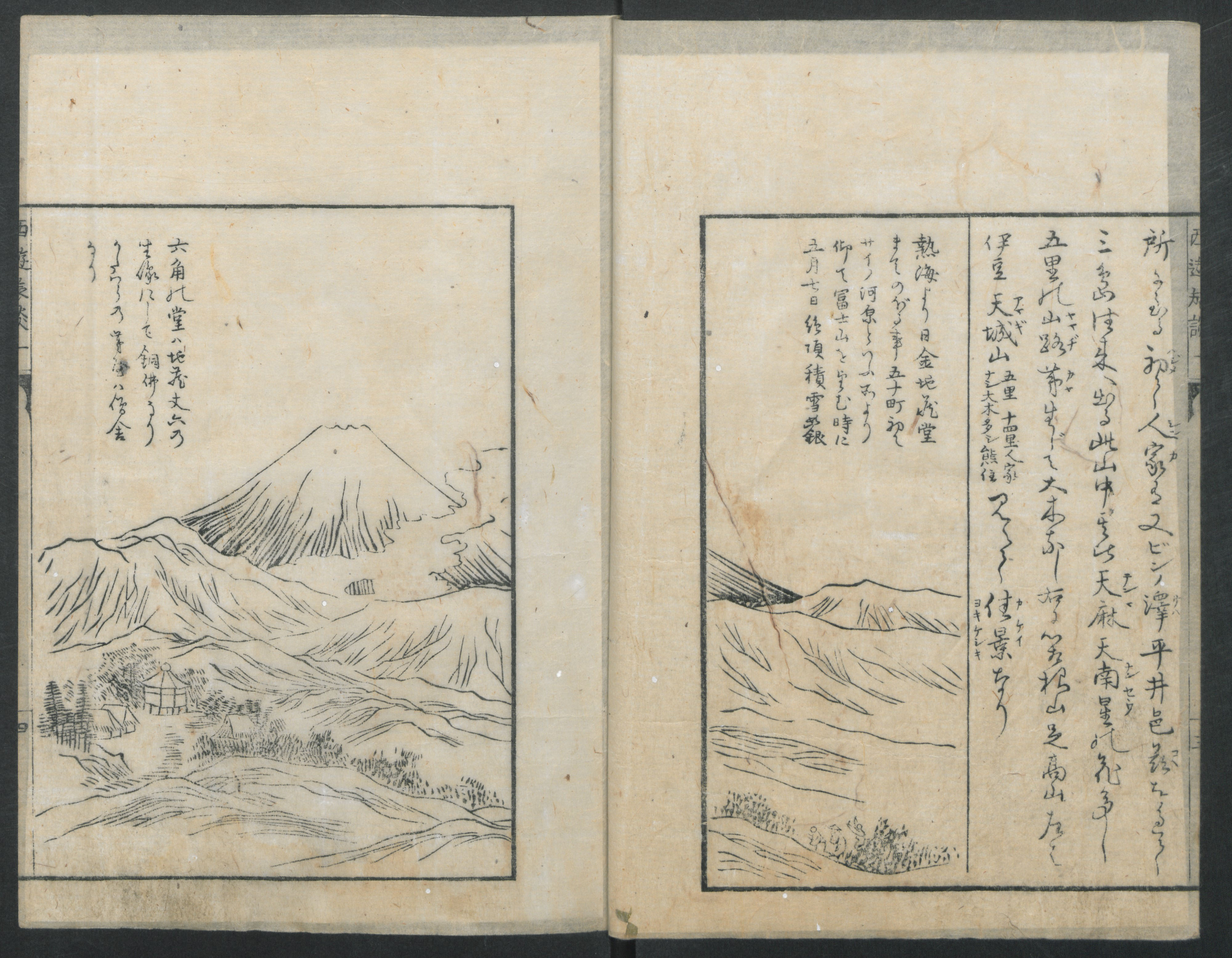
A Diary of Travel from Edo to Nagasaki (Seiyūryōdan)
1803
Five volumes of woodblock printed books; ink on paper