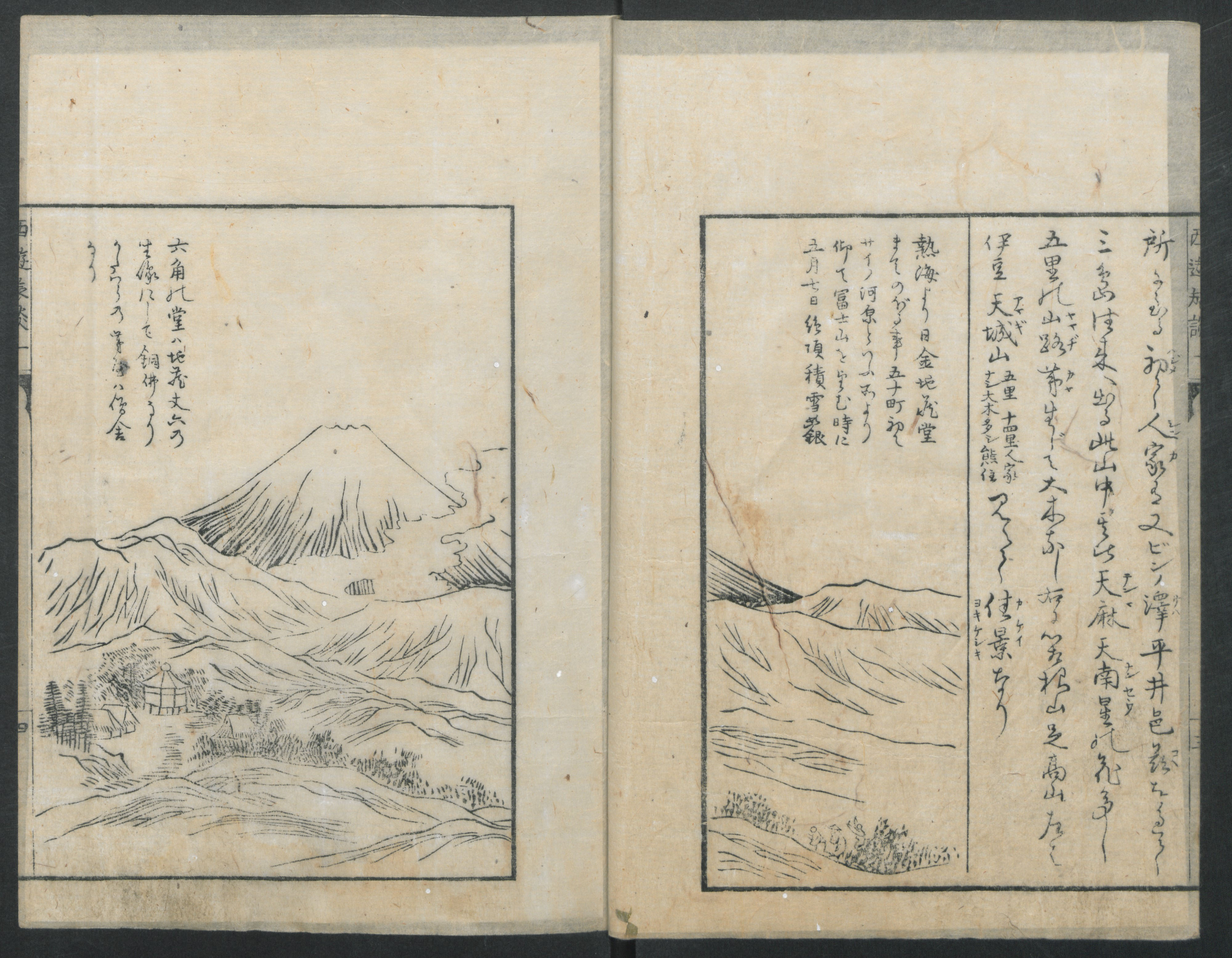
A Diary of Travel from Edo to Nagasaki (Seiyūryōdan)
by Suzuki Harushige (Shiba Kōkan)
- Date:
- 1803
- Medium:
- Five volumes of woodblock printed books; ink on paper
- Source:
- Metropolitan Museum of Art
Description
A Diary of Travel from Edo to Nagasaki (Seiyūryōdan), a five-volume set of woodblock-printed books in ink on paper published in 1803, is preserved in the collection of the Metropolitan Museum of Art. The publication records, in retrospective form, the artist's 1788 journey from Edo to Nagasaki — a defining expedition of his career as Shiba Kōkan, the Western-style painter and rangaku scholar he had become after abandoning his earlier ukiyo-e practice under the name Harushige. Nagasaki was the only Japanese port open to foreign trade during the long Tokugawa policy of national isolation, and its small Dutch factory at Dejima was the principal channel through which European books, scientific instruments, and visual conventions reached Japan. Kōkan's journey to Nagasaki was a pilgrimage of the highest importance to a Japanese student of European learning, and Seiyūryōdan records both the practical details of the journey along the Tōkaidō and through western Japan, and the artist's observations of the Dutch and Chinese trading communities, the local landscape, and the customs encountered along the way. Published fifteen years after the journey itself, the work is a hybrid of personal travelogue, scientific observation, and visual record, and its illustrations — woodblock-printed in the conventional Japanese manner rather than the copperplate medium Kōkan also championed — reflect the artist's late-career synthesis of his Edo training and his European-derived sensibility.
More Prints by Suzuki Harushige (Shiba Kōkan)

Young Man Walks in as Two Courtesans Read Love Letter
c. 1772/74
Color woodblock print; chuban

Praying for Rain Komachi (Amagoi Komachi)
Edo period (1615–1868), 1770
Color woodblock print; chuban

Scene of the Pleasure Quarter at Fukagawa
late 18th century
Woodblock print; ink and color on paper

The Hagi Jewel River, from an untitled series of Six Jewel Rivers
c. 1770/71
Color woodblock print; chuban
Frequently Asked Questions
A Diary of Travel from Edo to Nagasaki (Seiyūryōdan) was created by Suzuki Harushige (Shiba Kōkan) (鈴木春重) in 1803.