Biography
Utagawa Kunitaka (歌川国孝, active c. 1854–1868) was a designer of woodblock prints belonging to the Utagawa school, working in Edo during the final years of the Tokugawa shogunate and the opening of the Meiji Restoration. Like the great majority of Utagawa-school printmakers of the Bakumatsu generation, he was a pupil of Utagawa Kunisada (1786–1865), the prolific master who in his maturity took the great name Toyokuni III and who through his enormous workshop trained almost every significant designer of Edo theatrical and bijin-ga prints active in the 1850s and 1860s. Kunitaka's career falls within the Ansei-to-Keiō era (1854–1868) — a fourteen-year span that begins with the arrival of Commodore Perry's American steam fleet in Edo Bay and ends with the collapse of the shogunate and the restoration of the Meiji emperor — and his surviving prints belong to the dramatic late-Tokugawa Edo print culture that responded to these political convulsions through pictorial coverage of contemporary events and the resurgence of historical-military subjects.
Kunitaka signed his prints as Utagawa Kunitaka and Ichigyokusai Kunitaka, and reference literature records several additional brush-names (gō) under which he worked — among them Kinosuke, Ichigyokusai (一玉斎), Ichiryūsai (一柳斎), and Yanagichōrō. The cluster of names is entirely typical of mid-nineteenth-century Utagawa-school practice, in which a designer might shift gō across phases of his career or across genres of subject matter.
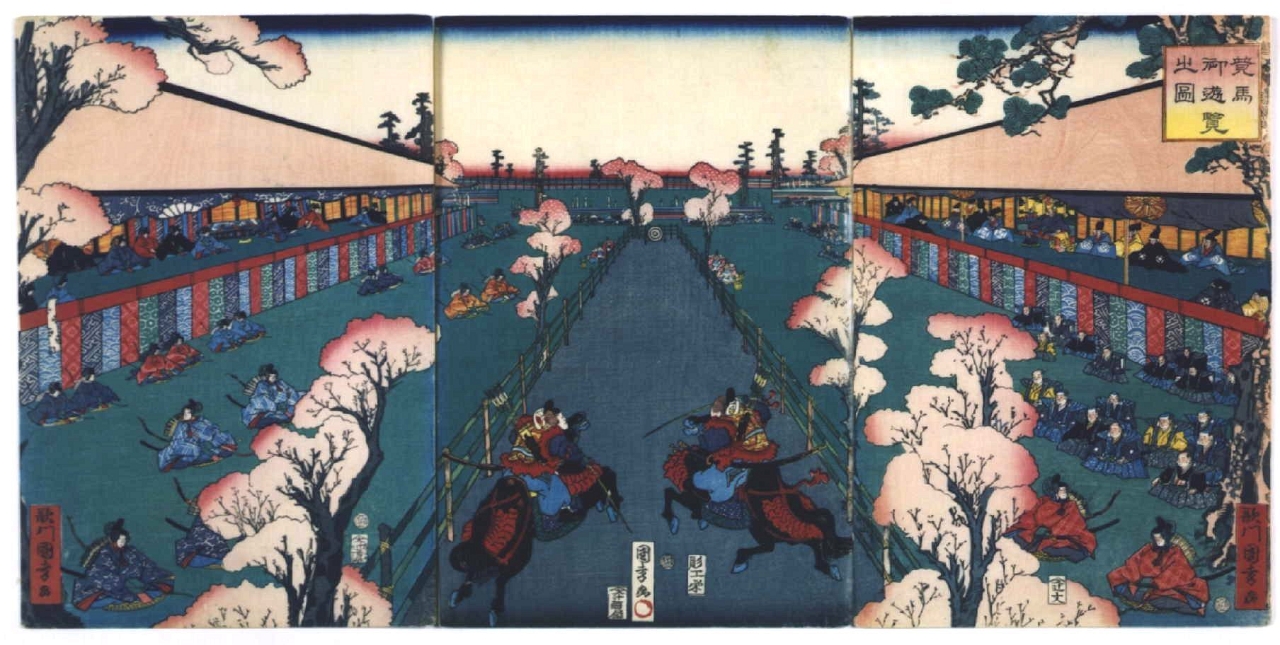
His surviving output, distributed today across the Museum of Fine Arts in Boston and the Edo-Tokyo Museum in Tokyo, divides between three principal subject groups. The first is historical-military (musha-e) imagery: his triptych The Great Battle of Kawanakajima in Shinano Province reconstructs the legendary sixteenth-century engagements between Takeda Shingen and Uesugi Kenshin, a Sengoku-period rivalry that had supplied Edo print culture with one of its most popular military subjects since at least the Tenpō era. The second is bijin-ga and Edo genre subjects, of which his Edo Beauties in the Evening is representative — the kind of fashionable single-sheet print that the late-Edo market continued to consume in volume even as the political ground shifted under the shogunate. The third is contemporary-event imagery: his triptych Imperial Visit to a Horse Race (Keiba goyūran no zu), which depicts horse racing watched by both shogunal samurai retinues on one side and imperial court nobles (kuge) on the other, registers in print form the political theatre of the early-1860s attempt to reconcile the bakufu and the imperial court through ceremonial visits between Edo and Kyoto — the so-called kōbu-gattai (court-shogunate union) policy that briefly stabilised the regime in the years before its collapse.
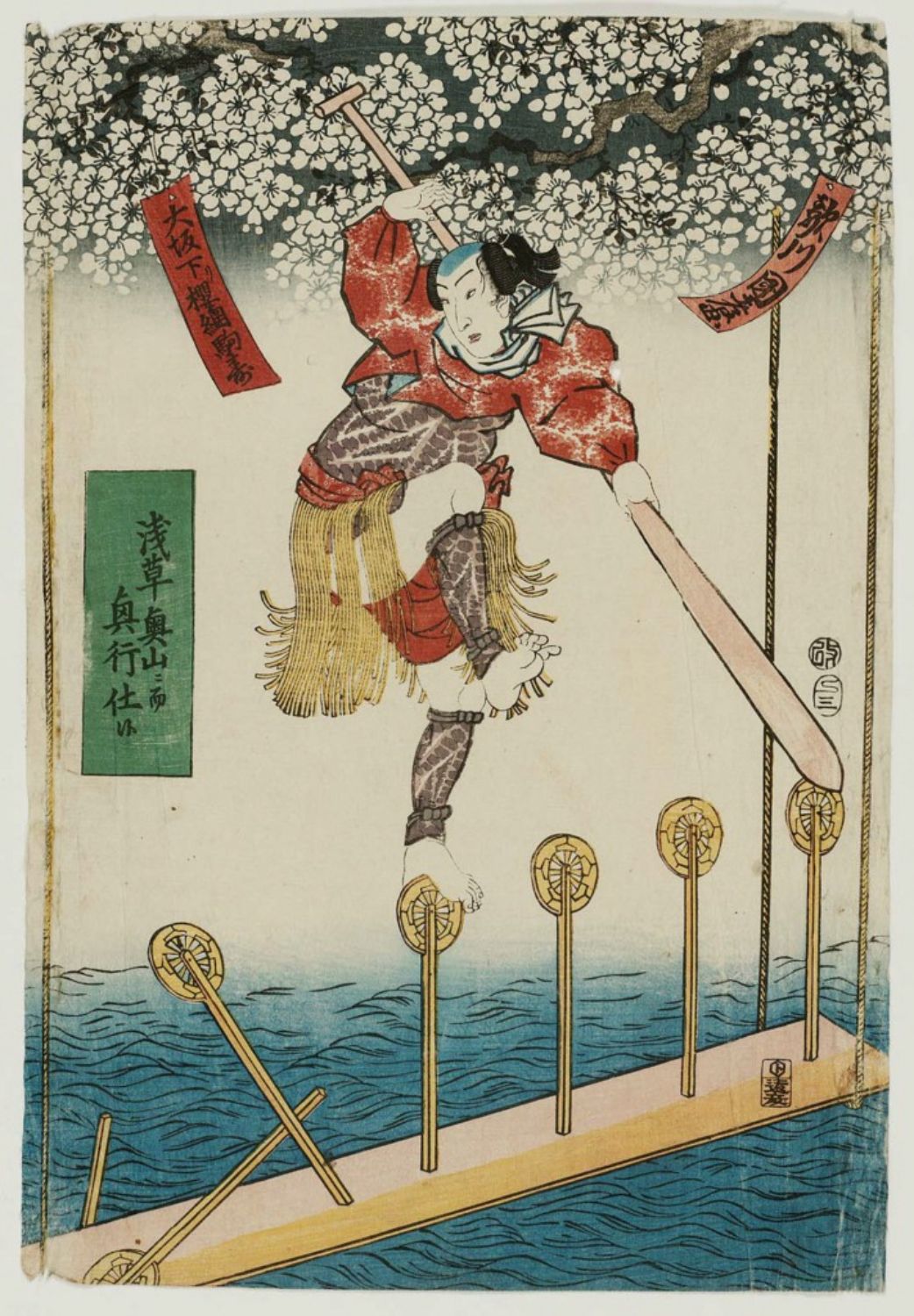
The two-panel composition Acrobat from Osaka Performing at Asakusa locates Kunitaka within the broader Edo print interest in misemono (popular sideshow attractions) that flourished in the Asakusa entertainment district through the 1850s and 1860s. Asakusa, with its temple grounds and shogunate-tolerated entertainment quarters, drew travelling performers from across Japan and supplied Edo print designers with a steady stream of contemporary spectacle subjects suitable for single-sheet or multi-sheet treatment. Kunitaka's coverage of an Osaka acrobat performing in Edo — a Kansai performer crossing into the eastern capital — records the geographic mobility of late-Tokugawa popular culture and the enduring cultural distance between the two metropolitan poles of the country.
Kunitaka belongs to that substantial group of Bakumatsu Utagawa-school designers — alongside contemporaries such as Utagawa Kunitsuna and the young Utagawa Kunichika — whose individual identities have been partially submerged by the more famous names of their generation. His work is preserved in institutional collections including the Museum of Fine Arts, Boston (which holds his Kawanakajima triptych, his Imperial Visit to a Horse Race, and his Acrobat from Osaka), the Edo-Tokyo Museum (which holds his Edo bijin-ga and Tōkaidō series prints), and the British Museum, and it is aggregated through the Ukiyo-e.org search engine, which draws together international digital collections. Recorded as a pupil of Kunisada in the standard literature on the Utagawa school's late-period roster, he left a body of surviving prints that offers a representative cross-section of the visual culture through which Edo townspeople processed the dramatic political events of the last years of the Tokugawa regime.
Key Facts
- Nationality
- 🇯🇵Japan
- Movement
- Ukiyo-e
- Works Indexed
- 6
Frequently Asked Questions
Utagawa Kunitaka (歌川国孝, active c. 1854–1868) was a designer of woodblock prints belonging to the Utagawa school, working in Edo during the final years of the Tokugawa shogunate and the opening of the Meiji Restoration. Like the great majority of Utagawa-school printmakers of the Bakumatsu generation, he was a pupil of Utagawa Kunisada (1786–1865), the prolific master who in his maturity took the great name Toyokuni III and who through his enormous workshop trained almost every significant designer of Edo theatrical and bijin-ga prints active in the 1850s and 1860s. Kunitaka's career falls within the Ansei-to-Keiō era (1854–1868) — a fourteen-year span that begins with the arrival of Commodore Perry's American steam fleet in Edo Bay and ends with the collapse of the shogunate and the restoration of the Meiji emperor — and his surviving prints belong to the dramatic late-Tokugawa Edo print culture that responded to these political convulsions through pictorial coverage of contemporary events and the resurgence of historical-military subjects.
Utagawa Kunitaka's work was shaped by the Ukiyo-e tradition in Japanese woodblock printmaking. Ukiyo-e: ## What is ukiyo-e? Ukiyo-e ([浮世絵](/glossary/ukiyo-e)) — literally "pictures of the floating world" — is the Edo-period Japanese print and painting tradition that flourished from roughly 1660 to 1868, depicting the pleasures of urban life in Edo (modern Tokyo): courtesans, kabuki actors, sumo wrestlers, famous landscapes, and seasonal beauties.
Original prints by Utagawa Kunitaka can be found in collections including Museum of Fine Arts, Boston (via Ukiyo-e.org), Edo-Tokyo Museum (via Ukiyo-e.org).
Woodblock Prints by Utagawa Kunitaka (6)
Acrobat from Osaka Performing at Asakusa
Edo period, c. 1854-1868
Woodblock print (nishiki-e), ink and color on paper

Edo Beauties in the Evening
late Edo period, c. 1854-1868
Woodblock print (nishiki-e), ink and color on paper
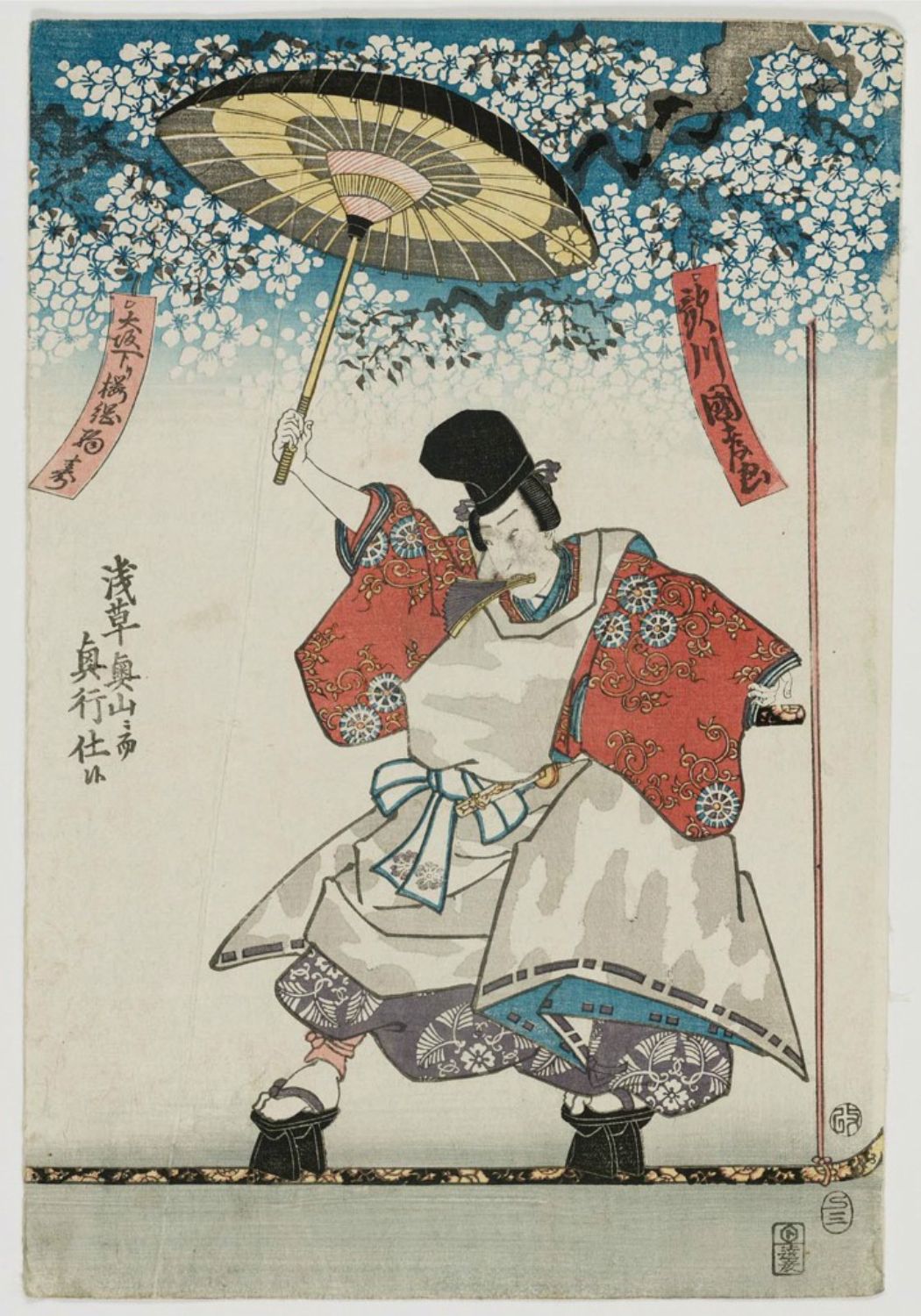
Acrobat from Osaka Performing at Asakusa (second sheet)
Edo period, c. 1854-1868
Woodblock print (nishiki-e), ink and color on paper
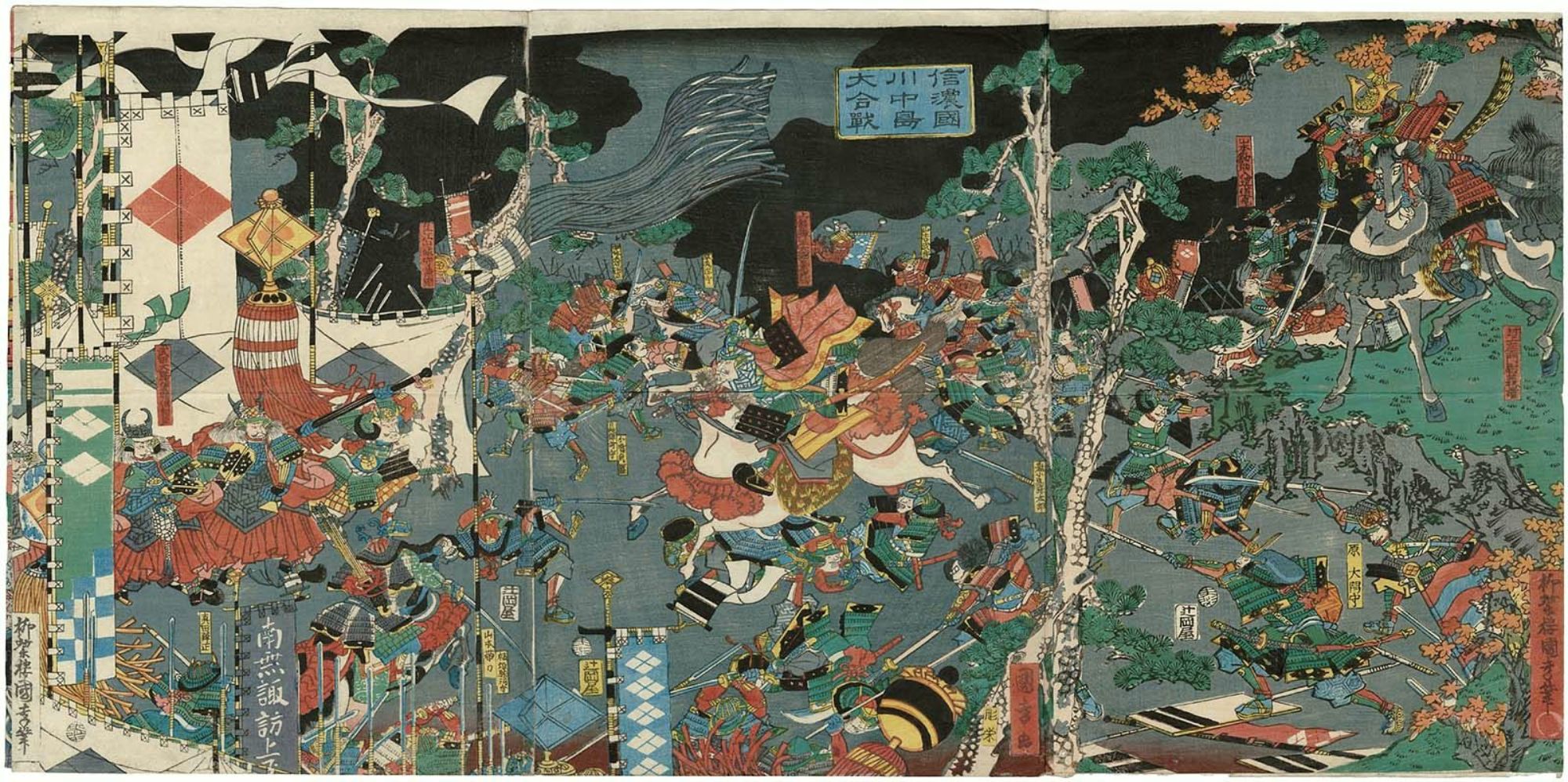
The Great Battle of Kawanakajima in Shinano Province (Shinano no kuni Kawanakajima ōgassen)
信濃国川中島大合戦
1863
Woodblock print (nishiki-e), ink and color on paper; triptych
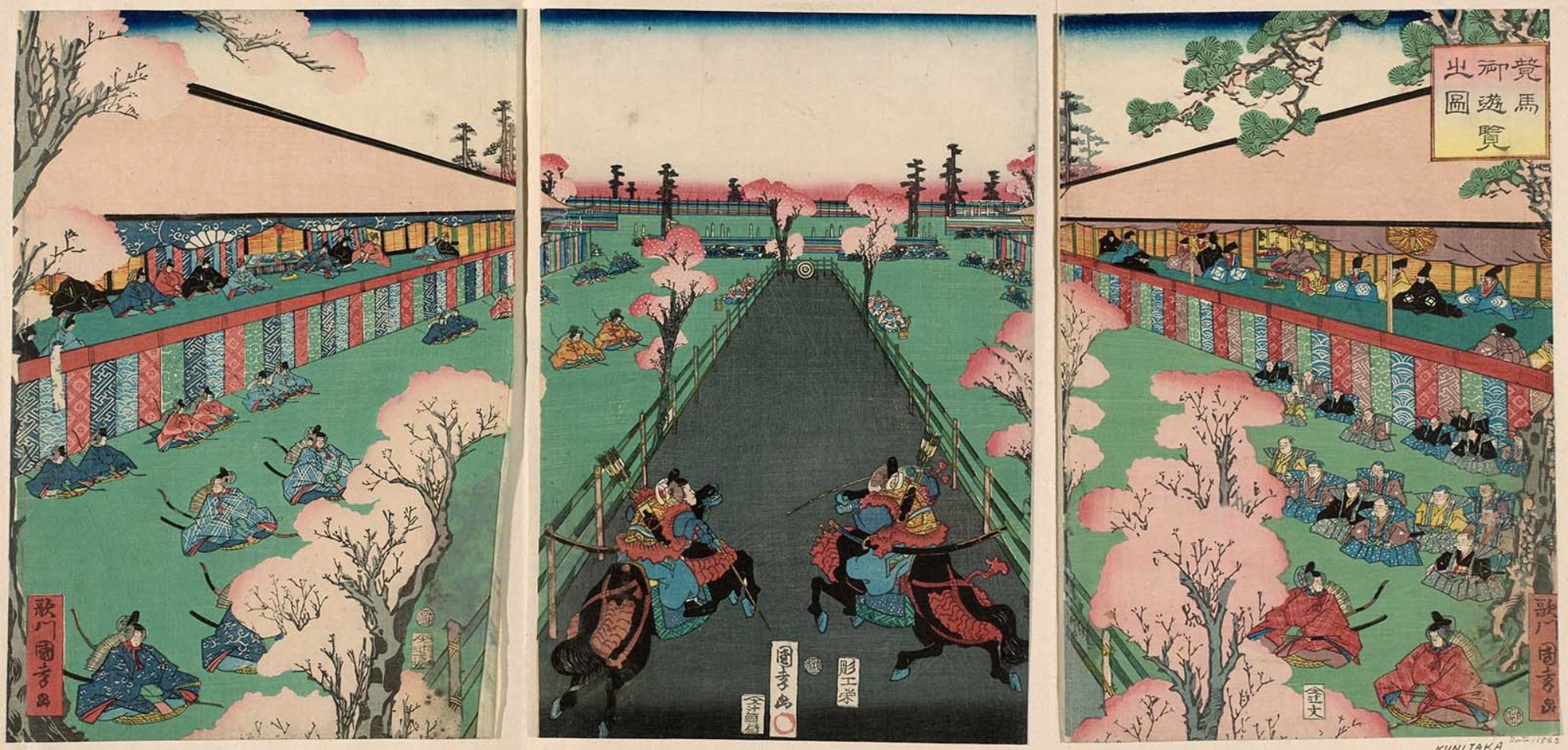
Imperial Visit to a Horse Race (Keiba goyūran no zu)
競馬御遊覧之図
1863
Woodblock print (nishiki-e), ink and color on paper; triptych
Famous Views of the Tōkaidō: Watching the Races
1863
Woodblock print (nishiki-e), ink and color on paper