
Morning after snow
- Medium:
- Mokuhanga (Japanese woodblock)
- Image courtesy of
- Saru Gallery
Description
Morning after snow depicts a landscape blanketed by fresh accumulation, the kind of quiet aftermath that Shoun returned to throughout his career. Snow scenes in this idiom rely heavily on the negative space of unprinted washi to suggest depth — drifts on rooftops, branches weighted down, the blur of distance dissolving into pale sky. Bokashi gradations along the horizon would model the cold light of early morning, while sparing applications of indigo and pale grey would block in shadow under eaves and against tree trunks. The carving for snow scenes demands restraint; too much line work breaks the stillness. Shoun's snow prints emerged from his work in the 1900s and 1910s for Tokyo publishers, sitting alongside his bijin-ga as part of a broader interest in seasonal observation. Where his contemporaries Kawase Hasui and Yoshida Hiroshi would later push the snow scene into the developed shin-hanga vocabulary, Shoun's earlier treatments retain a flatter, more decorative reading inherited from Meiji ukiyo-e conventions.
More Prints by Yamamoto Shoun


More Snow Scenes Prints
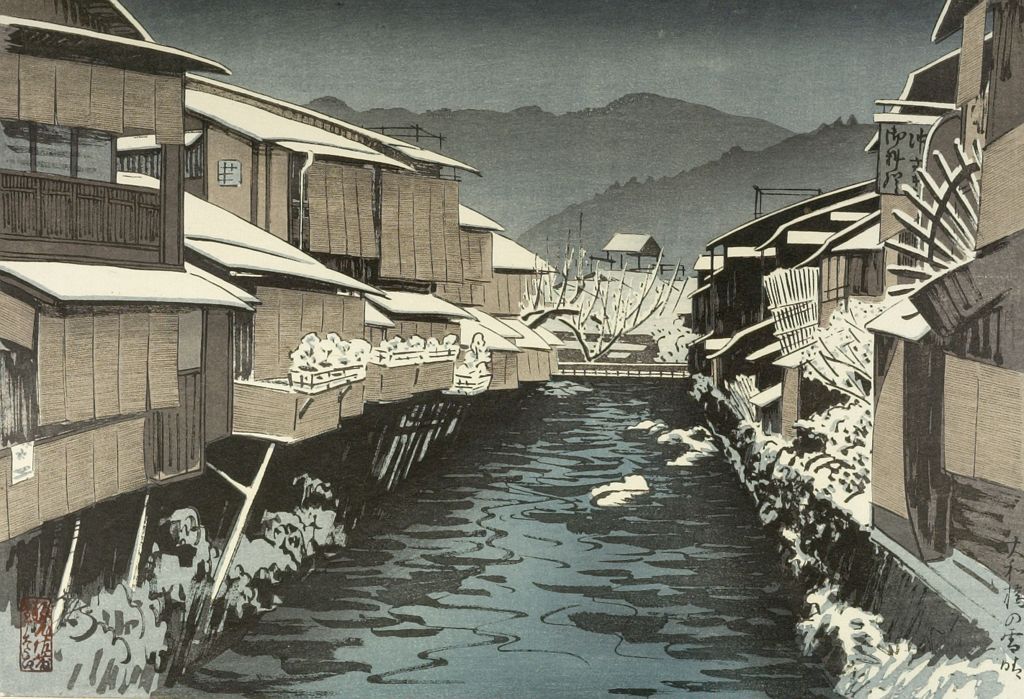
Fair Weather After Snow at Yamato Bridge, Kyoto (Yamato bashi no yukibare), Taishô period, dated 1924
Woodblock print

The Compound of the Tenman Shrine at Kameido in the Snow (Kameido Tenmangu keidai no yuki), from the series "Famous Places in the Eastern Capital (Toto meisho)"
c. 1832/38
Color woodblock print; oban

Miyajima in Snow (Yuki no Miyajima)
Yuki no Miyajima
1929
Color woodblock print; oban
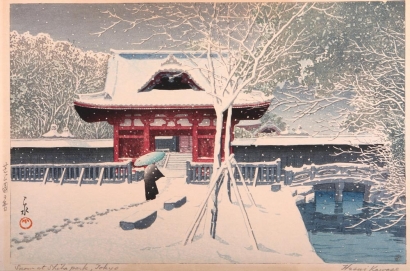
Evening Snow at Shiha Park, Tokyo
1932
Woodblock print
Featured in Collections
Curated cross-cuts that include this print.
Frequently Asked Questions
Morning after snow was created by Yamamoto Shoun (山本昇雲).
Morning after snow depicts snow scenes.