
Biography
Yamazaki Toshinobu (山崎年信, 1857-1886) was a Meiji-period ukiyo-e printmaker and newspaper illustrator whose short career coincided with one of the most consequential transitions in the history of Japanese popular printing. He came of age during the years when the woodblock industry of the late Edo period was being absorbed into the new mass media of the Meiji era, and his work spans both the inherited conventions of nineteenth-century ukiyo-e and the emerging genres of war reportage, newspaper insert prints, and illustrated chronicles of contemporary events. He died at only twenty-eight or twenty-nine, leaving behind a remarkably concentrated body of work that documents the political and military upheavals of Japan's first two decades of modernization.
Toshinobu was born in Edo (modern Tokyo) in 1857, in the closing years of the Tokugawa shogunate, into a family of modest means. He entered the studio of Tsukioka Yoshitoshi (1839-1892), the most original and influential ukiyo-e master of the Meiji period, while still a teenager, reportedly around the age of thirteen. From Yoshitoshi he received the toshi (年) character that became the first element of his go (artist's name), along with his training in the dramatic figural composition and historical narrative subjects for which the Yoshitoshi atelier became famous. Some sources also place him briefly within the wider Utagawa-school orbit that descended from Utagawa Kunisada (1786-1865), though it is the Yoshitoshi connection that defines his artistic identity. He is sometimes designated Yamazaki Toshinobu I to distinguish him from another of Yoshitoshi's pupils who worked under the same Toshinobu (年信) name, Shirai Toshinobu (1866-1903), who is himself sometimes mislabeled "Yamazaki Toshinobu II."
His major output began around 1877, coinciding with two of the defining developments of early Meiji Japan: the Satsuma Rebellion and the rapid expansion of the newspaper industry. The Satsuma Rebellion of 1877, in which the disaffected samurai of Satsuma province rose under the leadership of Saigō Takamori against the centralizing Meiji government, gave Toshinobu his first great subject. He produced approximately thirty woodblock prints documenting the campaign, from the initial uprising at Kagoshima through the fighting around Kumamoto Castle, the rebels' retreat across Kyushu, and the final defeat at Shiroyama in September 1877. These prints helped fix the iconography of Saigō and his commanders in Meiji popular imagination, and they range from scenes of imperial forces in action to the commemorative composition showing the rebel leader's severed head presented to Prince Arisogawa Taruhito, today in the Metropolitan Museum of Art.
From 1878 onward Toshinobu became increasingly identified with nishiki-e shinbun, the lavishly colored woodblock prints inserted into newspapers as visual supplements to the printed text. The most important of these were the prints he produced for the Tokyo paper Chōya shimbun, a leading organ of political journalism in the early Meiji period. His newspaper prints treated imperial ceremonies, sensational crimes, military and naval events, and the new Western customs transforming daily life in Tokyo, and they helped establish the visual vocabulary of Meiji journalism at the moment when illustrated newspapers were becoming a primary source of public information.
In parallel he produced book illustrations and commercial print work, and he designed printed series of historical and contemporary portraits. Late in his short career he turned increasingly to historical and literary subjects drawn from the classical Japanese repertoire. His 1886 triptych Commanders Receiving the Emperor's Drinking Cups, also in the Metropolitan Museum of Art, captures the formal pageantry of late-Meiji official ceremony.
Toshinobu's style synthesized Yoshitoshi's dramatic figural intensity with the documentary impulses of the new Meiji print culture. His battle scenes are populated by sharply individualized commanders and soldiers, his news prints organize complex compositions around a central narrative incident, and his portrait work combines the bold outlines and saturated color of late Edo Utagawa-school nishiki-e with the topical immediacy of the journalistic image. The Meiji aniline dyes that arrived from Europe in the 1870s give his prints the bright magentas, purples, and acid greens that distinguish the period's print production. His Satsuma Rebellion prints contributed to the rise of the senso-e, or war print, a genre that would dominate Japanese popular illustration through the Sino-Japanese War of 1894-1895 and the Russo-Japanese War of 1904-1905.
He died in 1886, before reaching his thirtieth birthday. His work survives today in the Metropolitan Museum of Art and other institutional collections. Within the broader Yoshitoshi lineage, which produced major figures such as Mizuno Toshikata, Migita Toshihide, and Tsukioka Kōgyo, Toshinobu represents the journalistic and documentary wing of the school, the printmaker whose career closed almost as soon as it began but whose work remains valuable for understanding how the woodblock print continued to serve as a vehicle of public information and historical memory at the dawn of modern Japan.
Key Facts
- Active Period
- 1857–1886
- Nationality
- 🇯🇵Japan
- Movement
- Meiji/Taishō Prints
- Works Indexed
- 8
Frequently Asked Questions
Yamazaki Toshinobu (山崎年信, 1857-1886) was a Meiji-period ukiyo-e printmaker and newspaper illustrator whose short career coincided with one of the most consequential transitions in the history of Japanese popular printing. He came of age during the years when the woodblock industry of the late Edo period was being absorbed into the new mass media of the Meiji era, and his work spans both the inherited conventions of nineteenth-century ukiyo-e and the emerging genres of war reportage, newspaper insert prints, and illustrated chronicles of contemporary events. He died at only twenty-eight or twenty-nine, leaving behind a remarkably concentrated body of work that documents the political and military upheavals of Japan's first two decades of modernization.
Yamazaki Toshinobu was active from 1857 to 1886. They were associated with the Meiji/Taishō Prints movement.
Yamazaki Toshinobu's work was shaped by the Meiji/Taishō Prints tradition in Japanese woodblock printmaking. Meiji/Taishō Prints: Meiji and Taishō era prints (1868–1926) bridge the transition from traditional ukiyo-e to the modern shin-hanga and sosaku-hanga movements.
Original prints by Yamazaki Toshinobu can be found in collections including Metropolitan Museum of Art, British Museum (via Wikimedia Commons), Wikimedia Commons, National Diet Library (via Wikimedia Commons).
Woodblock Prints by Yamazaki Toshinobu (8)
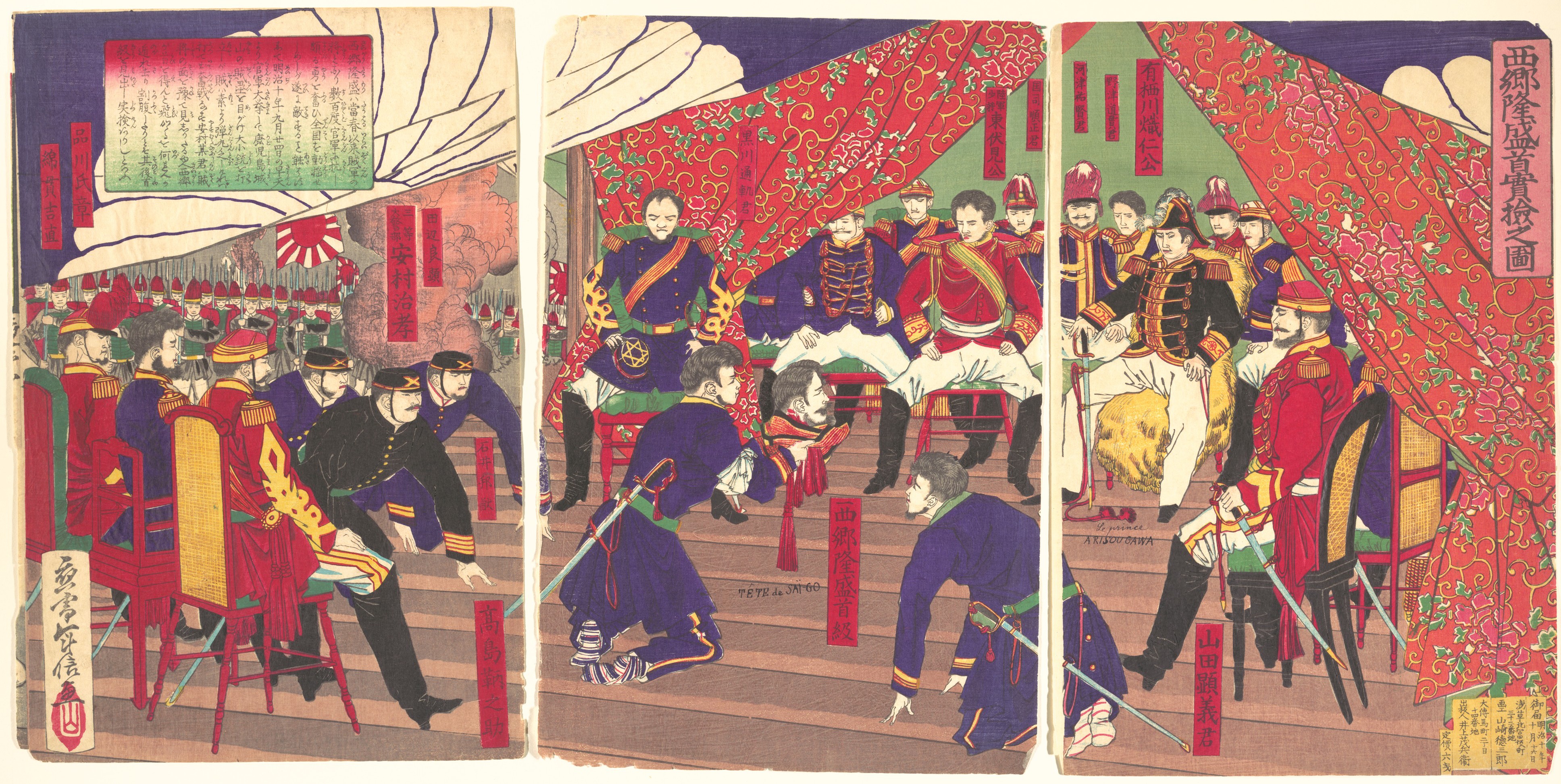
Presentation of the Head of Saigo to the Prince Arisogawa (Saigō ryūsei kubi jikken)
西郷隆盛首実検
Oct. 16, 1877 (Meiji 10)
Triptych of woodblock prints; ink and color on paper

Rebels Besieged at Mount Takachiho (Gyakuto Takachiho rōzan)
逆徒高千穂籠山
1877 (Meiji 10)
Color woodblock print (nishiki-e); ink and color on paper
A Glance at the Distinguished Figures of the Meiji Period (Meiji meiyo ichiran)
明治名誉一覧
1877 (Meiji 10)
Color woodblock print; ink and color on paper
Saigō at Mount Hanaoka during the Kagoshima Rebellion
1877 (Meiji 10)
Color woodblock print (nishiki-e); ink and color on paper
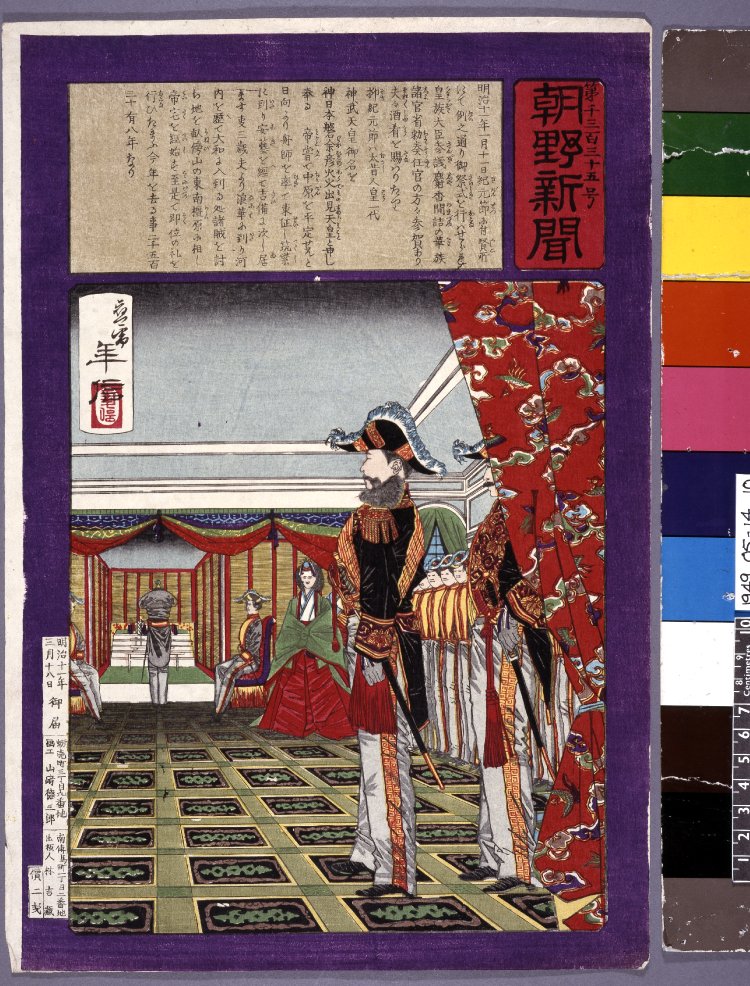
Chōya Shimbun, no. 1335
朝野新聞
18 March 1878 (Meiji 11)
Color woodblock print (nishiki-e shimbun); ink and color on paper

Empire Day of Japan (Kigensetsu)
紀元節
1878 (Meiji 11)
Color woodblock print; ink and color on paper

Hongan-ji Shōnyo and Shimotsuma Raikei, from Ishiyama Daigunkiki
石山大軍記 第二号
1878 (Meiji 11)
Color woodblock print (nishiki-e); ink and color on paper
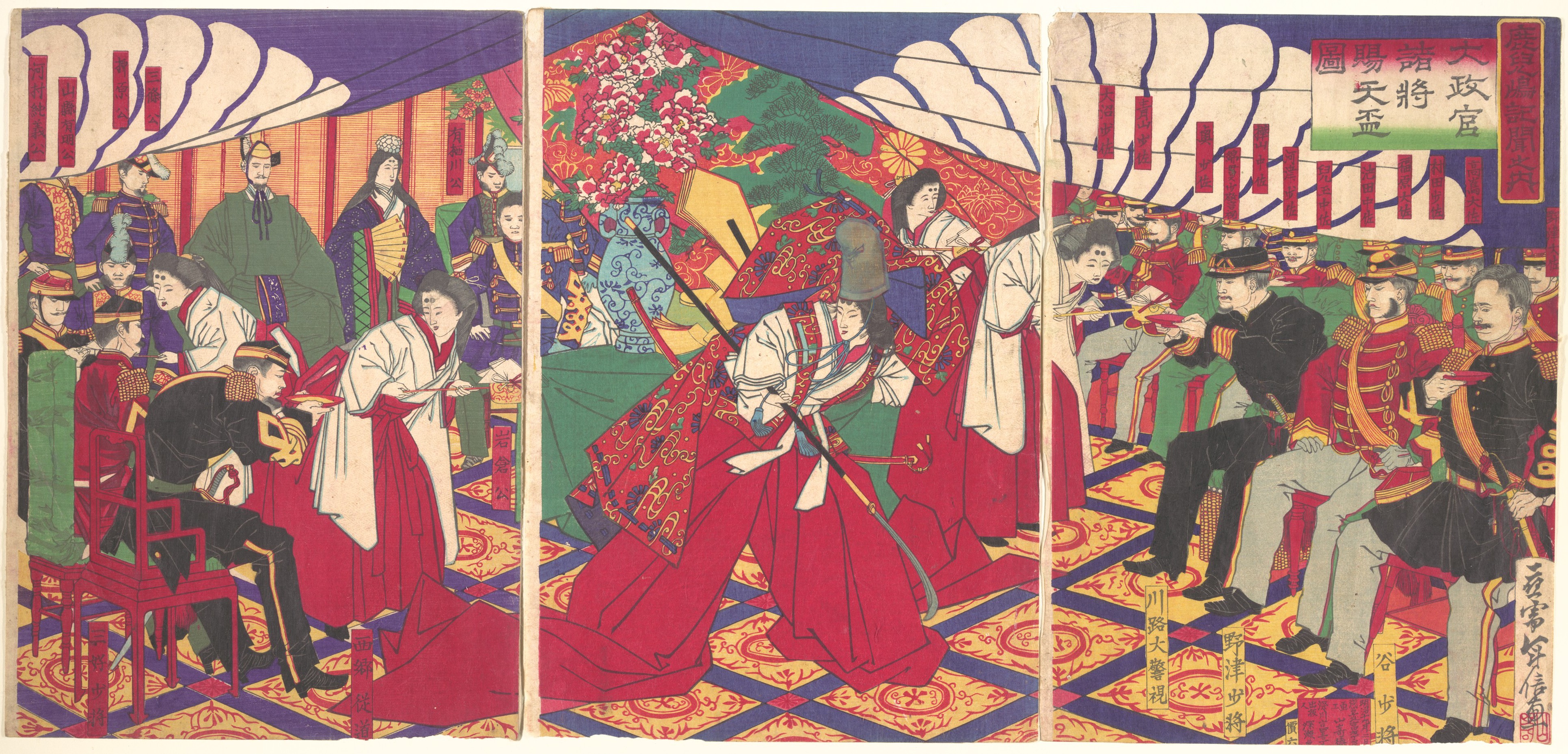
Commanders Receiving the Emperor's Drinking Cups (Taiseikan shōshō shiten)
大政官将相賜典
1886 (Meiji 19)
Triptych of woodblock prints; ink and color on paper