
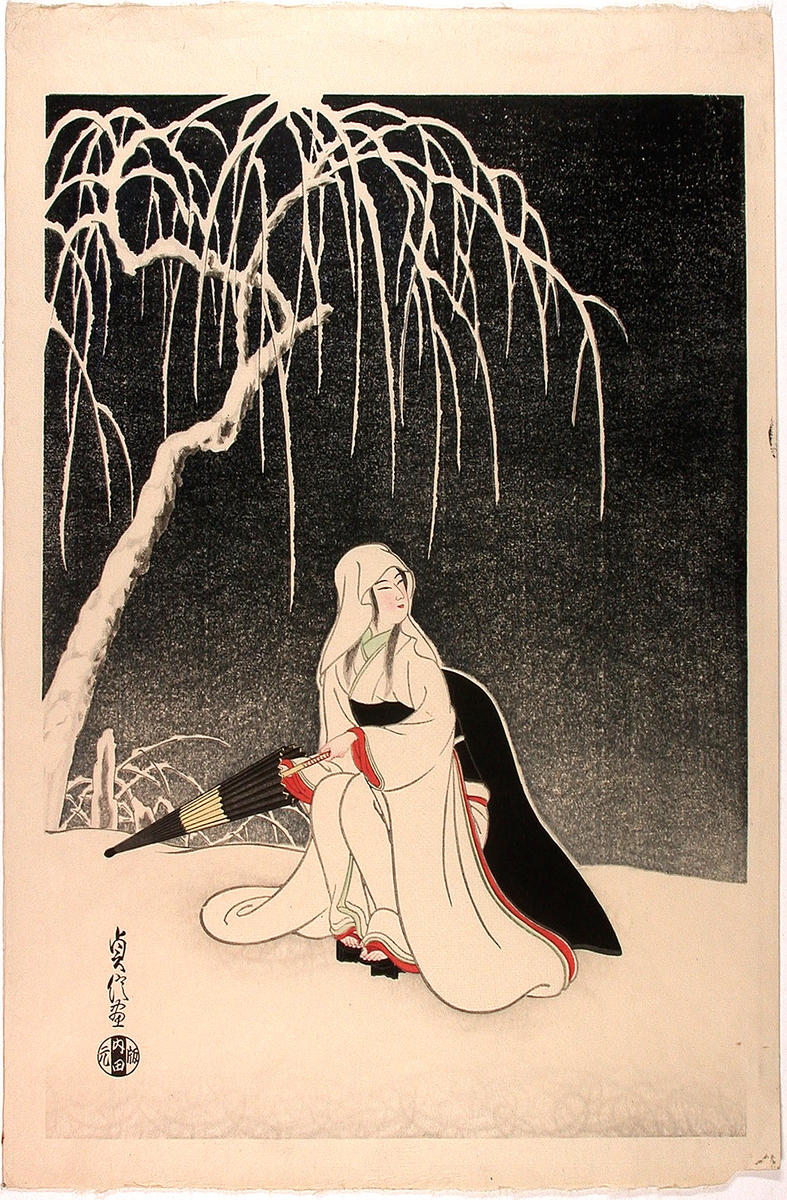
Young woman in winter dress
- Medium:
- Mokuhanga (Japanese woodblock)
- Image courtesy of
- Saru Gallery
Description
A single-figure portrait of a woman in heavy seasonal kimono, situating Fujimori within the sosaku-hanga reworking of the bijin-ga tradition. Where Edo-period publishers presented idealized beauties as commercial product, sosaku-hanga artists treated the female figure as a subject for direct observation, often a specific sitter rather than a type. Winter dress prints of this period typically emphasize layered textiles — padded collars, dense pattern repeats, the bulk of a haori over an under-kimono — which gave the artist scope to exploit flat planes of carved color against fine linear detail. Bokashi gradations were commonly used in such works to suggest the soft fall of light on fabric or the muted palette of winter interiors. Fujimori's handling reflects the sosaku-hanga conviction that the artist's hand should be present at every stage, so the print's textures and registration carry the imprint of his own carving and baren work. The subject connects to a broader interwar interest among Japanese print artists in the modern woman, observed rather than idealized.
More Prints by Fujimori Shizuo
More Winter Prints
Featured in Collections
Curated cross-cuts that include this print.
Frequently Asked Questions
Young woman in winter dress was created by Fujimori Shizuo (藤森静雄).
Young woman in winter dress depicts winter.