
Gate of Myoshinji Temple
- Medium:
- Mokuhanga (Japanese woodblock)
- Image courtesy of
- Saru Gallery
Description
The Sanmon of Myoshin-ji in Hanazono, northwest Kyoto, head temple of the Myoshinji branch of Rinzai Zen and one of the largest temple complexes in the city. The two-story timber gate dates to 1599 and stands within a walled compound of more than forty subtemples. Kitaoka's print likely treats the gate's heavy proportions and tile-roofed silhouette through dark blocks of pigment for the timberwork and lighter passages for plaster walls and the approach, with the carved grain of the woodblock often left visible in flat color areas. Architectural subjects allowed him to work with the rectilinear geometries that mokuhanga handles cleanly—straight beams, right-angle joints, hipped roofs—while reserving softer treatment for surrounding trees or sky. The print belongs to a broader strand of postwar sosaku-hanga that revisited the historic temples and shrines of Kyoto and Nara through a contemporary graphic vocabulary.
More Prints by Fumio Kitaoka



More Temples & Shrines Prints
Fushimi Inari Temple
伏見稲荷
Woodblock print

The Compound of the Tenman Shrine at Kameido in the Snow (Kameido Tenmangu keidai no yuki), from the series "Famous Places in the Eastern Capital (Toto meisho)"
c. 1832/38
Color woodblock print; oban
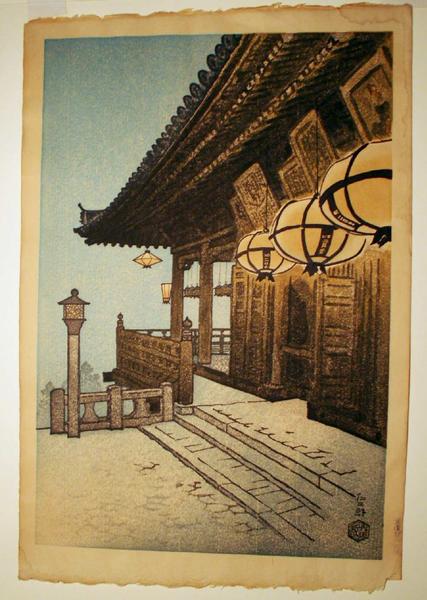
Temple with lanterns
Woodblock print

A Section of the Byodo Temple at Uji (Uji Byodoin no ichibu), from the series "Souvenirs of Travel, Second Series (Tabi miyage dai nishu)"
Uji Byodoin no ichibu
1921
Color woodblock print; oban
Featured in Collections
Curated cross-cuts that include this print.
Frequently Asked Questions
Gate of Myoshinji Temple was created by Fumio Kitaoka (北岡文雄).
Gate of Myoshinji Temple depicts temples & shrines.