
Kintai bridge
- Medium:
- Mokuhanga (Japanese woodblock)
- Image courtesy of
- Saru Gallery
Description
Kintai bridge depicts the five-arch wooden span over the Nishiki River at Iwakuni in Yamaguchi Prefecture, originally constructed in 1673 and rebuilt after typhoon damage in the postwar period. The print belongs to the meisho-e tradition of famous-place views, though filtered through Kitaoka's modernist sensibility: rather than the panoramic theatrics of Hokusai or Hiroshige, the composition likely emphasizes the geometric repetition of the wooden arches against the river surface. The carved blocks would distinguish the bridge's construction joinery from the smoother washes of water and sky, with bokashi gradations possibly used for atmospheric transitions in the background hills. Kintai-kyō has been a subject for Japanese printmakers since the Edo period, and Kitaoka's treatment connects to his broader interest in Japan's traditional architectural and landscape heritage, observed through the lens of a postwar artist who had also recorded the streets of Paris and New York. The print sits among his Japanese subjects, where the country's familiar landmarks are renewed through the formal vocabulary of sosaku-hanga.
More Prints by Fumio Kitaoka


More Bridges Prints
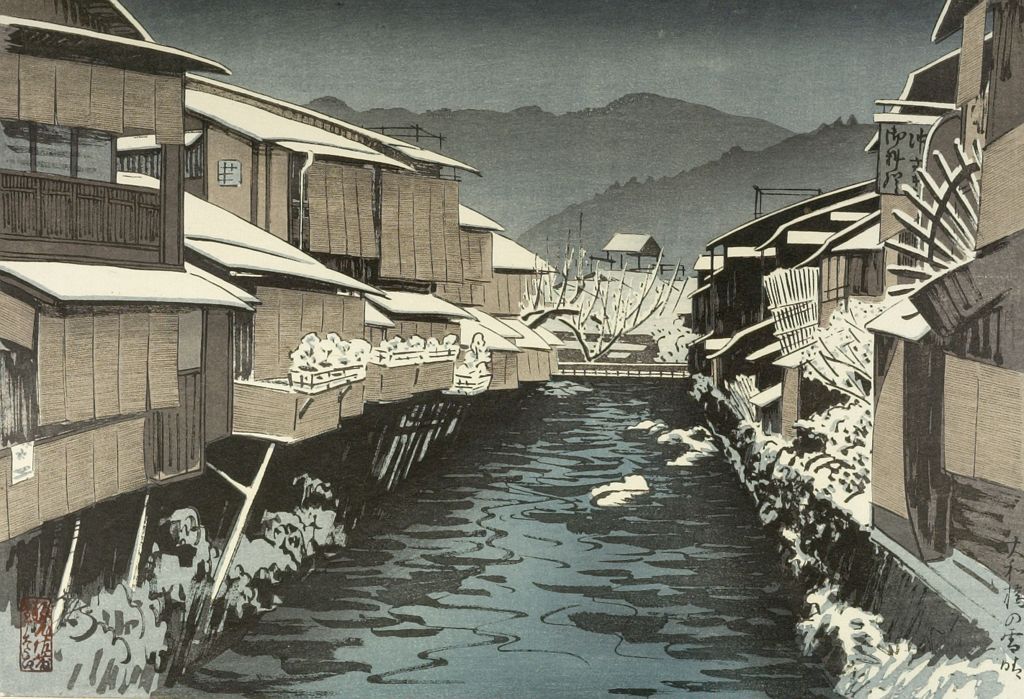
Fair Weather After Snow at Yamato Bridge, Kyoto (Yamato bashi no yukibare), Taishô period, dated 1924
Woodblock print
![Mount Fuji on a Moonlit Night, Kawai Bridge (Tsukiyo no Fuji [Kawaibashi]), from the series "Selection of Views of the Tokaido (Tokaido fukei senshu)" by Kawase Hasui](https://www.artic.edu/iiif/2/d0960668-1e73-339a-b182-fb995a54bff0/full/843,/0/default.jpg)
Mount Fuji on a Moonlit Night, Kawai Bridge (Tsukiyo no Fuji [Kawaibashi]), from the series "Selection of Views of the Tokaido (Tokaido fukei senshu)"
1947
Color woodblock print; oban

Shin Ohashi Bridge (Shin Ohashi), from the series "Twenty View of Tokyo (Tokyu nijukkei)"
1926
Color woodblock print; oban

Sacred Bridge in Nikko (Nikko Shinkyo)
1930
Color woodblock print; oban
Featured in Collections
Curated cross-cuts that include this print.
Frequently Asked Questions
Kintai bridge was created by Fumio Kitaoka (北岡文雄).
Kintai bridge depicts bridges.