
Myoshinji Temple gate
- Medium:
- Mokuhanga (Japanese woodblock)
- Image courtesy of
- Saru Gallery
Description
"Myoshinji Temple gate" depicts the sanmon of Myoshinji, the head temple of the Myoshinji branch of Rinzai Zen and one of the largest monastic complexes in Kyoto. Founded in 1342 on the former villa grounds of Emperor Hanazono in the Hanazono district of northwest Kyoto, Myoshinji preserves a sequence of monumental wooden gates, of which the two-storey sanmon (rebuilt in 1599) is the largest. The print belongs to the meisho-e or famous-place tradition, but executed in the sosaku-hanga register: rather than the publisher-driven topographic surveys of Hiroshige or Hasui's shin-hanga reinterpretations, Kitaoka approached the temple as a personal architectural subject. Compositionally, temple-gate prints of this kind typically exploit the strong horizontal of the entablature against the vertical pillars, with the dense black of the key block carrying the structural weight and bokashi gradations softening the stone foundations or surrounding foliage. Within Kitaoka's oeuvre, his Kyoto temple subjects sit between his earlier social-realist documentation and his later abstract landscape work as a more meditative middle register.
More Prints by Fumio Kitaoka



More Temples & Shrines Prints
Fushimi Inari Temple
伏見稲荷
Woodblock print

The Compound of the Tenman Shrine at Kameido in the Snow (Kameido Tenmangu keidai no yuki), from the series "Famous Places in the Eastern Capital (Toto meisho)"
c. 1832/38
Color woodblock print; oban
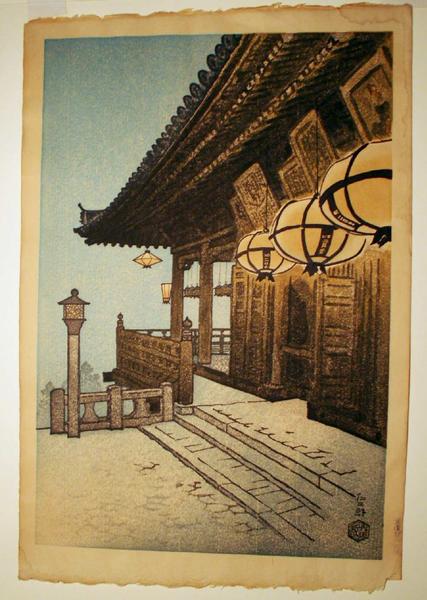
Temple with lanterns
Woodblock print

A Section of the Byodo Temple at Uji (Uji Byodoin no ichibu), from the series "Souvenirs of Travel, Second Series (Tabi miyage dai nishu)"
Uji Byodoin no ichibu
1921
Color woodblock print; oban
Featured in Collections
Curated cross-cuts that include this print.
Frequently Asked Questions
Myoshinji Temple gate was created by Fumio Kitaoka (北岡文雄).
Myoshinji Temple gate depicts temples & shrines.