
Hall of the Great Buddha
by Hideo Takeda
- Medium:
- Mokuhanga (Japanese woodblock)
- Image courtesy of
- Saru Gallery
Description
This second composition on the same subject — the 1180 burning of the Daibutsuden at Todai-ji by Taira no Shigehira — gives Takeda occasion to revisit a scene from a different vantage. Working in mokuhanga, he treats the Saru series as a sequence of variations rather than a fixed iconographic program, and paired views of a single event align with the way handscroll painters had long composed sequential scenes around one episode. The destruction of the Buddhist site is among the more morally weighted passages in the Heike chronicle, and Takeda's monkey cast preserves the gravity of the source even as it caricatures it. Compositional devices typical of the series recur here: flat color, strong contour, asymmetric grouping of figures, and the architectural framework of a temple complex used as a stage. The print belongs to the body of work most widely associated with Takeda outside Japan, exhibited at venues including the Tokyo National Museum.
More Prints by Hideo Takeda
More Religious Prints

The Great Buddha, Kamakura (Kamakura Daibutsu)
Kamakura Daibutsu
1930
Color woodblock print

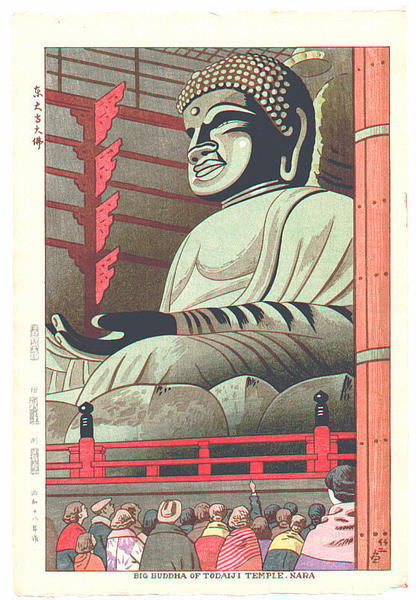
Hall of the Great Buddha (Nara Daibutsuden)
1950
Color woodblock print
Great Buddha
大仏
Woodblock print

Clearing after a Snowfall at the Kannon Temple in Asakusa (Asakusa Kannon no yukibare), from the series "Twenty Views of Tokyo (Tokyo nijukkei)"
1926
Color woodblock print; oban
Featured in Collections
Curated cross-cuts that include this print.
Frequently Asked Questions
Hall of the Great Buddha was created by Hideo Takeda (武田秀雄).
Hall of the Great Buddha depicts religious.