
Chikara-mochi cakes at Miidera Temple
- Medium:
- Mokuhanga (Japanese woodblock)
- Image courtesy of
- Saru Gallery
Description
Mii-dera (Onjo-ji), a Tendai temple on the western shore of Lake Biwa near Otsu, was associated with chikara-mochi — pounded rice cakes whose name (strength mochi) referred to the vigor believed to be imparted by their consumption. They were sold at teahouses adjoining the temple precincts. Nakazawa's print likely shows a teahouse scene with figures and mochi displayed in the foreground, integrating genre observation with temple architecture. This kind of picturesque travel subject was central to the meisho-e tradition that shin-hanga and sosaku-hanga artists revived in the 1920s and 1930s, when domestic tourism expanded and prints catering to nostalgia for the Kansai region found a market. Nakazawa's contribution diverges from the more decorative shin-hanga approach in its painterly handling: forms are softened by bokashi gradations rather than defined by crisp outline, and the atmosphere recalls the watercolor sketches he produced throughout his parallel career as an oil painter exhibiting at government salons.
More Prints by Hiromitsu Nakazawa
More Temples & Shrines Prints
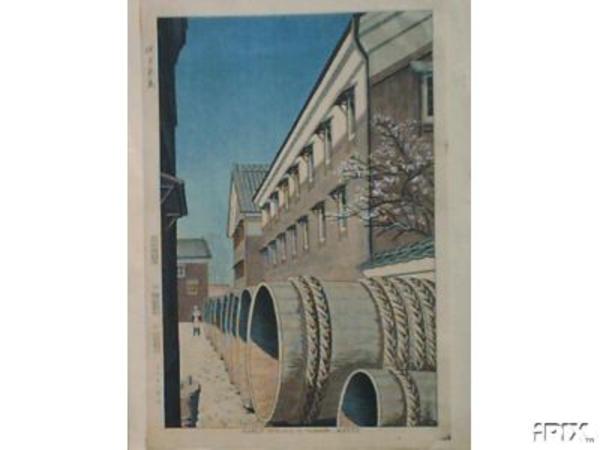
Fushimi Inari Temple
伏見稲荷
Woodblock print

The Compound of the Tenman Shrine at Kameido in the Snow (Kameido Tenmangu keidai no yuki), from the series "Famous Places in the Eastern Capital (Toto meisho)"
c. 1832/38
Color woodblock print; oban
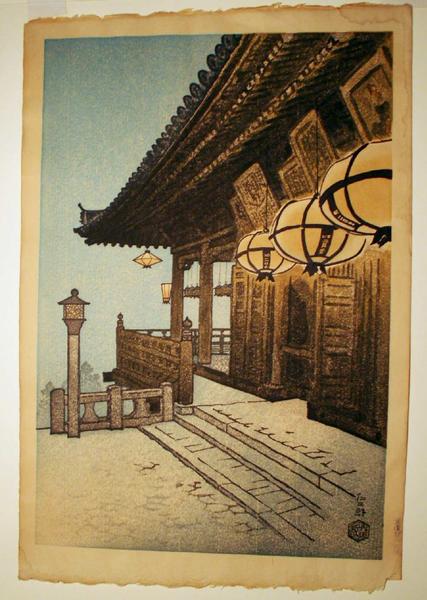
Temple with lanterns
Woodblock print

A Section of the Byodo Temple at Uji (Uji Byodoin no ichibu), from the series "Souvenirs of Travel, Second Series (Tabi miyage dai nishu)"
Uji Byodoin no ichibu
1921
Color woodblock print; oban
Featured in Collections
Curated cross-cuts that include this print.
Frequently Asked Questions
Chikara-mochi cakes at Miidera Temple was created by Hiromitsu Nakazawa (中沢弘光).
Chikara-mochi cakes at Miidera Temple depicts temples & shrines.