
Sanjo Bridge, Kyoto
- Medium:
- Mokuhanga (Japanese woodblock)
- Image courtesy of
- Saru Gallery
Description
Sanjo Ohashi spans the Kamo River and historically marked the eastern terminus of the Tokaido road from Edo. Nakazawa's treatment likely emphasizes the geometry of the bridge's wooden balustrades and stone pylons set against the water and the Higashiyama hills beyond. His Western-painting background informs the perspective: rather than the elevated diagonal viewpoint of Edo-period meisho-e, he adopts a level eye, treating architecture as a structural problem in the manner of the Impressionist urban landscapists he absorbed through Kuroda Seiki's teaching at the Tokyo School of Fine Arts. The print sits within his project of applying yoga sensibilities to woodblock printing — preserving the paper's grain and the pigment's transparency while organizing the image by tonal mass rather than crisp outline. Sanjo Bridge appears across the work of nearly every shin-hanga and sosaku-hanga landscapist of the period; Nakazawa's contribution differs in its painterly restraint, declining the dramatic weather effects favored by Hasui or Yoshida.
More Prints by Hiromitsu Nakazawa
More Bridges Prints
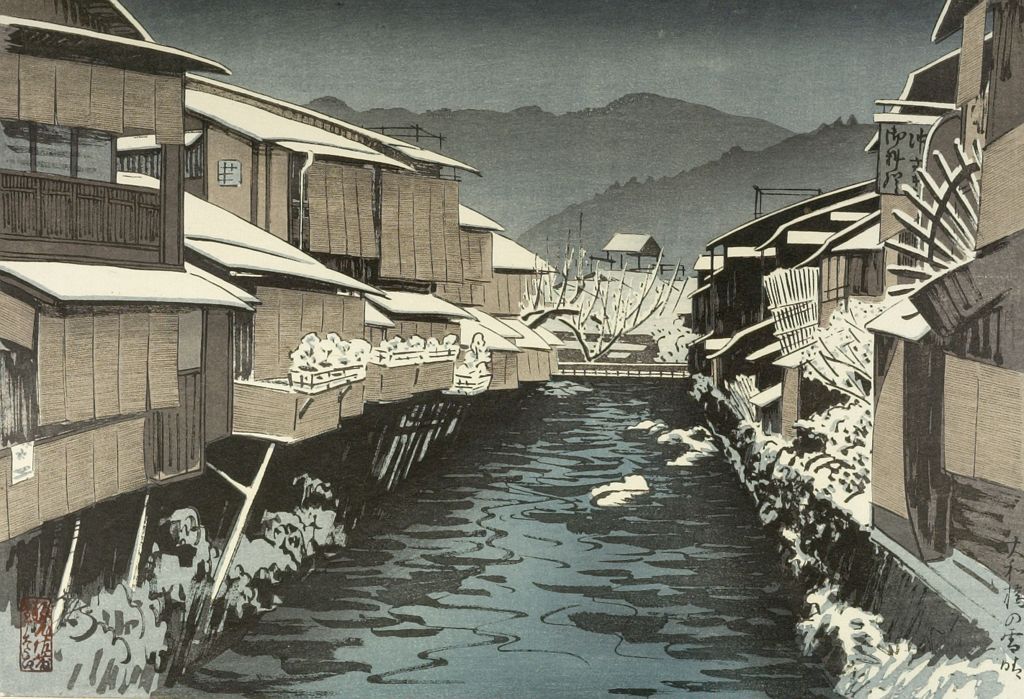
Fair Weather After Snow at Yamato Bridge, Kyoto (Yamato bashi no yukibare), Taishô period, dated 1924
Woodblock print
![Mount Fuji on a Moonlit Night, Kawai Bridge (Tsukiyo no Fuji [Kawaibashi]), from the series "Selection of Views of the Tokaido (Tokaido fukei senshu)" by Kawase Hasui](https://www.artic.edu/iiif/2/d0960668-1e73-339a-b182-fb995a54bff0/full/843,/0/default.jpg)
Mount Fuji on a Moonlit Night, Kawai Bridge (Tsukiyo no Fuji [Kawaibashi]), from the series "Selection of Views of the Tokaido (Tokaido fukei senshu)"
1947
Color woodblock print; oban

Shin Ohashi Bridge (Shin Ohashi), from the series "Twenty View of Tokyo (Tokyu nijukkei)"
1926
Color woodblock print; oban

Sacred Bridge in Nikko (Nikko Shinkyo)
1930
Color woodblock print; oban
Featured in Collections
Curated cross-cuts that include this print.
Frequently Asked Questions
Sanjo Bridge, Kyoto was created by Hiromitsu Nakazawa (中沢弘光).
Sanjo Bridge, Kyoto depicts bridges.