
Shisendo Shrine
- Medium:
- Mokuhanga (Japanese woodblock)
- Image courtesy of
- Saru Gallery
Description
Shisendo, more precisely a hermitage and Buddhist retreat than a Shinto shrine, was founded in 1641 by the samurai-poet Ishikawa Jozan in the Ichijoji district at the foot of Mount Hiei, northeast of Kyoto. The complex is known for its garden of clipped azaleas and raked white sand, and for a simple thatched hall whose interior bears portraits of thirty-six Chinese poets Jozan revered—the source of the name 'Shisen-do,' Hall of the Poetry Immortals. It was the kind of literati retreat that appealed to early-twentieth-century Japanese artists who valued its association with bunjin (literati) culture and its garden-centered aesthetic. Nakazawa's print likely focuses on the garden, the thatched eaves, or the approach path—subjects amenable to atmospheric treatment in tonal woodblock printing. His handling, consistent with sosaku-hanga practice, prioritizes the experience of the site over topographical detail, using bokashi gradations for foliage and sky to evoke the secluded character that has long defined Shisendo's reputation among Kyoto's hermitage gardens.
More Prints by Hiromitsu Nakazawa
More Temples & Shrines Prints

Fushimi Inari Temple
伏見稲荷
Woodblock print

The Compound of the Tenman Shrine at Kameido in the Snow (Kameido Tenmangu keidai no yuki), from the series "Famous Places in the Eastern Capital (Toto meisho)"
c. 1832/38
Color woodblock print; oban
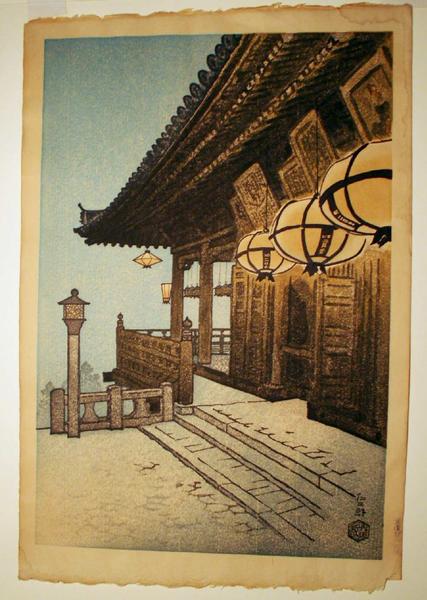
Temple with lanterns
Woodblock print

A Section of the Byodo Temple at Uji (Uji Byodoin no ichibu), from the series "Souvenirs of Travel, Second Series (Tabi miyage dai nishu)"
Uji Byodoin no ichibu
1921
Color woodblock print; oban
Featured in Collections
Curated cross-cuts that include this print.
Frequently Asked Questions
Shisendo Shrine was created by Hiromitsu Nakazawa (中沢弘光).
Shisendo Shrine depicts temples & shrines.