Arashiyama
- Medium:
- Woodblock print
- Source:
- Art Gallery of Greater Victoria
- Image courtesy of
- Art Gallery of Greater Victoria
Description
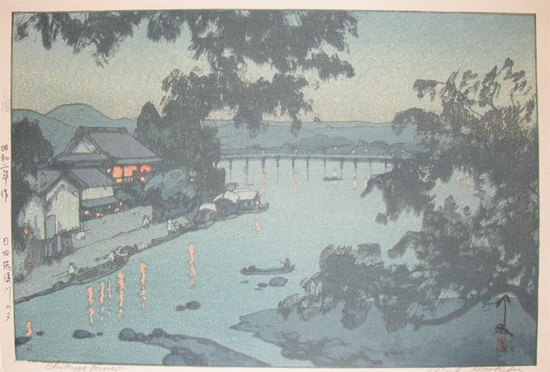
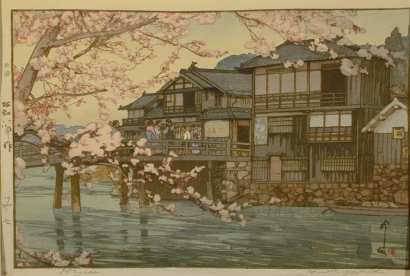
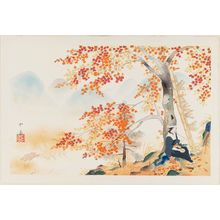
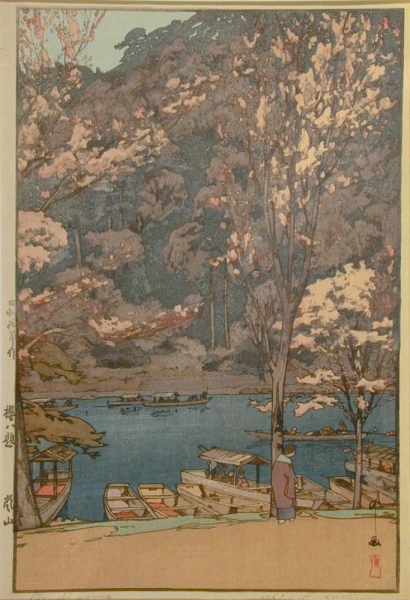
Arashiyama, the mountainous district at the western edge of Kyoto along the Oi River (also called the Hozu and Katsura), has been celebrated in Japanese poetry and painting since the Heian period for its seasonal beauty — autumn maples, spring cherries, and the dramatic profile of the Togetsu-kyo bridge spanning the river below wooded hills. Yoshida's composition likely positions the iconic bridge as a horizontal axis across the middle ground, with the forested hills of Arashiyama rising behind and the river reflecting the sky in the foreground. The subject is [meisho-e](/glossary/meisho-e) of the highest classical pedigree, and Yoshida's treatment would bring his characteristic atmospheric sensitivity — graduated sky tones, reflective water surfaces achieved through multiple [bokashi](/glossary/bokashi) passes, and precise rendering of deciduous trees — to a landscape carrying centuries of literary association. The dampened [washi](/glossary/washi) printing method would allow the river reflection to read as a continuous tonal field, distinguishing it from the harder outlines of the bridge and mountain forms above.