
Camping at Washibadake
- Date:
- 1926
- Medium:
- Color woodblock print
- Format:
- Oban
- Dimensions:
- 26.2 × 40.8 cm
- Publisher:
- Yoshida Studio
- Source:
- Art Institute of Chicago
Description
Printed in 1926, this work documents a mountain encampment at Washibadake — "eagle cliff" — in the Japanese Alps, likely during one of Yoshida's celebrated alpine expeditions. A tent or bivouac nestles among the high crags, conveying the solitude and raw grandeur that drew Yoshida repeatedly into the mountains as both painter and climber. His training in Western light effects gives the rocky terrain a sculptural dimensionality rare in woodblock art of the period.
More Prints by Hiroshi Yoshida
More Landscapes Prints

Lake Kugushi in Wakasa Province (Wakasa Kugushiko), from the series Souvenirs of Travel I (Tabi miyage dai isshu)"
Wakasa Kugushiko
1920
Color woodblock print; oban
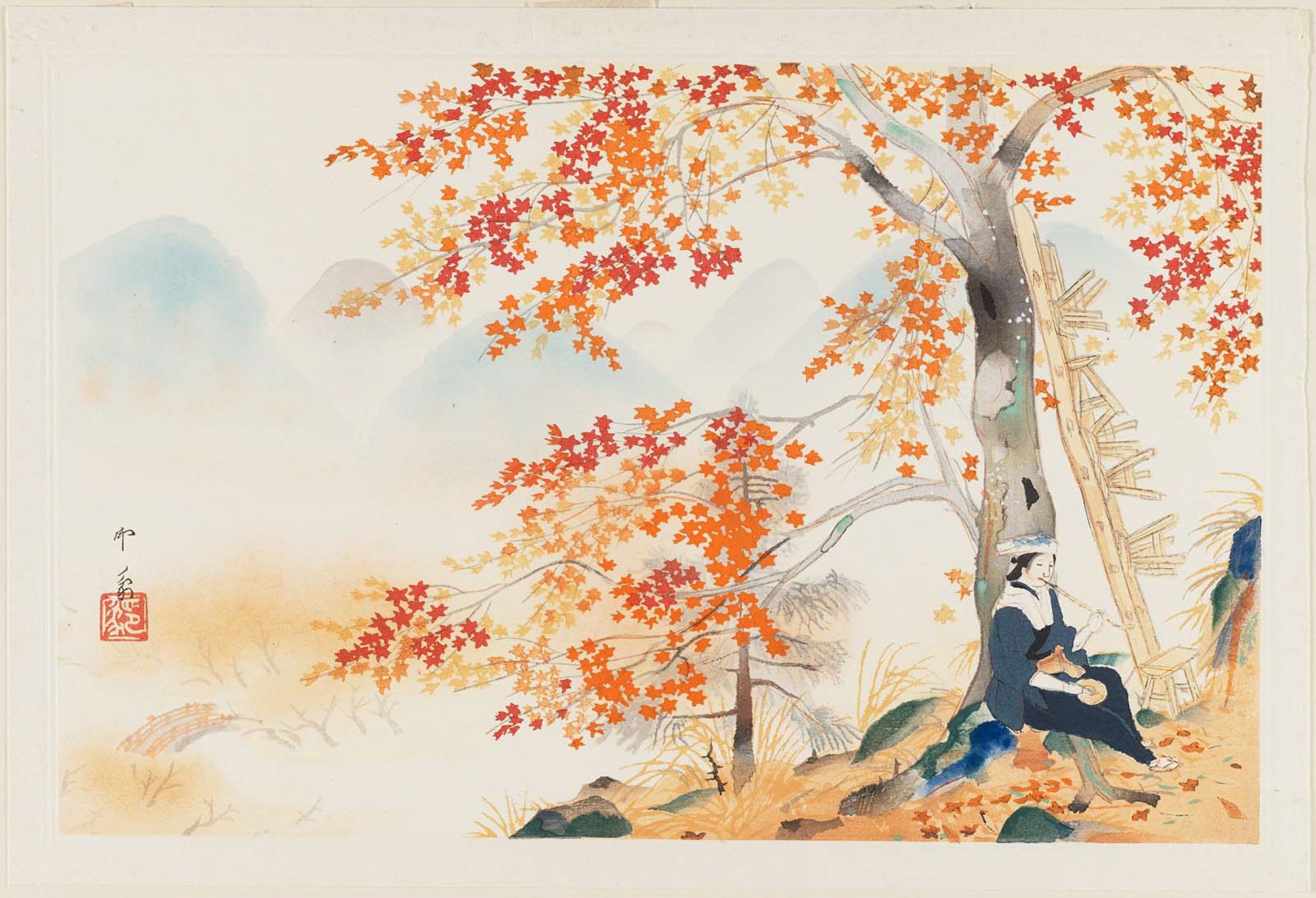
Autumn Maple Leaves at Takao, from the album Eight Views of Kyoto (Kyôto hakkei)
Woodblock print

The Beach at Kaiganji in Sanuki Province (Sanuki Kaiganji no hama), from the series "Collection of Views of Japan II, Kansai Edition (Nihon fukei shu II Kansai hen)"
1934
Color woodblock print; oban

Tea Kettle, section of a sheet from the series "Mirror of Stone Rubbings of Views of the Provinces" (Kohon meihitsu ishizuri kagami)
n.d.
Woodblock print; ishizuri-e, section of harimaze sheet
Featured in Collections
Curated cross-cuts that include this print.
Frequently Asked Questions
Camping at Washibadake was created by Hiroshi Yoshida (吉田博) in 1926.
Camping at Washibadake uses Bokashi, Nishiki-e, and Moku-hanga, on color woodblock print.
Camping at Washibadake was published by Yoshida Studio (1926).
Camping at Washibadake depicts landscapes, travel scenes, and mountains.
Camping at Washibadake measures 26.2 × 40.8 cm (Oban format).