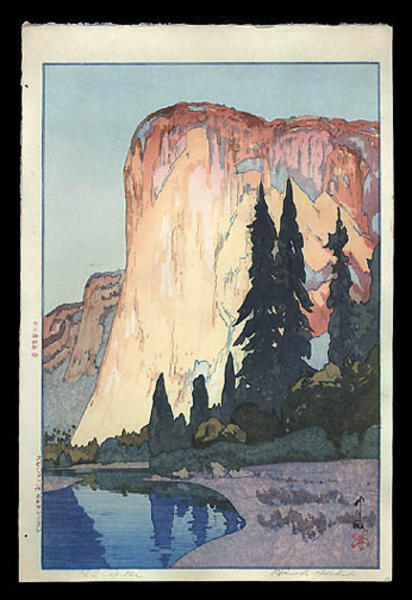
El Capitan
- Date:
- 1925
- Medium:
- Woodblock print
- Format:
- Oban
- Publisher:
- Yoshida Studio
- Source:
- Japanese Art Open Database
Description
El Capitan — the three-thousand-foot granite monolith rising from the floor of Yosemite Valley in California, one of the largest exposed granite faces on earth — provided Yoshida with a subject of monumental geological scale during his 1925 North American travels. The sheer vertical immensity of El Capitan, which rises nearly a kilometer above the valley floor and presents an unbroken wall of light-grey granite to the valley, demanded a compositional approach unlike anything the Japanese Alps had required: here, the mountain was not a summit with slopes and snowfields but a wall of stone, its face catching and releasing light in subtle variations across an otherwise uniform grey surface. Yoshida's treatment of this distinctly American geological spectacle brought his oil painter's sensitivity to granite to bear on a landscape of global significance.
More Prints by Hiroshi Yoshida
More Landscapes Prints

Lake Kugushi in Wakasa Province (Wakasa Kugushiko), from the series Souvenirs of Travel I (Tabi miyage dai isshu)"
Wakasa Kugushiko
1920
Color woodblock print; oban
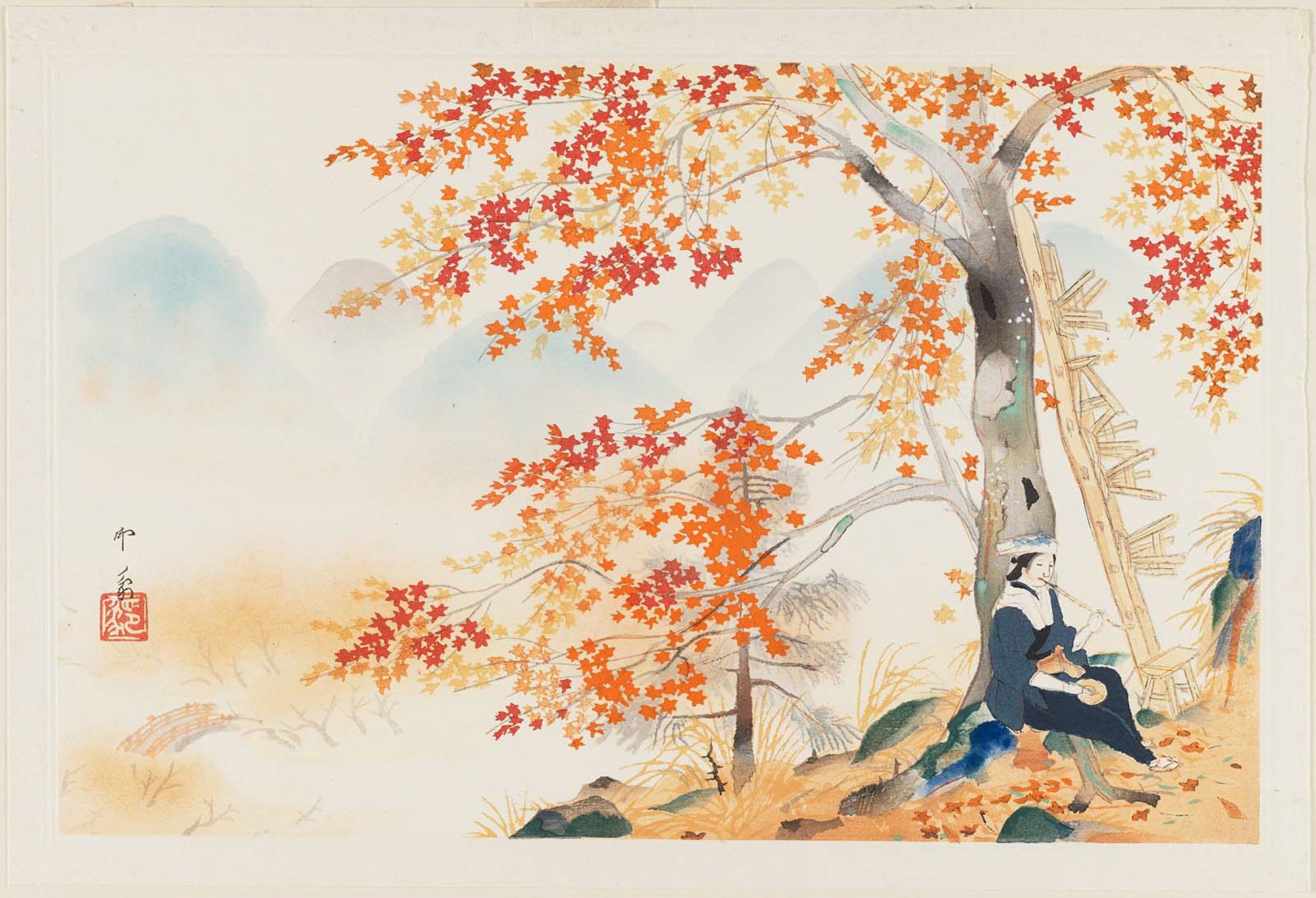
Autumn Maple Leaves at Takao, from the album Eight Views of Kyoto (Kyôto hakkei)
Woodblock print

The Beach at Kaiganji in Sanuki Province (Sanuki Kaiganji no hama), from the series "Collection of Views of Japan II, Kansai Edition (Nihon fukei shu II Kansai hen)"
1934
Color woodblock print; oban

Tea Kettle, section of a sheet from the series "Mirror of Stone Rubbings of Views of the Provinces" (Kohon meihitsu ishizuri kagami)
n.d.
Woodblock print; ishizuri-e, section of harimaze sheet
Featured in Collections
Curated cross-cuts that include this print.
Frequently Asked Questions
El Capitan was created by Hiroshi Yoshida (吉田博) in 1925.
El Capitan was published by Yoshida Studio (1925).
El Capitan depicts landscapes, travel scenes, and mountains.