
Kamogawa in Kyoto
- Date:
- 1933
- Medium:
- Color woodblock print
- Format:
- Oban
- Dimensions:
- 40.6 × 26.9 cm
- Publisher:
- Yoshida Studio
- Source:
- Art Institute of Chicago
Description
Yoshida depicts the Kamogawa as it flows through Kyoto in this 1933 print, framing the river between the distinctive stepped banks and teahouse galleries (yuka) that define the river's character through the Pontocho district. The Kamo River has been the social and visual spine of Kyoto since the city's founding, its banks hosting seasonal festivals, traditional entertainments, and the daily commerce of the imperial city. Yoshida's treatment captures the river at a moment when human activity and natural environment achieve one of their periodic moments of balance — the city present but not overwhelming, the water moving through it with indifferent continuity. The composition reflects his understanding that urban landscapes have their own form of natural integrity.
More Prints by Hiroshi Yoshida
More Urban Scenes Prints
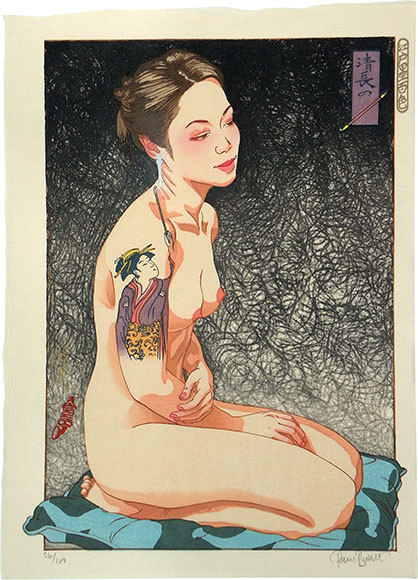
A Hundred Shades of Ink of Edo: Kiyonaga's Pipe (Edo zumi hyaku shoku: Kiyonaga no kiseru)
Woodblock print

View of Kabuki Theater from Matsuya (Ginza Matsuya yori Kabukiza), no. 3 from the series "Pictures of Ginza, First Series (Gashu Ginza dai isshu)"
1928
Color lithograph

Distant View of Mitsukoshi Movie Theater in Shinjuku from the Sixth Floor of Hoteiya (Hoteiya rokkai kara Shinjuku Mitsukoshi Musashi no kan enbo zu), no. 1 from the series "Scenery of Shinjuku (Gashu Shinjuku fukei)"
1930
Color lithograph
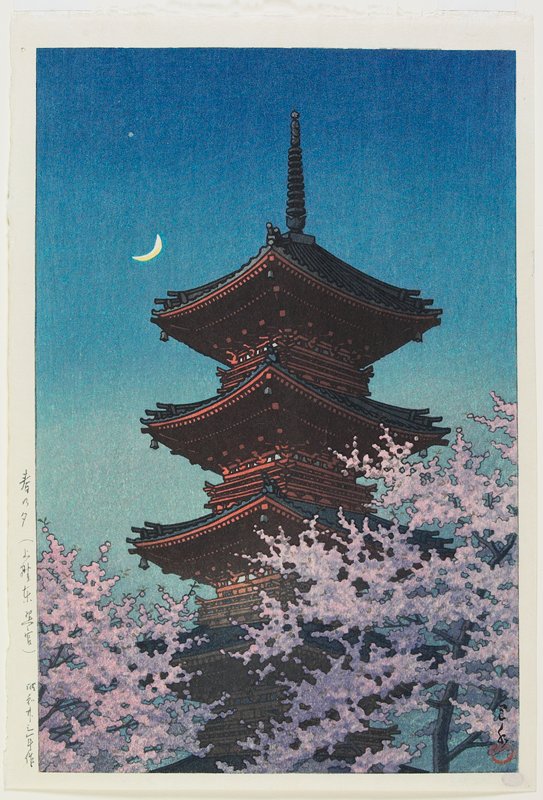
Spring Dusk at the Tōshō Shrine in Ueno
1948
Woodblock print, ink and color on paper
Featured in Collections
Curated cross-cuts that include this print.
Frequently Asked Questions
Kamogawa in Kyoto was created by Hiroshi Yoshida (吉田博) in 1933.
Kamogawa in Kyoto uses Moku-hanga, Nishiki-e, and Bokashi, on color woodblock print.
Kamogawa in Kyoto was published by Yoshida Studio (1933).
Kamogawa in Kyoto depicts urban scenes, landscapes, and rivers & lakes, set at Kyoto.
Kamogawa in Kyoto measures 40.6 × 26.9 cm (Oban format).