
Shokozan
- Date:
- 1939
- Medium:
- Color woodblock print
- Format:
- Oban
- Dimensions:
- 26.9 × 40.7 cm
- Publisher:
- Yoshida Studio
- Source:
- Art Institute of Chicago
Description
Shokozan — a mountain name suggesting a "mountain of pine and fragrance," possibly a specific peak in Japan or China encountered during Yoshida's Asian travels — appears in this 1939 print as a landscape rendered in the mature, atmospheric style of his late career. By 1939 Yoshida had spent over four decades perfecting his translation of observed landscape into the woodblock medium, and his treatment of any mountain subject at this point reflects the accumulated authority of that experience: the sky gradations precisely calibrated, the relationship between near and distant elements precisely weighted, the atmospheric conditions rendered with a specificity that goes beyond formula into direct perceptual observation.
More Prints by Hiroshi Yoshida
More Landscapes Prints

Lake Kugushi in Wakasa Province (Wakasa Kugushiko), from the series Souvenirs of Travel I (Tabi miyage dai isshu)"
Wakasa Kugushiko
1920
Color woodblock print; oban
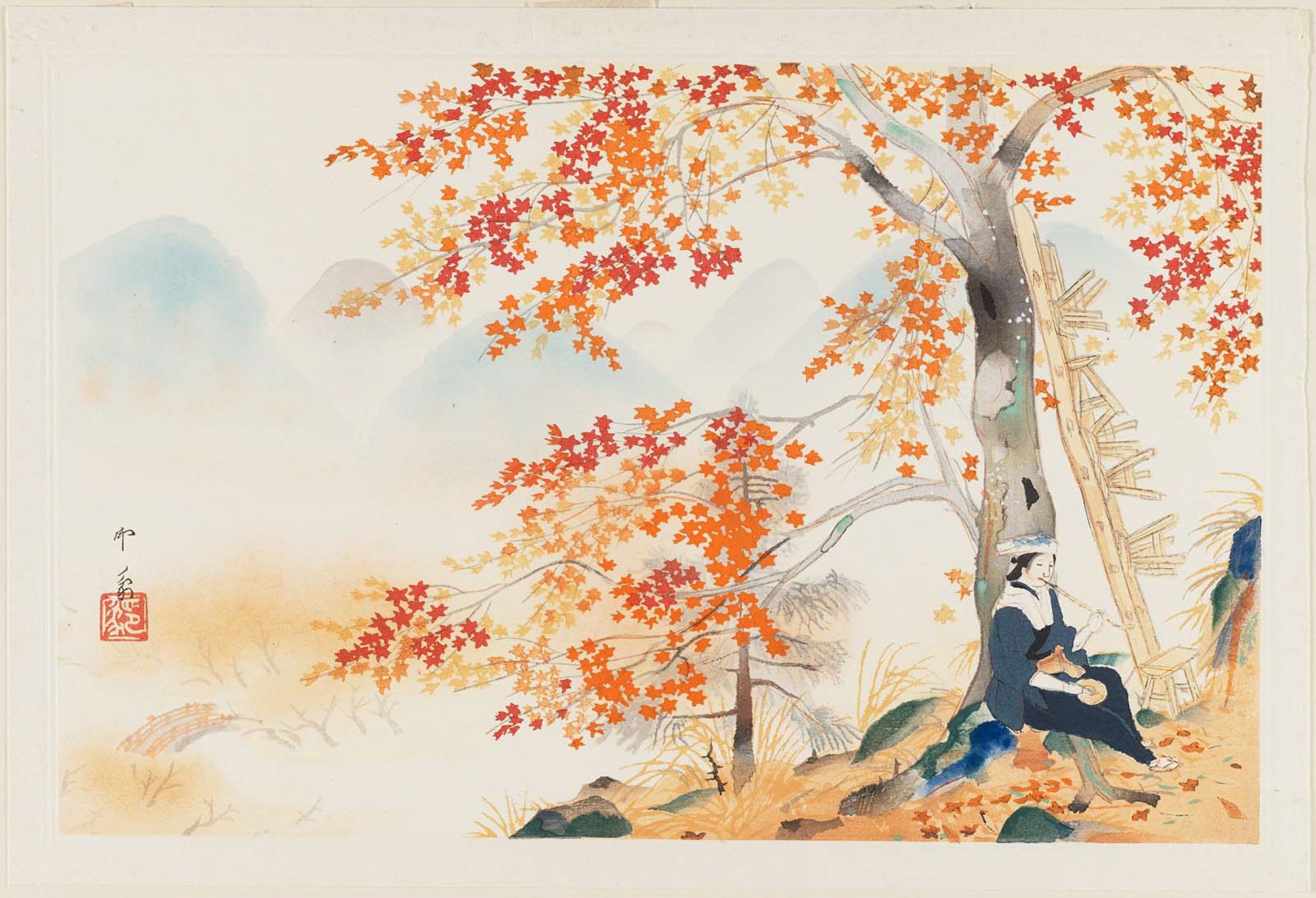
Autumn Maple Leaves at Takao, from the album Eight Views of Kyoto (Kyôto hakkei)
Woodblock print

The Beach at Kaiganji in Sanuki Province (Sanuki Kaiganji no hama), from the series "Collection of Views of Japan II, Kansai Edition (Nihon fukei shu II Kansai hen)"
1934
Color woodblock print; oban

Tea Kettle, section of a sheet from the series "Mirror of Stone Rubbings of Views of the Provinces" (Kohon meihitsu ishizuri kagami)
n.d.
Woodblock print; ishizuri-e, section of harimaze sheet
Featured in Collections
Curated cross-cuts that include this print.
Frequently Asked Questions
Shokozan was created by Hiroshi Yoshida (吉田博) in 1939.
Shokozan uses Bokashi, Nishiki-e, and Moku-hanga, on color woodblock print.
Shokozan was published by Yoshida Studio (1939).
Shokozan depicts landscapes, trees, and mountains.
Shokozan measures 26.9 × 40.7 cm (Oban format).