
Temple in the snow
by Ido Masao
- Medium:
- Mokuhanga (Japanese woodblock)
- Image courtesy of
- Saru Gallery
Description
"Temple in the snow" belongs to the seasonal core of Ido Masao's Kyoto practice, in which the tile roofs and timber halls of the city's temple precincts are recorded under fresh accumulation. The composition almost certainly relies on the tonal contrast between dark wooden eaves and the pale weight of snow on roof and ground, with karazuri (blind embossing) likely used to register drift and texture without ink. Ido's handling of snow scenes typically employs a restrained palette — sparse ink line, broad areas of unprinted washi for the snow itself, and a single bokashi gradient in sky or distance. Against the broader genre of Kyoto winter prints stretching back through Hasui and into the Edo meisho-e tradition, Ido's contribution is a sustained four-decade documentation of the city's monastic architecture across its annual transformations, a body of work that doubles as an archive of buildings under continual conservation pressure.
More Prints by Ido Masao


More Snow Scenes Prints
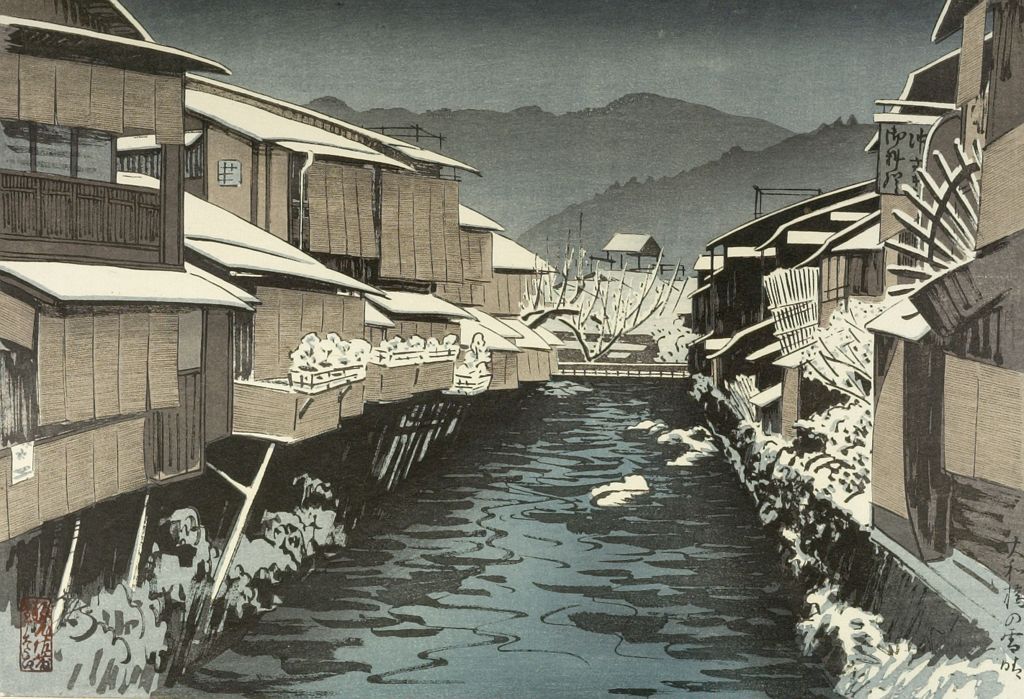
Fair Weather After Snow at Yamato Bridge, Kyoto (Yamato bashi no yukibare), Taishô period, dated 1924
Woodblock print

The Compound of the Tenman Shrine at Kameido in the Snow (Kameido Tenmangu keidai no yuki), from the series "Famous Places in the Eastern Capital (Toto meisho)"
c. 1832/38
Color woodblock print; oban

Miyajima in Snow (Yuki no Miyajima)
Yuki no Miyajima
1929
Color woodblock print; oban
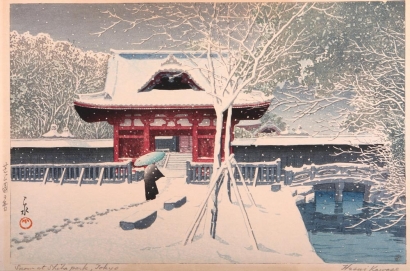
Evening Snow at Shiha Park, Tokyo
1932
Woodblock print
Featured in Collections
Curated cross-cuts that include this print.
Frequently Asked Questions
Temple in the snow was created by Ido Masao (井堂雅夫).
Temple in the snow depicts snow scenes and temples & shrines.