
Katayama harbor in the rain
- Medium:
- Mokuhanga (Japanese woodblock)
- Image courtesy of
- Saru Gallery
Description
Katayama harbor in the rain belongs to the lineage of meisho-e updated for the modern eye that defined much of Hakutei's print production. Rain in mokuhanga is conventionally rendered with diagonal lines carved into a separate block — a technique elaborated by Hiroshige in the nineteenth century — and Hakutei would have employed bokashi gradation in the sky and water to give weight to the storm. The harbor scene, with its low-keyed palette of greys, blue-greens, and weathered wood tones, would have shown moored boats, harbor structures, and figures moving under the rain, anchored in the working life of a small Japanese port. Hakutei's interest in atmospheric weather effects connects his work both to the shin-hanga atmospherics of Kawase Hasui and to the Western tonal painting he absorbed under Kuroda Seiki. The print exemplifies the way Hakutei moved between yoga (Western-style painting) and mokuhanga, treating the woodblock as a vehicle for modern observation rather than for traditional iconography.
More Prints by Ishii Hakutei
More Seascapes Prints
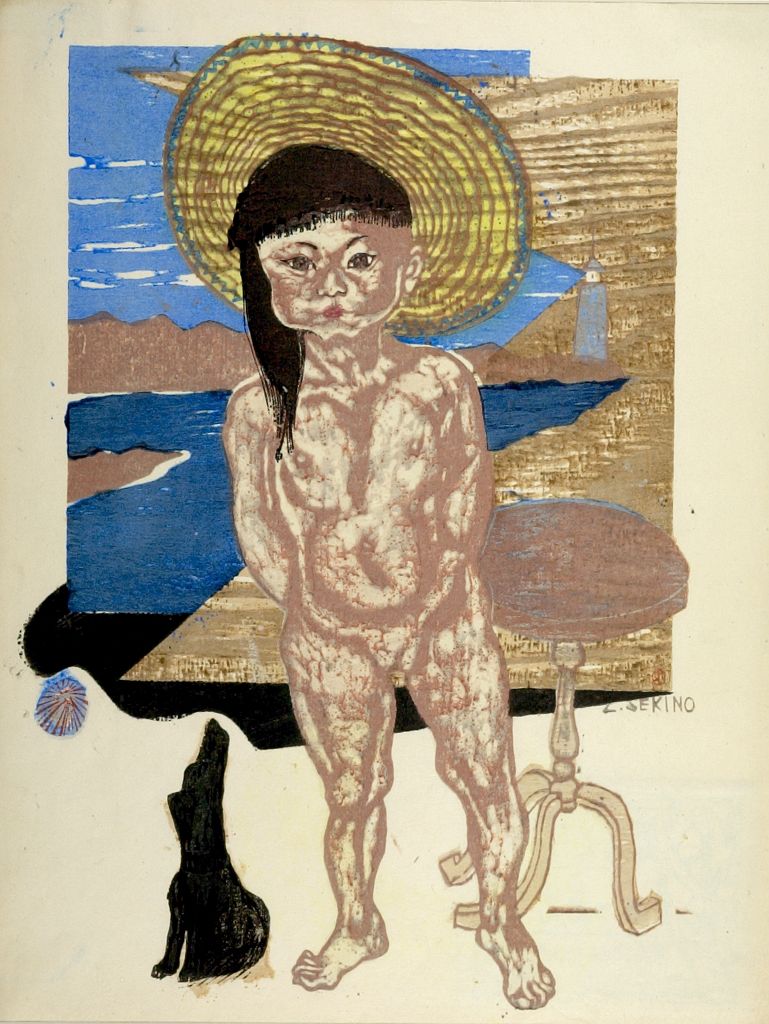
Child of the Sea
1940
Woodblock print

The Beach at Kaiganji in Sanuki Province (Sanuki Kaiganji no hama), from the series "Collection of Views of Japan II, Kansai Edition (Nihon fukei shu II Kansai hen)"
1934
Color woodblock print; oban

Pacific Ocean, Awa Province (Boshu Taikai), from the series "Souvenirs of Travel, Third Series (Tabi miyage dai sanshu)"
Boshu Taikai
1925
Color woodblock print; oban

Pine Beach at Miho (Miho no Matsubara), from the series "Selection of Views of the Tokaido (Tokaido fukei senshu)"
September 1931
Color woodblock print; oban
Featured in Collections
Curated cross-cuts that include this print.
Frequently Asked Questions
Katayama harbor in the rain was created by Ishii Hakutei (石井柏亭).
Katayama harbor in the rain depicts seascapes and rain.