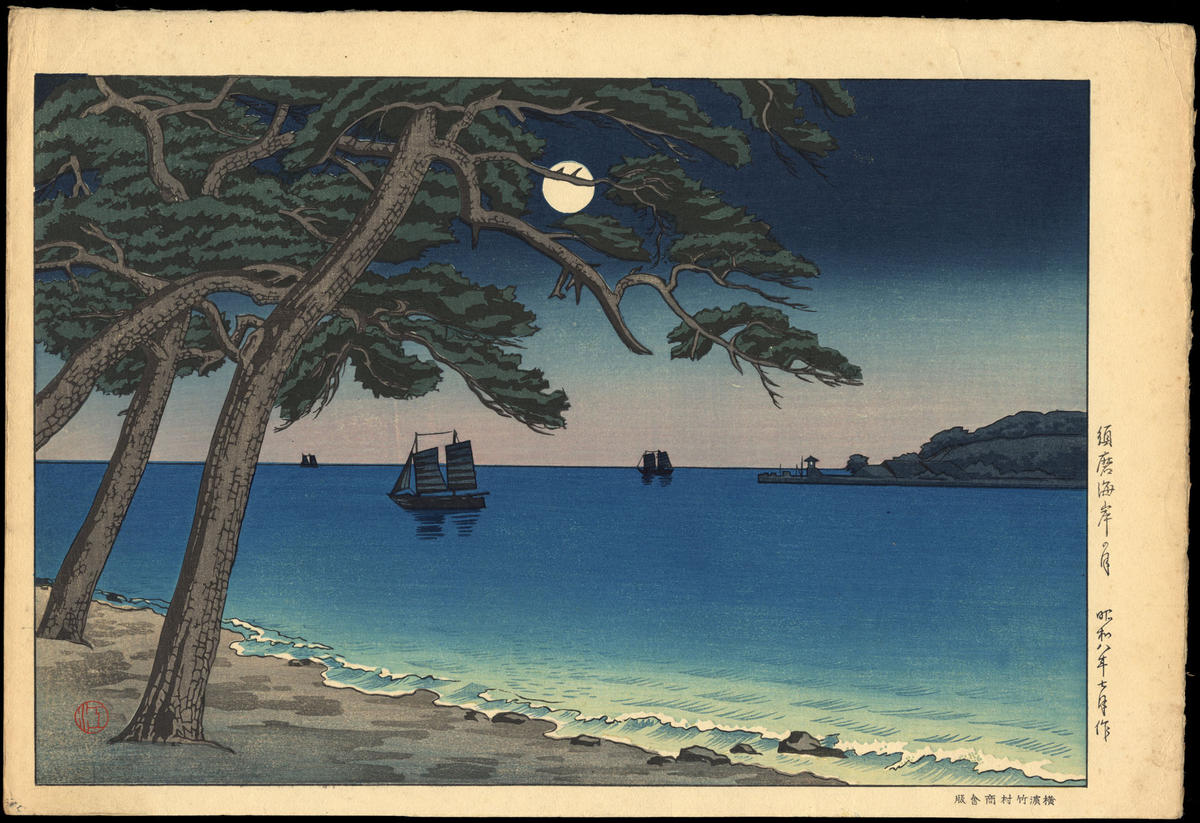
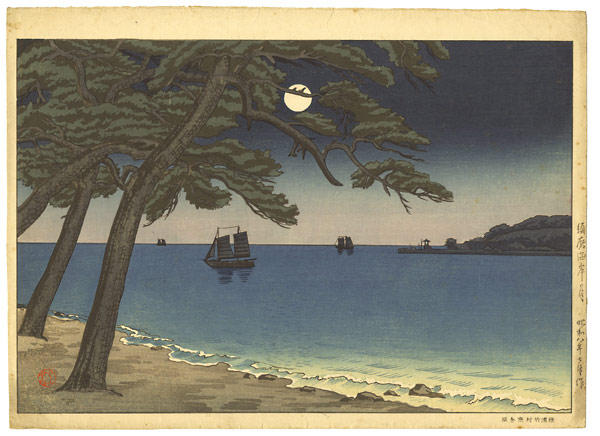
The Moon from Suma Beach — 須磨海岸の月
- Medium:
- Woodblock print
- Source:
- Japanese Art Open Database
- Image courtesy of
- Japanese Art Open Database
Description
A meisho-e of Suma Beach, the coastal stretch in present-day Kobe associated through classical literature with Hikaru Genji's exile in the Tale of Genji. Ishiwata's nocturne likely places the moon over the Inland Sea, with the pine-lined shore — the Suma pines being a long-standing poetic convention — silhouetted against a graduated sky. The composition would employ bokashi, the wiped tonal gradation worked across the colour block, to model the transition from deep indigo at the zenith to paler tones near the horizon, with the moon's disc reserved as unprinted washi or printed with a thin warm tint. This treatment of moonlit coastline belongs to a vein of shin-hanga landscape developed by Kawase Hasui and worked in parallel by Tsuchiya Koitsu, a strain that Ishiwata followed across his 1930s output during the period of greatest commercial demand for atmospheric Japanese landscape prints among Japanese and Western collectors.
More Prints by Ishiwata Koitsu
More Night Scenes Prints
Evening in East Africa
Woodblock print

Evening Shower at Teradomari (Teradomari no yau), from the series "Souvenirs of Travel, Second Series (Tabi miyage dai nishu)"
Teradomari no yau
1921
Color woodblock print; oban
![Mount Fuji on a Moonlit Night, Kawai Bridge (Tsukiyo no Fuji [Kawaibashi]), from the series "Selection of Views of the Tokaido (Tokaido fukei senshu)" by Kawase Hasui](https://www.artic.edu/iiif/2/d0960668-1e73-339a-b182-fb995a54bff0/full/843,/0/default.jpg)
Mount Fuji on a Moonlit Night, Kawai Bridge (Tsukiyo no Fuji [Kawaibashi]), from the series "Selection of Views of the Tokaido (Tokaido fukei senshu)"
1947
Color woodblock print; oban

Evening Moon at Nakanoshima, Sapporo (Sapporo Nakanoshima no yuzuki), from the series "Collection of Views of Japan, Eastern Japan Edition (Nihon fukei shu higashi Nihon hen)"
March 1933
Color woodblock print; oban
Featured in Collections
Curated cross-cuts that include this print.
Frequently Asked Questions
The Moon from Suma Beach — 須磨海岸の月 was created by Ishiwata Koitsu (石渡光逸).
The Moon from Suma Beach — 須磨海岸の月 depicts night scenes.