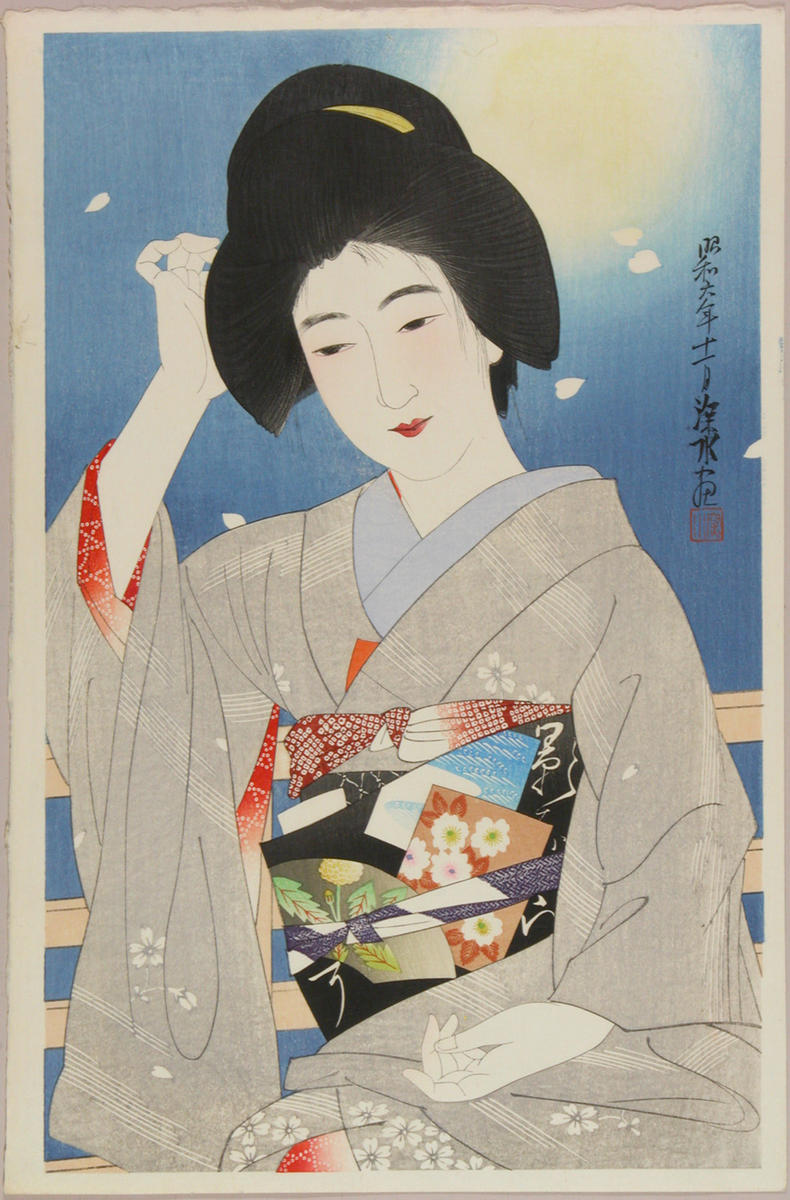
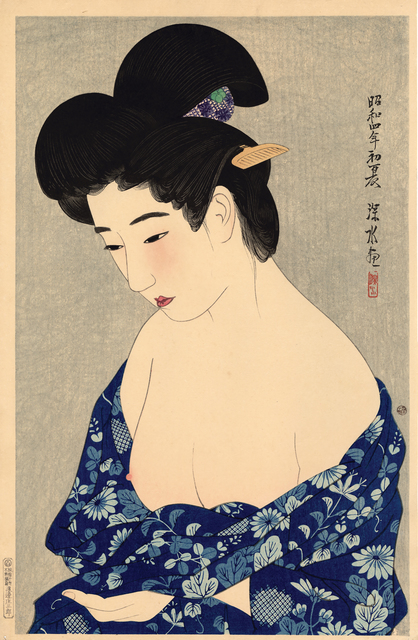
Hazy moon
by Ito Shinsui
- Medium:
- Woodblock print
- Format:
- Oban
- Publisher:
- Watanabe Shozaburo
- Edition:
- Published by Watanabe Shozaburo
- Source:
- Japanese Art Open Database
Description
A moon half-obscured by thin clouds or mist—the "hazy moon" (oborozuki) that was one of the most celebrated atmospheric subjects in Japanese poetry and art—is rendered here with the bokashi gradations that Shinsui used to build the soft, diffused glow of moonlight through cloud cover. The hazy moon carried enormous poetic weight in the Japanese tradition, appearing in classical waka and haiku as a symbol of things beautiful precisely because they are partially concealed—the principle of ma (negative space) extended to the sky. The bokashi printing excels at rendering this specific quality of light.
More Prints by Ito Shinsui
More Moonlight Prints
![Mount Fuji on a Moonlit Night, Kawai Bridge (Tsukiyo no Fuji [Kawaibashi]), from the series "Selection of Views of the Tokaido (Tokaido fukei senshu)" by Kawase Hasui](https://www.artic.edu/iiif/2/d0960668-1e73-339a-b182-fb995a54bff0/full/843,/0/default.jpg)
Mount Fuji on a Moonlit Night, Kawai Bridge (Tsukiyo no Fuji [Kawaibashi]), from the series "Selection of Views of the Tokaido (Tokaido fukei senshu)"
1947
Color woodblock print; oban

Evening Moon at Nakanoshima, Sapporo (Sapporo Nakanoshima no yuzuki), from the series "Collection of Views of Japan, Eastern Japan Edition (Nihon fukei shu higashi Nihon hen)"
March 1933
Color woodblock print; oban

Matsushima in Moonlight (Tsuki no Matsushima)
1919
Color woodblock print

Kiyozumi Garden in Moonlight
January 1938
Woodblock print, ink and color on paper
Featured in Collections
Curated cross-cuts that include this print.
Frequently Asked Questions
Hazy moon was created by Ito Shinsui (伊東深水).
Hazy moon uses Bokashi, on woodblock print.
Hazy moon was published by Watanabe Shozaburo.
Hazy moon depicts moonlight and night scenes.